

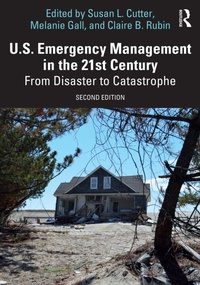
U.S. Emergency Management in the 21st Century
From Disaster to Catastrophe
2nd Edition
Published on 31. March 2025
264 pages
978-1-040-30761-8 (ISBN)
Description

Our understanding of hazards and disasters is rapidly changing, and it is unclear as to whether our existing management systems are adequate to adapt to current and future disasters. Thoroughly updated to include the latest research in the hazards and disasters field, U.S. Emergency Management in the 21st Century continues the tradition of giving readers access to exemplary case studies drawn from a wide variety of hazards and applied fields.
NEW TO THE SECOND EDITION
Discussion on COVID-19 pandemic and the lacking local capacity for preparedness.
"Forgotten" hazards (heatwaves and coldwaves) in Phoenix, AZ and Buffalo, N.Y
New challenges in hurricane preparedness and response with rapid intensification.
Changing cycles of water volume in the west resulting in storage emergencies.
Cascading hazards and out-of-sight water crises in the Southwest
Extreme precipitation resulting in flash flooding in Tennessee, New York City, Montana, and Vermont.
Updated conclusion describing divergence between federal, state, and local emergency management concerns and priorities.
A new co-editor, Melanie Gall, recognized for her teaching and scholarship on natural hazards and emergency management.
U.S. Emergency Management in the 21st Century remains an indispensable textbook on disaster case studies, emergency management policy and practice. An essential resource for students, public, and professionals alike.
NEW TO THE SECOND EDITION
Discussion on COVID-19 pandemic and the lacking local capacity for preparedness.
"Forgotten" hazards (heatwaves and coldwaves) in Phoenix, AZ and Buffalo, N.Y
New challenges in hurricane preparedness and response with rapid intensification.
Changing cycles of water volume in the west resulting in storage emergencies.
Cascading hazards and out-of-sight water crises in the Southwest
Extreme precipitation resulting in flash flooding in Tennessee, New York City, Montana, and Vermont.
Updated conclusion describing divergence between federal, state, and local emergency management concerns and priorities.
A new co-editor, Melanie Gall, recognized for her teaching and scholarship on natural hazards and emergency management.
U.S. Emergency Management in the 21st Century remains an indispensable textbook on disaster case studies, emergency management policy and practice. An essential resource for students, public, and professionals alike.
Reviews / Votes
"Natural disasters are increasing in frequency and impact due to both climate change and increasing urbanization. Business as usual could lead us to a disaster so great that we will no longer be able to effectively respond. Our only hope is to learn the lessons of past disasters and improve our response systems, knowing that what is coming will be worse than what has been. This book brings together case studies of the significant events of the American 21st century so we can learn from our mistakes and do better. It should be required reading in every emergency management program."Lucile M. Jones, Founder and Chief Scientist, Dr. Lucy Jones Center for Science and Society
The field of emergency management is continually evolving as a consequence of focusing events and their responses, in the form of new legislation, executive orders, and other policy interventions. This impressive new edition, which includes chapters by experts in the field, looks in detail at recent disaster events, the COVID-19 pandemic, trends fueled by the climate change crisis, and politics at the federal level, that are once again altering the landscape of the field.
Kathleen Tierney, Research Professor, Natural Hazards Center, University of Colorado Boulder
This excellent and essential book is more relevant than ever. Since the first edition of U.S. Emergency Management in the 21st Century: From Disaster to Catastrophe was published in 2020, the field of emergency management has faced profound changes. Through powerful case studies written by experts with firsthand experience, this second edition vividly captures how pivotal events like the COVID-19 pandemic, tornados, wildfires, extreme heat waves, and accelerating climate impacts have reshaped emergency management. The authors reveal how these events and shifting federal policies present critical gaps in the nation's emergency management system. This timely and compelling analysis emphasizes the urgent need for adaptable management systems to confront the rapidly changing landscape of hazards and disasters. It is a must-read for emergency management professionals, researchers, and students dedicated to advancing the field.
Philip Berke, Research Professor, Department of City & Regional Planning, University of North Carolina-Chapel Hill
More details
Edition
2nd edition
Language
English
Place of publication
London
United Kingdom
Publishing group
Taylor & Francis Ltd
Target group
College/higher education
Illustrations
10 Tables, color; 16 Line drawings, color; 28 Halftones, color; 44 Illustrations, color
File size
41,09 MB
ISBN-13
978-1-040-30761-8 (9781040307618)
Copyright in bibliographic data and cover images is held by Nielsen Book Services Limited or by the publishers or by their respective licensors: all rights reserved.
Schweitzer Classification
Other editions
Additional editions
Susan L. Cutter | Melanie Gall | Claire B. Rubin
U.S. Emergency Management in the 21st Century
From Disaster to Catastrophe
Book
03/2025
2nd Edition
Routledge
€97.50
Shipment within 10-20 days
Susan L. Cutter | Melanie Gall | Claire B. Rubin
U.S. Emergency Management in the 21st Century
From Disaster to Catastrophe
Book
03/2025
2nd Edition
Routledge
€251.60
Shipment within 10-20 days

U.S. Emergency Management in the 21st Century
From Disaster to Catastrophe
Book
03/2025
Routledge
Unfortunately, price unknown
Available (delivery time upon request)
Persons
Susan L. Cutter is Carolina Distinguished Professor at the University of South Carolina where she co-directs the Hazards Vulnerability and Resilience Institute. She is an internationally recognized scholar in the field, producing more than 13 books, and 200 peer-reviewed articles and book chapters. She has led post-event field teams across a range of events from September 11th World Trade Center attack to Hurricane Katrina.
Melanie Gall co-directs the Center for Emergency Management and Homeland Security at Arizona State University. She operates the Spatial Hazard Events and Losses Database for the United States which provides the most comprehensive data on the monetary and human impacts of hazards accessible to the public. Her publications have appeared in journals such as Nature Climate Change, Bulletin of the American Meteorological Society, and Natural Hazards Review.
Claire B. Rubin has almost 40 years of experience in the field of emergency management, having worked as an independent researcher, academic, practitioner, and consultant. From 1998 to 2014, Ms. Rubin was affiliated with the Institute for Crisis, Disaster, and Risk Management at The George Washington University in Washington, D.C. She is the co-founder and former Managing Editor of The Journal of Homeland Security and Emergency Management.
Melanie Gall co-directs the Center for Emergency Management and Homeland Security at Arizona State University. She operates the Spatial Hazard Events and Losses Database for the United States which provides the most comprehensive data on the monetary and human impacts of hazards accessible to the public. Her publications have appeared in journals such as Nature Climate Change, Bulletin of the American Meteorological Society, and Natural Hazards Review.
Claire B. Rubin has almost 40 years of experience in the field of emergency management, having worked as an independent researcher, academic, practitioner, and consultant. From 1998 to 2014, Ms. Rubin was affiliated with the Institute for Crisis, Disaster, and Risk Management at The George Washington University in Washington, D.C. She is the co-founder and former Managing Editor of The Journal of Homeland Security and Emergency Management.
Content
1 Challenges - Recent and Future 2 Emerging Tipping Points in Policy and Practice 3 Hard Lessons in the Human Nature of Pandemics: COVID-19 Response and Recovery in the United States 4 Transporting Toxics 5 Rural Tornado Outbreaks: Inequities in Exposure, Response, and Recovery 6 Wildfires: Firestorms, Smoke, and Unintended Consequences 7 From Phoenix to Buffalo: Experiences with Extreme Temperature 8 Not Enough Water: Drought Emergencies in the American Southwest 9 Climate Whiplash: Close Calls in Managing Water in the American West 10 Heavy Precipitation and Flash Flooding: Lessons from Vermont, Tennessee, Montana, and New York City 11 Hurricanes: Challenges in an Era of Rapid Intensification and Previously Unthinkable Disasters 12 Foreshadowing the Future: What is Looming on the Horizon? Afterword: Hurricanes Helene and Milton About the Authors
