

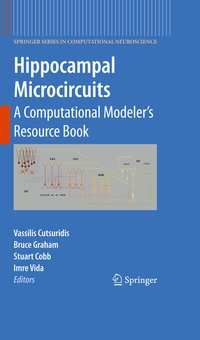
Hippocampal Microcircuits
Description

Rich in detail, Hippocampal Microcircuits: A Computational Modeler's Resource Book provides succinct and focused reviews of experimental results. It is an unparalleled resource of data and methodology that will be invaluable to anyone wishing to develop computational models of the microcircuits of the hippocampus. The editors have divided the material into two thematic areas. Covering the subject's experimental background, leading neuroscientists discuss the morphological, physiological and molecular characteristics as well as the connectivity and synaptic properties of the various cell types found in the hippocampus. Here, ensemble activity, related to behavior, on the part of morphologically identified neurons in anesthetized and freely moving animals, lead to insights into the functions of hippocampal areas. In the second section, on computational analysis, computational neuroscientists present models of hippocampal microcircuits at various levels of detail, including single-celland network levels. A full chapter is devoted to the single-neuron and network simulation environments currently used by computational neuroscientists in developing their models.
In addition to the above, the chapters also identify outstanding questions and areas in need of further clarification that will guide future research by computational neuroscientists.
Reviews / Votes
From the book reviews:
"This is a current textbook on the microanatomy and physiology of the Hippocampus. . I recommend this book to neurophysiologists and anatomists." (Joseph J. Grenier, Amazon.com, August, 2014)
"Hippocampal microcircuits: a computational modelers resource book serves to ease the process of mastering the literature within one of the most productive and active fields of neuroscience. . the book contains accessible and comprehensive reviews of experimental data on the hippocampus. . This book will prove highly valuable as a resource both for expert modelers as well as for new researcher constructing their first model of hippocampal cells and circuits." (Michael E. Hasselmo, Frontiers in Computational Neuroscience, Vol. 5 (2), January, 2011)
"Chapters offer a treasure trove of useful up-to-date and timely information, and extensive references, that should be valuable for those who model, and also for those who do not. . In summary, this book was intended to provide a set of resources; I think the Editors and the chapter authors have done an excellent job at achieving this goal." (Roger D. Traub, Hippocampus, 2010)
More details
Other editions
Additional editions
Persons
Dr. Vassilis Cutsuridis is a Research Fellow in the Department of Computing Science and Mathematics at the University of Stirling, Scotland, UK.
Bruce P. Graham is a Reader in Computing Science in the Department of Computing Science and Mathematics at the University of Stirling.
Stuart Cobb is a Senior Lecturer in the Neuroscience and Molecular Pharmacology Department at the University of Glasgow, Scotland, UK.
Imre Vida is a Senior Lecturer in the Neuroscience and Molecular Pharmacology Department at the University of Glasgow.
