

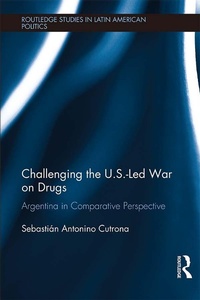
Challenging the U.S.-Led War on Drugs
Argentina in Comparative Perspective
Published on 16. March 2017
170 pages
978-1-351-81491-1 (ISBN)
Description

Challenging the U.S.-Led War on Drugs explores the cases that have resisted the U.S. pressure to adopt a militarized approach to fight against drug trafficking in Latin America and the Caribbean.
Through a sweeping narrative history from the recovery of democracy in 1983 to the present, Cutrona applies international relations and comparative politics theories to understand Argentina's different trajectory vis-a-vis the rest of the region. The author demonstrates that in broad questions of vulnerability to U.S. pressure, external factors often play a secondary role in explaining either balancing/resistance or bandwagoning/acceptance of the U.S. security agenda in the Americas. Emphasizing the role of domestic-level politics, Cutrona identifies the subordination of the military to civilian oversight, the transition outcome, the system of check and balances, and the role of civil society actors such as social movements, epistemic communities, and norm entrepreneurs as Argentina's most relevant sources explaining defection from Washington's main dictates to combat drug trafficking.
Through a sweeping narrative history from the recovery of democracy in 1983 to the present, Cutrona applies international relations and comparative politics theories to understand Argentina's different trajectory vis-a-vis the rest of the region. The author demonstrates that in broad questions of vulnerability to U.S. pressure, external factors often play a secondary role in explaining either balancing/resistance or bandwagoning/acceptance of the U.S. security agenda in the Americas. Emphasizing the role of domestic-level politics, Cutrona identifies the subordination of the military to civilian oversight, the transition outcome, the system of check and balances, and the role of civil society actors such as social movements, epistemic communities, and norm entrepreneurs as Argentina's most relevant sources explaining defection from Washington's main dictates to combat drug trafficking.
Reviews / Votes
"There is remarkably little written in English on how the U.S.-sponsored international "war on drugs" has played out in Argentina. This timely book helps to fill this huge gap, appropriately framing the case in regional comparative perspective." - Peter Andreas, Brown University, Author of Smuggler Nation: How Illicit Trade Made America"Cutrona's superbly researched and well written study of drug policies in Argentina is a pioneering work on this understudied subject in the Southern Cone countries and required reading for anyone - the general public, students and specialists alike - interested in the growing problems of drug consumption, drug trafficking, and drug-related crime, violence and corruption in his country." - Bruce M. Bagley, University of Miami
More details
Series
Language
English
Place of publication
London
United Kingdom
Publishing group
Taylor & Francis Ltd
Target group
College/higher education
Product notice
Reflowable
Illustrations
7 s/w Abbildungen, 11 s/w Tabellen, 7 s/w Zeichnungen
11 Tables, black and white; 7 Line drawings, black and white; 7 Illustrations, black and white
File size
1,78 MB
ISBN-13
978-1-351-81491-1 (9781351814911)
Copyright in bibliographic data and cover images is held by Nielsen Book Services Limited or by the publishers or by their respective licensors: all rights reserved.
Schweitzer Classification
Other editions
Additional editions
Sebastian Antonino Cutrona
Challenging the U.S.-Led War on Drugs
Argentina in Comparative Perspective
Book
06/2019
1st Edition
Routledge
€70.90
Shipment within 10-20 days
Sebastian Antonino Cutrona
Challenging the U.S.-Led War on Drugs
Argentina in Comparative Perspective
Book
02/2017
1st Edition
Routledge
€232.70
Shipment within 15-20 days
Person
Sebastian Antonino Cutrona is a professor at Universidad Nacional de La Rioja, Argentina. His research interests mainly consist in Latin American politics, organized crime and drug trafficking.
Content
Table of Contents
List of Figures
List of Tables
Introduction: The U.S. counter-narcotics strategy in the AmericasChapter 1: The emergence and consolidation of the Standard Security Model: Exploring the Colombian case
Chapter 2: 1983-1989: The Alfonsin administration
Chapter 3: 1989-1999: The Menem administration
Chapter 4: 1999-2015: The Kirchners' administrations
Chapter 5: The drug-problem today
Conclusions: Lessons from deviance
Epilogue: The Macri administration
Index
List of Figures
List of Tables
Introduction: The U.S. counter-narcotics strategy in the AmericasChapter 1: The emergence and consolidation of the Standard Security Model: Exploring the Colombian case
Chapter 2: 1983-1989: The Alfonsin administration
Chapter 3: 1989-1999: The Menem administration
Chapter 4: 1999-2015: The Kirchners' administrations
Chapter 5: The drug-problem today
Conclusions: Lessons from deviance
Epilogue: The Macri administration
Index
