

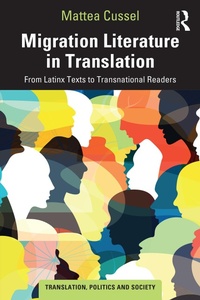
Migration Literature in Translation
From Latinx Texts to Transnational Readers
1st Edition
Published on 2. May 2025
176 pages
978-1-040-33251-1 (ISBN)
Description

Migration Literature in Translation explores the unique case of Latinx literature translated into Spanish, drawing from Latinx studies, sociology, political philosophy and cultural studies. The book focuses on works by Helena Maria Viramontes, Achy Obejas, Daisy Hernandez and Junot Diaz, analysing migration literature and translation as a social practice. Cussel introduces the 'integrated translation critique', a new methodology that examines the transformation of texts through translation and their reception, while incorporating empirical social research methods. This innovative approach highlights the roles of various actors-scholars, translators, authors, reviewers, and readers- in shaping Latinx literary texts' mobility and meaning across languages and cultures.
Through qualitative research including focus groups, questionnaires and fieldwork in Europe, Latin America and the US, Cussel sheds light on how transnational readers engage with translated migrant stories. By addressing the cultural, social and political dimensions of translation, this interdisciplinary work offers a sociological perspective on literary translation. It is essential reading for scholars and students in the sociology of translation, Latinx and migration literature, and migration studies.
Through qualitative research including focus groups, questionnaires and fieldwork in Europe, Latin America and the US, Cussel sheds light on how transnational readers engage with translated migrant stories. By addressing the cultural, social and political dimensions of translation, this interdisciplinary work offers a sociological perspective on literary translation. It is essential reading for scholars and students in the sociology of translation, Latinx and migration literature, and migration studies.
Reviews / Votes
'This important study challenges the assumption of readers as homogeneous, nationally circumscribed individuals. The author skillfully integrates textual analysis with sociological perspectives on representation, border writing, race, migration and erasure, urging a reassessment of how diverse readers engage with translated texts, including their responses to translation decisions and awareness of hybrid languages.'Moira Inghilleri, University of Massachusetts (Amherst), USA
'In this riveting, remarkably multifaceted study, Cussel sheds fresh light on the ways in which translated literary texts are read in different settings. Novel and ambitious comparative research allows her to question reading practices governed by ideas of "authenticity" or "identity" - we are, instead, encouraged to recognise reading as a situated and complex encounter.'
Andrew Smith, University of Glasgow, UK
Survival for immigrants requires translation. Yet translation is about impostorship, meaning that immigrants only succeed through the abandonment and reinvention of the self. Cussel attempts to sort out this conundrum-as we move to a new land and acquire a new tongue, are we still one or many? Have we become false versions of who we were? Or perhaps clones ready for an equalizing future?-by analyzing a handful of Latino texts and inviting readers to a poll. The result is a monograph-gotcha!-that is itself a translation.
Ilan Stavans, author of I Am Nobody.
More details
Series
Edition
1. Auflage
Language
English
Place of publication
London
United Kingdom
Publishing group
Taylor & Francis Ltd
Target group
College/higher education
Professional and scholarly
Illustrations
2 Tables, black and white
File size
8,21 MB
ISBN-13
978-1-040-33251-1 (9781040332511)
Copyright in bibliographic data and cover images is held by Nielsen Book Services Limited or by the publishers or by their respective licensors: all rights reserved.
Schweitzer Classification
Other editions
Additional editions
Book
05/2025
1st Edition
Routledge
€207.20
Shipment within 10-20 days
Book
05/2025
1st Edition
Routledge
€63.20
Shipment within 10-20 days
Person
Mattea Cussel is Research Fellow at the Universitat Autonoma de Barcelona. She is author of 'When Solidarity Is Possible Yet Fails', in Translation Studies (2023), and the book chapters 'Transnational and Global Approaches in Translation Studies' in The Routledge Handbook of Translation and Globalization (2020) and 'Linguistic and Narrative Hospitality in the Translation of Daisy Hernandez's "Before Love, Memory" ', in (In)Hospitable Encounters in Chicanx and Latinx Literature, Culture, and Thought (2025). She is currently coediting the second edition of The Routledge Handbook of Translation and Politics (with Jonathan Evans and Fruela Fernandez).
Content
Contents
Introduction
Situating a special case of translation
An integrated translation critique
Translation, migration and identity
Position of researcher
Explanation of terms
Overview
Part 1
Translations and texts
Chapter 1. Theories of migration literature and translation
Chapter 2. Literature and migrant points of view
Chapter 3. Latinx transformations and movements
Part 2
Translations and readers
Chapter 4. Interdisciplinary approaches to translation and reception
Chapter 5. A reader study of Latinx translations
Chapter 6. The reading culture of empathy
Conclusion
Introduction
Situating a special case of translation
An integrated translation critique
Translation, migration and identity
Position of researcher
Explanation of terms
Overview
Part 1
Translations and texts
Chapter 1. Theories of migration literature and translation
Chapter 2. Literature and migrant points of view
Chapter 3. Latinx transformations and movements
Part 2
Translations and readers
Chapter 4. Interdisciplinary approaches to translation and reception
Chapter 5. A reader study of Latinx translations
Chapter 6. The reading culture of empathy
Conclusion
