

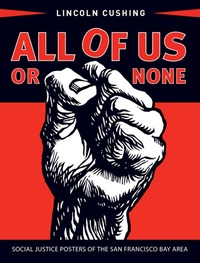
All of Us or None
Social Justice Posters of the San Francisco Bay Area
Published on 23. November 2021
407 pages
978-1-59714-270-0 (ISBN)
Description

A riveting survey of almost three hundred posters, revealing a history of Bay Area artists, activists, and movements from the 1960s to 2012.
This catalog of political posters pays homage to an influential and populist art movement that has created some of the most enduring imagery of our time. In All of Us or None, author Lincoln Cushing examines key selections from a remarkable archive of over 24,000 posters amassed by free speech movement activist, author, and educator Michael Rossman over the course of thirty years. This inspiring collection of Bay Area posters illuminates the history of this ad-hoc and ephemeral art form, celebrating its unique capacity to infuse contemporary issues with the urgency and energy of the eternal fight for justice.
Featuring posters on topics as diverse as civil rights, war, poverty, the environment, music, women's liberation, fine art, and gentrification, All of Us or None shows us why the Bay Area was such fertile breeding ground for the genre and why it arguably produced more independent political posters than anywhere else on earth. Here is an exhilarating history of artists, studios, printshops, distributors, activists, icons, and changemakers-among them R. Crumb, Stanley Mouse, Cesar Chavez, Max Scherr, Emory Douglas, Angela Davis, the San Francisco Mime Troupe, Bill Graham, and Pete Seeger-together raising their voices in opposition to the status quo.
In spring of 2012, the Oakland Museum of California presented its first comprehensive exhibition of this recently acquired treasure; the show, along with this book, presented an unbroken narrative of passionate social justice printmaking from the mid-1960s to 2012.
"This engaging catalogue surveys nearly 300 of the late Michael Rossman's enormous collection of over 24,000 San Francisco Bay Area social justice posters.... With fluid, highly accessible prose, Cushing traces the lineage of images that have now become iconic, such as Frank Cieciorka's often quoted clenched fist, or the Black Panther Party's panther symbol as rendered by Emory Douglas and others." - Publishers Weekly
"An extremely remarkable and useful book: remarkable because it brings back so many of the memorable images of rebellion political, cultural, and both together from a past now rapidly receding, and useful because in our new era of protest, creative expression in artistic forms is more badly needed than ever. Lincoln Cushing, a distinguished scholar of political art, has given us a small masterpiece." -Paul Buhle, publisher of the SDS magazine Radical America and author of more than forty books on radical politics and culture
This catalog of political posters pays homage to an influential and populist art movement that has created some of the most enduring imagery of our time. In All of Us or None, author Lincoln Cushing examines key selections from a remarkable archive of over 24,000 posters amassed by free speech movement activist, author, and educator Michael Rossman over the course of thirty years. This inspiring collection of Bay Area posters illuminates the history of this ad-hoc and ephemeral art form, celebrating its unique capacity to infuse contemporary issues with the urgency and energy of the eternal fight for justice.
Featuring posters on topics as diverse as civil rights, war, poverty, the environment, music, women's liberation, fine art, and gentrification, All of Us or None shows us why the Bay Area was such fertile breeding ground for the genre and why it arguably produced more independent political posters than anywhere else on earth. Here is an exhilarating history of artists, studios, printshops, distributors, activists, icons, and changemakers-among them R. Crumb, Stanley Mouse, Cesar Chavez, Max Scherr, Emory Douglas, Angela Davis, the San Francisco Mime Troupe, Bill Graham, and Pete Seeger-together raising their voices in opposition to the status quo.
In spring of 2012, the Oakland Museum of California presented its first comprehensive exhibition of this recently acquired treasure; the show, along with this book, presented an unbroken narrative of passionate social justice printmaking from the mid-1960s to 2012.
"This engaging catalogue surveys nearly 300 of the late Michael Rossman's enormous collection of over 24,000 San Francisco Bay Area social justice posters.... With fluid, highly accessible prose, Cushing traces the lineage of images that have now become iconic, such as Frank Cieciorka's often quoted clenched fist, or the Black Panther Party's panther symbol as rendered by Emory Douglas and others." - Publishers Weekly
"An extremely remarkable and useful book: remarkable because it brings back so many of the memorable images of rebellion political, cultural, and both together from a past now rapidly receding, and useful because in our new era of protest, creative expression in artistic forms is more badly needed than ever. Lincoln Cushing, a distinguished scholar of political art, has given us a small masterpiece." -Paul Buhle, publisher of the SDS magazine Radical America and author of more than forty books on radical politics and culture
More details
Other editions
Additional editions

Book
05/2012
Heyday Books
€43.16
Article exhausted; check different version
Person
Lincoln Cushing has at various times been a printer, artist, librarian, archivist, and author. His books include
Revolución!: Cuban Poster Art and
Chinese Posters: Art from the Great Proletarian Cultural Revolution. Formerly he was the Cataloging and Electronic Outreach Librarian at UC Berkeley's Bancroft Library and he is currently an archivist for Kaiser Permanente Heritage Resources. He is involved in numerous efforts to document, catalog, and disseminate oppositional political culture of the late twentieth century.
Content
- Intro
- Title
- Copyright
- Contents
- Introduction
- Chapter 1: Building Up to the Long 1960s
- Chapter 2: The First Wave
- Chapter 3: The New Left
- Chapter 4: Counterculture
- Chapter 5: Other Voices
- Chapter 6: International Solidarity
- Chapter 7: Moving Forward
- Appendix: The Workshops, Printshops, and Distributors
- Endnotes
- Notes on the Collection
- Bibliography
- Acknowledgments
