

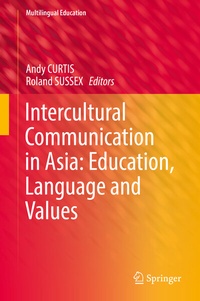
Intercultural Communication in Asia: Education, Language and Values
Description

The studies address key questions that are essential to the future of education in an Asia where intercultural communication is ever more important with the rise of the ASEAN Economic Community and other international initiatives. These questions include the properties of the increasing globalisation of communication and how it plays out in Asia, especially but not exclusively with reference to English, and how we can place intercultural communication in this context, as well as studies that highlight intercultural communication and its underlying value systems and ideologiesin Asia.
More details
Other editions
Additional editions
Content
Introduction, Roland SUSSEX and Andy CURTIS.- Part I: Models, Intercultural Competence and Education.- Individual, Institutional and International: Three Aspects of Intercultural Communication, Andy CURTIS.- Toward a Critical Epistemology for Learning Languages and Cultures in 21 st Century Asia, Andrew LIAN and Roland SUSSEX.- Intercultural Communication in English Courses in Asia: What Should we Teach About? Don SNOW.- Part II: Values and Communication in Cultural Contexts.- Confucian Values as Challenges for Communication in Intercultural Workplace Contexts: Evidence from the Motivational Concerns in Vietnamese Politeness Behaviour, PHAM Thi Hong Nhung.- Part III: English as a Lingua Franca and in Inter/intra-cultural Communication.- The impact of English as a Global Lingua Franca on Intercultural Communication, Juliane HOUSE.- How does Intercultural Communication differ from Intracultural Communication? Istvan KECSKES.- Part IV: Focal areas of Intercultural Communication.- Reading the city: The Lnguistic and Semiotic Landscape of Macao's San Ma Lo (???), Joanna RADWANSKA-WILLIAMS.- Intercultural Communication about pain, Roland SUSSEX.- Functions of Humor in Intercultural Communication and Educational Environments, Kimie OSHIMA.- Part V: Identity.- Emotional Branding on Social Media: A Cross-cultural Discourse Analysis of Global brands on Twitter and Weibo, Doreen D. WU and Chaoyuan LI.- China's Fluctuating English Education Policy Discourses and Continuing Ambivalences in Identity Construction, GAO Yihong.- Conclusion, Roland SUSSEX and Andy CURTIS.
