

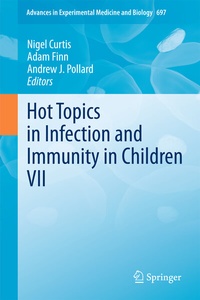
Hot Topics in Infection and Immunity in Children VII
1st Edition
Published on 1. December 2010
XIV, 318 pages
978-1-4419-7185-2 (ISBN)
Description

Course covers topics in infectious diseases in children and is intended for Pediatric Infectious disease trainees, trainers, and all those who manage children with infections.
More details
Series
Language
English
Place of publication
New York
United States
Publishing group
Springer US
Target group
Professional and scholarly
Product notice
Reflowable
Illustrations
XIV, 318 p.
File size
5,56 MB
ISBN-13
978-1-4419-7185-2 (9781441971852)
DOI
10.1007/978-1-4419-7185-2
Schweitzer Classification
Other editions
Additional editions
Nigel Curtis | Adam Finn | Andrew J. Pollard
Hot Topics in Infection and Immunity in Children VII
Book
12/2010
1st Edition
Springer
€213.99
Shipment within 15-20 days
Content
1 - Preface [Seite 4]
2 - Acknowledgments [Seite 5]
3 - Contents [Seite 6]
4 - Contributors [Seite 8]
5 - The Value of Vaccination [Seite 12]
5.1 - 1 Population Health and Economic Well-Being [Seite 12]
5.2 - 2 A New Paradigm for the Value of Vaccination [Seite 16]
5.3 - 3 Applications of the New Approach [Seite 17]
5.4 - 4 Two Calls to Action [Seite 18]
6 - References [Seite 19]
7 - Recent Trends in Global Immunisation [Seite 20]
7.1 - 1 Introduction [Seite 20]
7.2 - 2 Official Development Assistance at the Global Level [Seite 20]
7.3 - 3 Health Progress is Possible [Seite 21]
7.4 - 4 The GAVI Alliance, Formerly the Global Alliance for Vaccines and Immunisation [Seite 22]
7.5 - 5 Polio Eradication Still Somewhat Problematic [Seite 23]
7.6 - 6 Recent Developments in Malaria [Seite 23]
7.7 - 7 HIV/AIDS Vaccine A Long Way to Go [Seite 24]
7.8 - 8 Measles Remains a Threat [Seite 25]
7.9 - 9 Anti-Vaccine Activists are a Real Danger [Seite 25]
7.10 - 10 Conclusion [Seite 26]
8 - References [Seite 27]
9 - New Advances in Typhoid Fever Vaccination Strategies [Seite 28]
9.1 - 1 Introduction [Seite 28]
9.2 - 2 Typhoid Fever Epidemiology [Seite 29]
9.3 - 3 Typhoid Fever: Clinical Presentation and Outcome [Seite 30]
9.3.1 - 3.1 Diagnosis [Seite 31]
9.3.2 - 3.2 Management [Seite 32]
9.4 - 4 Control Strategies [Seite 32]
9.4.1 - 4.1 Antimicrobial Resistance [Seite 33]
9.4.2 - 4.2 Vaccination [Seite 34]
9.4.2.1 - 4.2.1 Ty21a [Seite 36]
9.4.2.2 - 4.2.2 Vi Capsular Polysaccharide [Seite 38]
9.4.2.3 - 4.2.3 New Vaccines in Pipeline [Seite 38]
9.4.3 - 4.3 Perceived Risk of Disease and Vaccination Acceptance [Seite 40]
9.4.4 - 4.4 The Market (Vaccine Demand and Supply) [Seite 40]
9.4.4.1 - 4.4.1 Vaccination Strategies [Seite 41]
9.4.4.2 - 4.4.2 Determining Endemicity [Seite 42]
9.5 - 5 Population Impact [Seite 42]
9.5.1 - 5.1 Guangxi Province, China [Seite 42]
9.5.2 - 5.2 National Immunization Program, Vietnam [Seite 43]
9.5.3 - 5.3 Delhi State, India [Seite 44]
9.5.4 - 5.4 Disease of Most Impoverished (DOMI) Studies in South and SouthEast Asia [Seite 44]
9.6 - 6 Conclusion [Seite 46]
10 - References [Seite 46]
11 - Prevention of Vertical Transmission of HIVin Resource-Limited Countries [Seite 51]
11.1 - 1 Introduction Global Status of Efforts to Prevent Vertical Transmission of HIV [Seite 51]
11.2 - 2 Program Experience [Seite 52]
11.2.1 - 2.1 Thailand and Botswana National Programs [Seite 52]
11.2.1.1 - 2.1.1 Thailand [Seite 52]
11.2.1.2 - 2.1.2 Botswana [Seite 53]
11.2.2 - 2.2 Elizabeth Glaser Pediatric AIDS Foundation Program and Experience [Seite 53]
11.3 - 3 Lessons Learned [Seite 56]
11.3.1 - 3.1 Counseling [Seite 56]
11.3.2 - 3.2 Testing [Seite 56]
11.3.3 - 3.3 ARV Prophylaxis [Seite 56]
11.3.4 - 3.4 Uptake of Maternal and Infant Prophylaxis [Seite 57]
11.3.5 - 3.5 HIV Testing in Labor and Delivery [Seite 58]
11.4 - 4 Modeling Service Coverage [Seite 58]
11.4.1 - 4.1 2000--2002 [Seite 60]
11.4.2 - 4.2 2003--2005 [Seite 60]
11.4.3 - 4.3 2006--2008 [Seite 61]
11.5 - 5 Effectiveness of Prevention of Vertical Transmission Programs: The PEARL Study [Seite 61]
11.6 - 6 Importance of Identifying Pregnant Women Eligible for ART [Seite 62]
11.7 - 7 Prevention of Vertical Transmission During Breastfeeding [Seite 63]
11.8 - 8 Conclusion [Seite 65]
12 - References [Seite 65]
13 - Pneumonia in Children in Developing Countries [Seite 68]
13.1 - 1 Introduction [Seite 68]
13.2 - 2 Aetiology [Seite 68]
13.3 - 3 Standard Management [Seite 69]
13.4 - 4 Which Children Need an Antibiotic [Seite 70]
13.5 - 5 Which Children Need Admission [Seite 71]
13.6 - 6 Which Children Have Very Severe Pneumonia [Seite 71]
13.7 - 7 Which Antibiotic for Outpatients With Non-severe Pneumonia [Seite 72]
13.8 - 8 Which Antibiotics for Severe Pneumonia [Seite 73]
13.9 - 9 Which Antibiotics for Very Severe Pneumonia [Seite 74]
13.10 - 10 Oxygen Therapy [Seite 75]
13.11 - 11 Fluid Therapy [Seite 75]
13.12 - 12 Fever [Seite 75]
13.13 - 13 Neonates, Malnutrition and HIV [Seite 76]
13.14 - 14 Overall Effect of Case Management [Seite 76]
13.15 - 15 Immunisation [Seite 76]
13.16 - 16 Conclusion [Seite 77]
14 - References [Seite 80]
15 - Darwin, Microbes and Evolution by Natural Selection [Seite 85]
15.1 - 1 Darwin, Microbes and Evolution by Natural Selection [Seite 85]
15.2 - Box 1 [Seite 92]
16 - References [Seite 93]
17 - Human Herpesvirus 6 [Seite 95]
18 - References [Seite 98]
19 - Advances in the Diagnosis and Management of Central Venous Access Device Infections in Children [Seite 99]
19.1 - 1 Introduction [Seite 99]
19.2 - 2 Types of Devices Used in Children for Central Venous Access [Seite 100]
19.2.1 - 2.1 Temporary CVAD [Seite 100]
19.2.2 - 2.2 Permanent, Tunnelled CVAD [Seite 100]
19.3 - 3 Pathogenesis [Seite 101]
19.3.1 - 3.1 Common Organisms [Seite 101]
19.4 - 4 Epidemiology [Seite 102]
19.5 - 5 Diagnosis [Seite 103]
19.6 - 6 Prevention [Seite 104]
19.7 - 7 Management [Seite 105]
19.7.1 - 7.1 Antimicrobial Therapy [Seite 105]
19.7.2 - 7.2 New Strategies [Seite 106]
19.8 - 8 Antimicrobial Lock Therapy (ALT) [Seite 106]
19.9 - 9 Ethanol Locks [Seite 107]
19.10 - 10 Hydrochloric Acid Locks [Seite 107]
19.11 - 11 Taurolidine Citrate Locks (TauroLock) [Seite 109]
19.12 - 12 Urokinase Locks and Infusions [Seite 109]
19.13 - 13 Conclusions [Seite 109]
20 - References [Seite 110]
21 - Moraxella catarrhalis -- Pathogen or Commensal? [Seite 115]
21.1 - 1 Introduction [Seite 116]
21.2 - 2 Phylogenetic Evidence for Virulence [Seite 116]
21.3 - 3 Expression of Virulence Factors [Seite 117]
21.3.1 - 3.1 Complement Resistance [Seite 117]
21.3.2 - 3.2 Adherence to Human Epithelial Cells [Seite 117]
21.3.3 - 3.3 Colonization and Immune Response [Seite 118]
21.3.4 - 3.4 Biofilm Formation [Seite 119]
21.3.5 - 3.5 Cellular Invasion [Seite 120]
21.3.6 - 3.6 Proinflammatory Activity of Moraxella catarrhalis [Seite 120]
21.4 - 4 Cold Shock Response of Moraxella catarrhalis [Seite 120]
21.5 - 5 Summary [Seite 122]
22 - References [Seite 122]
23 - Anaerobic Infections in Children [Seite 125]
23.1 - 1 Introduction [Seite 125]
23.2 - 2 Microbiology [Seite 126]
23.2.1 - 2.1 Gram-Positive Spore-Forming Bacilli [Seite 126]
23.2.2 - 2.2 Gram-Positive Non-Spore-Forming Bacilli [Seite 128]
23.2.3 - 2.3 Gram-Negative Bacilli [Seite 129]
23.2.4 - 2.4 Gram-Positive Cocci [Seite 130]
23.2.5 - 2.5 Gram-Negative Cocci [Seite 130]
23.3 - 3 Pathogenicity and Virulence [Seite 130]
23.3.1 - 3.1 Anaerobes as Normal Flora [Seite 130]
23.3.2 - 3.2 Conditions Predisposing to Anaerobic Infection [Seite 132]
23.3.3 - 3.3 Virulence Factors [Seite 134]
23.4 - 4 Diagnostic Microbiology [Seite 134]
23.4.1 - 4.1 Collection of Specimens for Anaerobic Bacteria [Seite 134]
23.4.2 - 4.2 Transportation of Specimens [Seite 136]
23.4.3 - 4.3 Laboratory Diagnosis [Seite 136]
23.4.4 - 4.4 Antimicrobial Susceptibility Testing [Seite 137]
23.5 - 5 Prevention [Seite 137]
23.6 - 6 Clinical Infections [Seite 138]
23.6.1 - 6.1 Central Nervous System Infections [Seite 138]
23.6.2 - 6.2 Head and Neck Infections [Seite 139]
23.6.2.1 - 6.2.1 Sinusitis [Seite 141]
23.6.2.2 - 6.2.2 Parotitis [Seite 141]
23.6.2.3 - 6.2.3 Cervical Lymphadenitis [Seite 141]
23.6.2.4 - 6.2.4 Thyroiditis [Seite 142]
23.6.2.5 - 6.2.5 Infected Cysts [Seite 142]
23.6.2.6 - 6.2.6 Wound Infection After Head and Neck Surgery [Seite 142]
23.6.2.7 - 6.2.7 Tonsillitis [Seite 142]
23.6.3 - 6.3 Pleuropulmonary Infections [Seite 143]
23.6.4 - 6.4 Intra-Abdominal Infections [Seite 145]
23.6.5 - 6.5 Female Genital Tract Infection [Seite 146]
23.6.6 - 6.6 Skin and Soft Tissue Infections [Seite 146]
23.6.7 - 6.7 Osteomyelitis and Septic Arthritis [Seite 147]
23.6.8 - 6.8 Bacteremia [Seite 148]
23.6.9 - 6.9 Neonatal Infection [Seite 148]
23.7 - 7 Management [Seite 149]
23.7.1 - 7.1 Hyperbaric Oxygen [Seite 149]
23.7.2 - 7.2 Surgical Therapy [Seite 149]
23.7.3 - 7.3 Antimicrobial Therapy [Seite 150]
23.7.4 - 7.4 Antimicrobial Agents [Seite 153]
23.7.4.1 - 7.4.1 Penicillins [Seite 153]
23.7.4.2 - 7.4.2 Cephalosporins [Seite 154]
23.7.4.3 - 7.4.3 Carbapenem (imipenem, meropenem) [Seite 154]
23.7.4.4 - 7.4.4 Chloramphenicol [Seite 155]
23.7.4.5 - 7.4.5 Clindamycin and Lincomycin [Seite 155]
23.7.4.6 - 7.4.6 Metronidazole [Seite 155]
23.7.4.7 - 7.4.7 Macrolids (Erythromycin, Azithromycin, Clarithromycin) [Seite 155]
23.7.4.8 - 7.4.8 Glycopeptides (Vancomycin, Teicoplanin) [Seite 155]
23.7.4.9 - 7.4.9 Tetracyclines [Seite 156]
23.7.4.10 - 7.4.10 Quinolones [Seite 156]
23.7.5 - 7.5 Choice of Antimicrobial Agents [Seite 156]
24 - References [Seite 157]
25 - Encephalitis Diagnosis and Management in the Real World [Seite 161]
25.1 - 1 Approach to Focusing Possible Etiologies [Seite 161]
25.1.1 - 1.1 Pathogenesis [Seite 161]
25.1.2 - 1.2 Prioritizing Treatable Etiologies [Seite 163]
25.1.3 - 1.3 Etiologically Focussed Prevention of Acute Encephalitis [Seite 165]
25.1.4 - 1.4 Season, Geography, and Epidemiology of Viral Encephalitis [Seite 166]
25.1.5 - 1.5 Studies of Causes of Acute Encephalitis [Seite 169]
25.1.6 - 1.6 Additional Noteworthy Diagnoses [Seite 172]
25.1.6.1 - 1.6.1 Acute Disseminated Encephalomyelitis (ADEM) [Seite 172]
25.1.6.2 - 1.6.2 Acute Necrotizing Encephalopathy (ANE) [Seite 174]
25.1.7 - 1.7 Additional Noteworthy Pathogens [Seite 175]
25.1.7.1 - 1.7.1 B. burgdorferi [Seite 175]
25.1.7.2 - 1.7.2 Parvovirus B19 [Seite 175]
25.1.7.3 - 1.7.3 Balamuthia mandrillaris [Seite 176]
25.1.8 - 1.8 Specific Clinical Neurologic Syndromes [Seite 176]
25.2 - 2 Approach to Empiric Management [Seite 176]
26 - References [Seite 179]
27 - Toxic Shock Syndrome -- Evolution of an Emerging Disease [Seite 182]
27.1 - 1 Introduction [Seite 182]
27.2 - 2 Epidemiology [Seite 182]
27.3 - 3 Pathogenesis [Seite 182]
27.4 - 4 Clinical Findings [Seite 183]
27.5 - 5 Management [Seite 184]
27.6 - 6 Prognosis [Seite 185]
28 - References [Seite 186]
29 - Dissection of B-Cell Development to Unravel Defectsin Patients with a Primary Antibody Deficiency [Seite 189]
29.1 - 1 Introduction [Seite 189]
29.2 - 2 Generation of Nave Mature B Cells by Stepwise Differentiation in Bone Marrow [Seite 189]
29.3 - 3 Antigen-Dependent B-Cell Maturation in Secondary Lymphoid Organs [Seite 191]
29.4 - 4 Dynamics in the Peripheral B-Cell Compartment During Early Childhood [Seite 194]
29.5 - 5 Antibody Deficiencies [Seite 194]
29.5.1 - 5.1 Agammaglobulinemia [Seite 195]
29.5.2 - 5.2 B-Cell Antigen Receptor Signaling Deficiency [Seite 198]
29.5.3 - 5.3 IgCSR Deficiency [Seite 198]
29.5.4 - 5.4 Common Variable Immunodeficiencies (CVID) [Seite 199]
29.6 - 6 Conclusion [Seite 200]
30 - References [Seite 200]
31 - Mumps is Back: Why is Mumps EradicationNot Working? [Seite 203]
31.1 - 1 Introduction [Seite 203]
31.2 - 2 Mumps: The Clinical Presentation [Seite 204]
31.3 - 3 Mumps: The Virus [Seite 205]
31.4 - 4 Mumps: The Pathogenesis and Transmission [Seite 207]
31.5 - 5 Mumps: The Diagnosis [Seite 207]
31.5.1 - 5.1 Mumps: Laboratory Diagnosis for Mumps Infection [Seite 208]
31.5.1.1 - 5.1.1 Specimen Collection [Seite 208]
31.5.1.2 - 5.1.2 Tissue Culture [Seite 208]
31.5.1.3 - 5.1.3 Molecular Testing [Seite 209]
31.5.1.4 - 5.1.4 IgM Serology [Seite 209]
31.5.1.5 - 5.1.5 IgG Serology [Seite 210]
31.6 - 6 Mumps: The Epidemiology [Seite 211]
31.7 - 7 Mumps: The Vaccines [Seite 212]
31.8 - 8 Mumps: Recent Resurgence [Seite 213]
31.8.1 - 8.1 Vaccine Program: Refusal to Accept Immunization: 2007--2008 Outbreak in the Netherlands [Seite 214]
31.8.2 - 8.2 Vaccine Program: Failure to Immunize an Age Group: --Lost Cohort--: 2004--2006 Outbreak in United Kingdom [Seite 214]
31.8.3 - 8.3 Vaccine Program: Single Dose: Forgotten Cohort 2004--2007 Outbreaks in Canada, 2005--2007 in Australia [Seite 217]
31.8.4 - 8.4 Vaccine Failure: Primary Vaccine Failure: Ineffective Vaccine -- Rubini [Seite 218]
31.8.5 - 8.5 Vaccine Failure: Two-dose Vaccine Failure: Waning Immunity: 2006 Outbreaks in the United States [Seite 219]
31.9 - 9 Mumps Elimination in Finland [Seite 219]
31.10 - 10 Mumps: Public Health Control Strategies in Outbreaks [Seite 220]
31.11 - 11 Mumps Outbreaks: Lessons Learned [Seite 220]
31.12 - 12 Mumps Control: Unanswered Questions [Seite 221]
31.13 - 13 Summary [Seite 222]
32 - References [Seite 222]
33 - Neonatal Herpes Simplex Virus Infections: Where Are We Now [Seite 227]
33.1 - 1 Background [Seite 227]
33.2 - 2 Epidemiology of Neonatal HSV [Seite 228]
33.3 - 3 Clinical Manifestations of Neonatal HSV [Seite 228]
33.4 - 4 Mortality and Morbidity [Seite 228]
33.5 - 5 Antiviral Therapy [Seite 229]
33.6 - 6 Determining Dosage and Duration of Treatment [Seite 230]
33.7 - 7 Polymerase Chain Reaction (PCR)-Guided Therapy [Seite 230]
33.8 - 8 Oral Suppression Therapy [Seite 233]
33.9 - 9 Antiviral Resistance [Seite 234]
33.10 - 10 Conclusion [Seite 235]
34 - References [Seite 235]
35 - Rational Approach to Pediatric Antifungal Therapy [Seite 237]
35.1 - 1 Introduction [Seite 237]
35.2 - 2 Treatment of Pediatric Invasive Aspergillosis [Seite 238]
35.2.1 - 2.1 Voriconazole Dosing in Children [Seite 240]
35.2.2 - 2.2 Combination Therapy for Invasive Aspergillosis [Seite 242]
35.3 - 3 Treatment of Pediatric Invasive Candidiasis [Seite 243]
35.4 - 4 Conclusion [Seite 246]
36 - References [Seite 246]
37 - Antiviral Therapy of CMV Disease in Children [Seite 249]
37.1 - 1 Spectrum of Clinical Disease [Seite 249]
37.1.1 - 1.1 Congenital CMV [Seite 249]
37.1.1.1 - 1.1.1 Clinical Features [Seite 250]
37.1.1.2 - 1.1.2 Predicting Long-Term Neurological Impairment [Seite 251]
37.1.2 - 1.2 PostNatal CMV [Seite 252]
37.1.2.1 - 1.2.1 Clinical Features [Seite 252]
37.1.3 - 1.3 CMV Disease in Older Children [Seite 252]
37.2 - 2 Ganciclovir and Valganciclovir Use in Children [Seite 253]
37.2.1 - 2.1 Pharmacokinetics [Seite 253]
37.2.1.1 - 2.1.1 Ganciclovir [Seite 253]
37.2.1.2 - 2.1.2 Valganciclovir [Seite 254]
37.2.1.3 - 2.1.3 CSF and CNS Penetration [Seite 255]
37.2.2 - 2.2 Pharmacodynamics [Seite 255]
37.2.3 - 2.3 Resistance [Seite 256]
37.2.4 - 2.4 Drug Levels [Seite 257]
37.2.5 - 2.5 Safety [Seite 257]
37.3 - 3 Clinical Studies of GCV in Childhood CMV Infection [Seite 258]
37.3.1 - 3.1 Congenital CMV [Seite 258]
37.3.2 - 3.2 Clinical Use of GCV in Postnatal CMV Infection [Seite 262]
37.3.3 - 3.3 CMV Disease and GCV Treatment in Older Immunocompromised Children [Seite 262]
37.4 - 4 Summary [Seite 263]
38 - References [Seite 263]
39 - Infectious Hazards from Pets and Domestic Animals [Seite 267]
39.1 - 1 Introduction [Seite 267]
39.2 - 2 Global Trends in Emerging Infectious Diseases (EID) [Seite 268]
39.3 - 3 Pets and Domestic Animals as Reservoirs of Antimicrobial Resistance (AMR) [Seite 270]
39.4 - 4 Staphylococcus intermedius in Pets [Seite 271]
39.5 - 5 MRSA in Pets and Domestic Animals [Seite 273]
39.6 - 6 A Call for an Action [Seite 274]
39.7 - 7 Pets and Immunocompromised Hosts [Seite 275]
39.8 - 8 Conclusion [Seite 275]
40 - References [Seite 276]
41 - Novel Technology to Study Co-Evolution of Humans StaphylococcusINTtie [Seite 279]
41.1 - 1 Introduction [Seite 279]
41.2 - 2 The Microorganism [Seite 280]
41.2.1 - 2.1 Detection and Identification [Seite 280]
41.2.2 - 2.2 Habitat and Genome Complexity [Seite 280]
41.3 - 3 The Host [Seite 281]
41.3.1 - 3.1 Human Niches [Seite 281]
41.3.2 - 3.2 Patterns of and Susceptibility to Carriage [Seite 282]
41.4 - 4 Artificial Colonisation Studies [Seite 282]
41.4.1 - 4.1 Setting Up a Nasal Colonisation Study [Seite 283]
41.4.2 - 4.2 Examples of Previous Colonisation Studies [Seite 284]
41.4.3 - 4.3 Ongoing Experiments and Ideas for Future Colonisation Studies [Seite 285]
41.5 - 5 Example Of A Cohort Study [Seite 286]
41.5.1 - 5.1 Relevance of Cohort Studies [Seite 286]
41.5.2 - 5.2 Microbiology in Generation R [Seite 286]
41.5.3 - 5.3 Preliminary Results [Seite 287]
41.6 - 6 Humoral Immunity and S. aureus Carriage and Infection [Seite 288]
41.6.1 - 6.1 Technical Aspects of Multiplex Anti-staphylococcal Antibody Measurements [Seite 288]
41.6.2 - 6.2 Application of the Luminex Technology and Microbiological Implications [Seite 288]
41.7 - 7 Conclusion [Seite 290]
42 - References [Seite 290]
43 - A Practical Approach to Eosinophilia in a Child Arriving orINTtie [Seite 295]
43.1 - 1 Introduction [Seite 295]
43.2 - 2 Why it is Often Difficult to Determine the Parasite Causing Eosinophilia [Seite 295]
43.2.1 - 2.1 Patients with Helminthic Infection may be Asymptomatic [Seite 295]
43.2.2 - 2.2 Patients with Eosinophilia may have a Helminthic Infection that is too Early to Diagnose [Seite 296]
43.2.3 - 2.3 It is Difficult to Distinguish Between Different Helminthic Infections by Either Degree or Persistence of Eosinophilia [Seite 296]
43.2.4 - 2.4 Whether a Child is an Immigrant or Returned Traveller does not help to Distinguish Between Different Helminthic Infections [Seite 297]
43.2.5 - 2.5 Serum IgE Level does not help to Distinguish Between Different Helminthic Infections or Exclude a Non-Parasitic Cause for Eosinophilia [Seite 298]
43.2.6 - 2.6 Patients with Helminthic Infection may not have Eosinophilia [Seite 298]
43.2.7 - 2.7 The Degree of Eosinophilia does not Necessarily Relate to the Burden of Infection [Seite 299]
43.2.8 - 2.8 Negative Investigations for Parasites do not Exclude Helminthic Infection [Seite 299]
43.2.9 - 2.9 Eosinophilia may Worsen Despite Appropriate Treatment [Seite 300]
43.2.10 - 2.10 Patients from a Tropical Country may have an Alternative Explanation Other than Helminthic Infection for Their Eosinophilia [Seite 300]
43.3 - 3 An Approach to Diagnosing and Treating Parasitic Infections in Children with Eosinophilia Returning From Tropical Countries [Seite 300]
43.3.1 - 3.1 History [Seite 301]
43.3.2 - 3.2 Investigations [Seite 302]
43.3.3 - 3.3 Treatment [Seite 304]
44 - References [Seite 304]
45 - Subject Index [Seite 306]
2 - Acknowledgments [Seite 5]
3 - Contents [Seite 6]
4 - Contributors [Seite 8]
5 - The Value of Vaccination [Seite 12]
5.1 - 1 Population Health and Economic Well-Being [Seite 12]
5.2 - 2 A New Paradigm for the Value of Vaccination [Seite 16]
5.3 - 3 Applications of the New Approach [Seite 17]
5.4 - 4 Two Calls to Action [Seite 18]
6 - References [Seite 19]
7 - Recent Trends in Global Immunisation [Seite 20]
7.1 - 1 Introduction [Seite 20]
7.2 - 2 Official Development Assistance at the Global Level [Seite 20]
7.3 - 3 Health Progress is Possible [Seite 21]
7.4 - 4 The GAVI Alliance, Formerly the Global Alliance for Vaccines and Immunisation [Seite 22]
7.5 - 5 Polio Eradication Still Somewhat Problematic [Seite 23]
7.6 - 6 Recent Developments in Malaria [Seite 23]
7.7 - 7 HIV/AIDS Vaccine A Long Way to Go [Seite 24]
7.8 - 8 Measles Remains a Threat [Seite 25]
7.9 - 9 Anti-Vaccine Activists are a Real Danger [Seite 25]
7.10 - 10 Conclusion [Seite 26]
8 - References [Seite 27]
9 - New Advances in Typhoid Fever Vaccination Strategies [Seite 28]
9.1 - 1 Introduction [Seite 28]
9.2 - 2 Typhoid Fever Epidemiology [Seite 29]
9.3 - 3 Typhoid Fever: Clinical Presentation and Outcome [Seite 30]
9.3.1 - 3.1 Diagnosis [Seite 31]
9.3.2 - 3.2 Management [Seite 32]
9.4 - 4 Control Strategies [Seite 32]
9.4.1 - 4.1 Antimicrobial Resistance [Seite 33]
9.4.2 - 4.2 Vaccination [Seite 34]
9.4.2.1 - 4.2.1 Ty21a [Seite 36]
9.4.2.2 - 4.2.2 Vi Capsular Polysaccharide [Seite 38]
9.4.2.3 - 4.2.3 New Vaccines in Pipeline [Seite 38]
9.4.3 - 4.3 Perceived Risk of Disease and Vaccination Acceptance [Seite 40]
9.4.4 - 4.4 The Market (Vaccine Demand and Supply) [Seite 40]
9.4.4.1 - 4.4.1 Vaccination Strategies [Seite 41]
9.4.4.2 - 4.4.2 Determining Endemicity [Seite 42]
9.5 - 5 Population Impact [Seite 42]
9.5.1 - 5.1 Guangxi Province, China [Seite 42]
9.5.2 - 5.2 National Immunization Program, Vietnam [Seite 43]
9.5.3 - 5.3 Delhi State, India [Seite 44]
9.5.4 - 5.4 Disease of Most Impoverished (DOMI) Studies in South and SouthEast Asia [Seite 44]
9.6 - 6 Conclusion [Seite 46]
10 - References [Seite 46]
11 - Prevention of Vertical Transmission of HIVin Resource-Limited Countries [Seite 51]
11.1 - 1 Introduction Global Status of Efforts to Prevent Vertical Transmission of HIV [Seite 51]
11.2 - 2 Program Experience [Seite 52]
11.2.1 - 2.1 Thailand and Botswana National Programs [Seite 52]
11.2.1.1 - 2.1.1 Thailand [Seite 52]
11.2.1.2 - 2.1.2 Botswana [Seite 53]
11.2.2 - 2.2 Elizabeth Glaser Pediatric AIDS Foundation Program and Experience [Seite 53]
11.3 - 3 Lessons Learned [Seite 56]
11.3.1 - 3.1 Counseling [Seite 56]
11.3.2 - 3.2 Testing [Seite 56]
11.3.3 - 3.3 ARV Prophylaxis [Seite 56]
11.3.4 - 3.4 Uptake of Maternal and Infant Prophylaxis [Seite 57]
11.3.5 - 3.5 HIV Testing in Labor and Delivery [Seite 58]
11.4 - 4 Modeling Service Coverage [Seite 58]
11.4.1 - 4.1 2000--2002 [Seite 60]
11.4.2 - 4.2 2003--2005 [Seite 60]
11.4.3 - 4.3 2006--2008 [Seite 61]
11.5 - 5 Effectiveness of Prevention of Vertical Transmission Programs: The PEARL Study [Seite 61]
11.6 - 6 Importance of Identifying Pregnant Women Eligible for ART [Seite 62]
11.7 - 7 Prevention of Vertical Transmission During Breastfeeding [Seite 63]
11.8 - 8 Conclusion [Seite 65]
12 - References [Seite 65]
13 - Pneumonia in Children in Developing Countries [Seite 68]
13.1 - 1 Introduction [Seite 68]
13.2 - 2 Aetiology [Seite 68]
13.3 - 3 Standard Management [Seite 69]
13.4 - 4 Which Children Need an Antibiotic [Seite 70]
13.5 - 5 Which Children Need Admission [Seite 71]
13.6 - 6 Which Children Have Very Severe Pneumonia [Seite 71]
13.7 - 7 Which Antibiotic for Outpatients With Non-severe Pneumonia [Seite 72]
13.8 - 8 Which Antibiotics for Severe Pneumonia [Seite 73]
13.9 - 9 Which Antibiotics for Very Severe Pneumonia [Seite 74]
13.10 - 10 Oxygen Therapy [Seite 75]
13.11 - 11 Fluid Therapy [Seite 75]
13.12 - 12 Fever [Seite 75]
13.13 - 13 Neonates, Malnutrition and HIV [Seite 76]
13.14 - 14 Overall Effect of Case Management [Seite 76]
13.15 - 15 Immunisation [Seite 76]
13.16 - 16 Conclusion [Seite 77]
14 - References [Seite 80]
15 - Darwin, Microbes and Evolution by Natural Selection [Seite 85]
15.1 - 1 Darwin, Microbes and Evolution by Natural Selection [Seite 85]
15.2 - Box 1 [Seite 92]
16 - References [Seite 93]
17 - Human Herpesvirus 6 [Seite 95]
18 - References [Seite 98]
19 - Advances in the Diagnosis and Management of Central Venous Access Device Infections in Children [Seite 99]
19.1 - 1 Introduction [Seite 99]
19.2 - 2 Types of Devices Used in Children for Central Venous Access [Seite 100]
19.2.1 - 2.1 Temporary CVAD [Seite 100]
19.2.2 - 2.2 Permanent, Tunnelled CVAD [Seite 100]
19.3 - 3 Pathogenesis [Seite 101]
19.3.1 - 3.1 Common Organisms [Seite 101]
19.4 - 4 Epidemiology [Seite 102]
19.5 - 5 Diagnosis [Seite 103]
19.6 - 6 Prevention [Seite 104]
19.7 - 7 Management [Seite 105]
19.7.1 - 7.1 Antimicrobial Therapy [Seite 105]
19.7.2 - 7.2 New Strategies [Seite 106]
19.8 - 8 Antimicrobial Lock Therapy (ALT) [Seite 106]
19.9 - 9 Ethanol Locks [Seite 107]
19.10 - 10 Hydrochloric Acid Locks [Seite 107]
19.11 - 11 Taurolidine Citrate Locks (TauroLock) [Seite 109]
19.12 - 12 Urokinase Locks and Infusions [Seite 109]
19.13 - 13 Conclusions [Seite 109]
20 - References [Seite 110]
21 - Moraxella catarrhalis -- Pathogen or Commensal? [Seite 115]
21.1 - 1 Introduction [Seite 116]
21.2 - 2 Phylogenetic Evidence for Virulence [Seite 116]
21.3 - 3 Expression of Virulence Factors [Seite 117]
21.3.1 - 3.1 Complement Resistance [Seite 117]
21.3.2 - 3.2 Adherence to Human Epithelial Cells [Seite 117]
21.3.3 - 3.3 Colonization and Immune Response [Seite 118]
21.3.4 - 3.4 Biofilm Formation [Seite 119]
21.3.5 - 3.5 Cellular Invasion [Seite 120]
21.3.6 - 3.6 Proinflammatory Activity of Moraxella catarrhalis [Seite 120]
21.4 - 4 Cold Shock Response of Moraxella catarrhalis [Seite 120]
21.5 - 5 Summary [Seite 122]
22 - References [Seite 122]
23 - Anaerobic Infections in Children [Seite 125]
23.1 - 1 Introduction [Seite 125]
23.2 - 2 Microbiology [Seite 126]
23.2.1 - 2.1 Gram-Positive Spore-Forming Bacilli [Seite 126]
23.2.2 - 2.2 Gram-Positive Non-Spore-Forming Bacilli [Seite 128]
23.2.3 - 2.3 Gram-Negative Bacilli [Seite 129]
23.2.4 - 2.4 Gram-Positive Cocci [Seite 130]
23.2.5 - 2.5 Gram-Negative Cocci [Seite 130]
23.3 - 3 Pathogenicity and Virulence [Seite 130]
23.3.1 - 3.1 Anaerobes as Normal Flora [Seite 130]
23.3.2 - 3.2 Conditions Predisposing to Anaerobic Infection [Seite 132]
23.3.3 - 3.3 Virulence Factors [Seite 134]
23.4 - 4 Diagnostic Microbiology [Seite 134]
23.4.1 - 4.1 Collection of Specimens for Anaerobic Bacteria [Seite 134]
23.4.2 - 4.2 Transportation of Specimens [Seite 136]
23.4.3 - 4.3 Laboratory Diagnosis [Seite 136]
23.4.4 - 4.4 Antimicrobial Susceptibility Testing [Seite 137]
23.5 - 5 Prevention [Seite 137]
23.6 - 6 Clinical Infections [Seite 138]
23.6.1 - 6.1 Central Nervous System Infections [Seite 138]
23.6.2 - 6.2 Head and Neck Infections [Seite 139]
23.6.2.1 - 6.2.1 Sinusitis [Seite 141]
23.6.2.2 - 6.2.2 Parotitis [Seite 141]
23.6.2.3 - 6.2.3 Cervical Lymphadenitis [Seite 141]
23.6.2.4 - 6.2.4 Thyroiditis [Seite 142]
23.6.2.5 - 6.2.5 Infected Cysts [Seite 142]
23.6.2.6 - 6.2.6 Wound Infection After Head and Neck Surgery [Seite 142]
23.6.2.7 - 6.2.7 Tonsillitis [Seite 142]
23.6.3 - 6.3 Pleuropulmonary Infections [Seite 143]
23.6.4 - 6.4 Intra-Abdominal Infections [Seite 145]
23.6.5 - 6.5 Female Genital Tract Infection [Seite 146]
23.6.6 - 6.6 Skin and Soft Tissue Infections [Seite 146]
23.6.7 - 6.7 Osteomyelitis and Septic Arthritis [Seite 147]
23.6.8 - 6.8 Bacteremia [Seite 148]
23.6.9 - 6.9 Neonatal Infection [Seite 148]
23.7 - 7 Management [Seite 149]
23.7.1 - 7.1 Hyperbaric Oxygen [Seite 149]
23.7.2 - 7.2 Surgical Therapy [Seite 149]
23.7.3 - 7.3 Antimicrobial Therapy [Seite 150]
23.7.4 - 7.4 Antimicrobial Agents [Seite 153]
23.7.4.1 - 7.4.1 Penicillins [Seite 153]
23.7.4.2 - 7.4.2 Cephalosporins [Seite 154]
23.7.4.3 - 7.4.3 Carbapenem (imipenem, meropenem) [Seite 154]
23.7.4.4 - 7.4.4 Chloramphenicol [Seite 155]
23.7.4.5 - 7.4.5 Clindamycin and Lincomycin [Seite 155]
23.7.4.6 - 7.4.6 Metronidazole [Seite 155]
23.7.4.7 - 7.4.7 Macrolids (Erythromycin, Azithromycin, Clarithromycin) [Seite 155]
23.7.4.8 - 7.4.8 Glycopeptides (Vancomycin, Teicoplanin) [Seite 155]
23.7.4.9 - 7.4.9 Tetracyclines [Seite 156]
23.7.4.10 - 7.4.10 Quinolones [Seite 156]
23.7.5 - 7.5 Choice of Antimicrobial Agents [Seite 156]
24 - References [Seite 157]
25 - Encephalitis Diagnosis and Management in the Real World [Seite 161]
25.1 - 1 Approach to Focusing Possible Etiologies [Seite 161]
25.1.1 - 1.1 Pathogenesis [Seite 161]
25.1.2 - 1.2 Prioritizing Treatable Etiologies [Seite 163]
25.1.3 - 1.3 Etiologically Focussed Prevention of Acute Encephalitis [Seite 165]
25.1.4 - 1.4 Season, Geography, and Epidemiology of Viral Encephalitis [Seite 166]
25.1.5 - 1.5 Studies of Causes of Acute Encephalitis [Seite 169]
25.1.6 - 1.6 Additional Noteworthy Diagnoses [Seite 172]
25.1.6.1 - 1.6.1 Acute Disseminated Encephalomyelitis (ADEM) [Seite 172]
25.1.6.2 - 1.6.2 Acute Necrotizing Encephalopathy (ANE) [Seite 174]
25.1.7 - 1.7 Additional Noteworthy Pathogens [Seite 175]
25.1.7.1 - 1.7.1 B. burgdorferi [Seite 175]
25.1.7.2 - 1.7.2 Parvovirus B19 [Seite 175]
25.1.7.3 - 1.7.3 Balamuthia mandrillaris [Seite 176]
25.1.8 - 1.8 Specific Clinical Neurologic Syndromes [Seite 176]
25.2 - 2 Approach to Empiric Management [Seite 176]
26 - References [Seite 179]
27 - Toxic Shock Syndrome -- Evolution of an Emerging Disease [Seite 182]
27.1 - 1 Introduction [Seite 182]
27.2 - 2 Epidemiology [Seite 182]
27.3 - 3 Pathogenesis [Seite 182]
27.4 - 4 Clinical Findings [Seite 183]
27.5 - 5 Management [Seite 184]
27.6 - 6 Prognosis [Seite 185]
28 - References [Seite 186]
29 - Dissection of B-Cell Development to Unravel Defectsin Patients with a Primary Antibody Deficiency [Seite 189]
29.1 - 1 Introduction [Seite 189]
29.2 - 2 Generation of Nave Mature B Cells by Stepwise Differentiation in Bone Marrow [Seite 189]
29.3 - 3 Antigen-Dependent B-Cell Maturation in Secondary Lymphoid Organs [Seite 191]
29.4 - 4 Dynamics in the Peripheral B-Cell Compartment During Early Childhood [Seite 194]
29.5 - 5 Antibody Deficiencies [Seite 194]
29.5.1 - 5.1 Agammaglobulinemia [Seite 195]
29.5.2 - 5.2 B-Cell Antigen Receptor Signaling Deficiency [Seite 198]
29.5.3 - 5.3 IgCSR Deficiency [Seite 198]
29.5.4 - 5.4 Common Variable Immunodeficiencies (CVID) [Seite 199]
29.6 - 6 Conclusion [Seite 200]
30 - References [Seite 200]
31 - Mumps is Back: Why is Mumps EradicationNot Working? [Seite 203]
31.1 - 1 Introduction [Seite 203]
31.2 - 2 Mumps: The Clinical Presentation [Seite 204]
31.3 - 3 Mumps: The Virus [Seite 205]
31.4 - 4 Mumps: The Pathogenesis and Transmission [Seite 207]
31.5 - 5 Mumps: The Diagnosis [Seite 207]
31.5.1 - 5.1 Mumps: Laboratory Diagnosis for Mumps Infection [Seite 208]
31.5.1.1 - 5.1.1 Specimen Collection [Seite 208]
31.5.1.2 - 5.1.2 Tissue Culture [Seite 208]
31.5.1.3 - 5.1.3 Molecular Testing [Seite 209]
31.5.1.4 - 5.1.4 IgM Serology [Seite 209]
31.5.1.5 - 5.1.5 IgG Serology [Seite 210]
31.6 - 6 Mumps: The Epidemiology [Seite 211]
31.7 - 7 Mumps: The Vaccines [Seite 212]
31.8 - 8 Mumps: Recent Resurgence [Seite 213]
31.8.1 - 8.1 Vaccine Program: Refusal to Accept Immunization: 2007--2008 Outbreak in the Netherlands [Seite 214]
31.8.2 - 8.2 Vaccine Program: Failure to Immunize an Age Group: --Lost Cohort--: 2004--2006 Outbreak in United Kingdom [Seite 214]
31.8.3 - 8.3 Vaccine Program: Single Dose: Forgotten Cohort 2004--2007 Outbreaks in Canada, 2005--2007 in Australia [Seite 217]
31.8.4 - 8.4 Vaccine Failure: Primary Vaccine Failure: Ineffective Vaccine -- Rubini [Seite 218]
31.8.5 - 8.5 Vaccine Failure: Two-dose Vaccine Failure: Waning Immunity: 2006 Outbreaks in the United States [Seite 219]
31.9 - 9 Mumps Elimination in Finland [Seite 219]
31.10 - 10 Mumps: Public Health Control Strategies in Outbreaks [Seite 220]
31.11 - 11 Mumps Outbreaks: Lessons Learned [Seite 220]
31.12 - 12 Mumps Control: Unanswered Questions [Seite 221]
31.13 - 13 Summary [Seite 222]
32 - References [Seite 222]
33 - Neonatal Herpes Simplex Virus Infections: Where Are We Now [Seite 227]
33.1 - 1 Background [Seite 227]
33.2 - 2 Epidemiology of Neonatal HSV [Seite 228]
33.3 - 3 Clinical Manifestations of Neonatal HSV [Seite 228]
33.4 - 4 Mortality and Morbidity [Seite 228]
33.5 - 5 Antiviral Therapy [Seite 229]
33.6 - 6 Determining Dosage and Duration of Treatment [Seite 230]
33.7 - 7 Polymerase Chain Reaction (PCR)-Guided Therapy [Seite 230]
33.8 - 8 Oral Suppression Therapy [Seite 233]
33.9 - 9 Antiviral Resistance [Seite 234]
33.10 - 10 Conclusion [Seite 235]
34 - References [Seite 235]
35 - Rational Approach to Pediatric Antifungal Therapy [Seite 237]
35.1 - 1 Introduction [Seite 237]
35.2 - 2 Treatment of Pediatric Invasive Aspergillosis [Seite 238]
35.2.1 - 2.1 Voriconazole Dosing in Children [Seite 240]
35.2.2 - 2.2 Combination Therapy for Invasive Aspergillosis [Seite 242]
35.3 - 3 Treatment of Pediatric Invasive Candidiasis [Seite 243]
35.4 - 4 Conclusion [Seite 246]
36 - References [Seite 246]
37 - Antiviral Therapy of CMV Disease in Children [Seite 249]
37.1 - 1 Spectrum of Clinical Disease [Seite 249]
37.1.1 - 1.1 Congenital CMV [Seite 249]
37.1.1.1 - 1.1.1 Clinical Features [Seite 250]
37.1.1.2 - 1.1.2 Predicting Long-Term Neurological Impairment [Seite 251]
37.1.2 - 1.2 PostNatal CMV [Seite 252]
37.1.2.1 - 1.2.1 Clinical Features [Seite 252]
37.1.3 - 1.3 CMV Disease in Older Children [Seite 252]
37.2 - 2 Ganciclovir and Valganciclovir Use in Children [Seite 253]
37.2.1 - 2.1 Pharmacokinetics [Seite 253]
37.2.1.1 - 2.1.1 Ganciclovir [Seite 253]
37.2.1.2 - 2.1.2 Valganciclovir [Seite 254]
37.2.1.3 - 2.1.3 CSF and CNS Penetration [Seite 255]
37.2.2 - 2.2 Pharmacodynamics [Seite 255]
37.2.3 - 2.3 Resistance [Seite 256]
37.2.4 - 2.4 Drug Levels [Seite 257]
37.2.5 - 2.5 Safety [Seite 257]
37.3 - 3 Clinical Studies of GCV in Childhood CMV Infection [Seite 258]
37.3.1 - 3.1 Congenital CMV [Seite 258]
37.3.2 - 3.2 Clinical Use of GCV in Postnatal CMV Infection [Seite 262]
37.3.3 - 3.3 CMV Disease and GCV Treatment in Older Immunocompromised Children [Seite 262]
37.4 - 4 Summary [Seite 263]
38 - References [Seite 263]
39 - Infectious Hazards from Pets and Domestic Animals [Seite 267]
39.1 - 1 Introduction [Seite 267]
39.2 - 2 Global Trends in Emerging Infectious Diseases (EID) [Seite 268]
39.3 - 3 Pets and Domestic Animals as Reservoirs of Antimicrobial Resistance (AMR) [Seite 270]
39.4 - 4 Staphylococcus intermedius in Pets [Seite 271]
39.5 - 5 MRSA in Pets and Domestic Animals [Seite 273]
39.6 - 6 A Call for an Action [Seite 274]
39.7 - 7 Pets and Immunocompromised Hosts [Seite 275]
39.8 - 8 Conclusion [Seite 275]
40 - References [Seite 276]
41 - Novel Technology to Study Co-Evolution of Humans StaphylococcusINTtie [Seite 279]
41.1 - 1 Introduction [Seite 279]
41.2 - 2 The Microorganism [Seite 280]
41.2.1 - 2.1 Detection and Identification [Seite 280]
41.2.2 - 2.2 Habitat and Genome Complexity [Seite 280]
41.3 - 3 The Host [Seite 281]
41.3.1 - 3.1 Human Niches [Seite 281]
41.3.2 - 3.2 Patterns of and Susceptibility to Carriage [Seite 282]
41.4 - 4 Artificial Colonisation Studies [Seite 282]
41.4.1 - 4.1 Setting Up a Nasal Colonisation Study [Seite 283]
41.4.2 - 4.2 Examples of Previous Colonisation Studies [Seite 284]
41.4.3 - 4.3 Ongoing Experiments and Ideas for Future Colonisation Studies [Seite 285]
41.5 - 5 Example Of A Cohort Study [Seite 286]
41.5.1 - 5.1 Relevance of Cohort Studies [Seite 286]
41.5.2 - 5.2 Microbiology in Generation R [Seite 286]
41.5.3 - 5.3 Preliminary Results [Seite 287]
41.6 - 6 Humoral Immunity and S. aureus Carriage and Infection [Seite 288]
41.6.1 - 6.1 Technical Aspects of Multiplex Anti-staphylococcal Antibody Measurements [Seite 288]
41.6.2 - 6.2 Application of the Luminex Technology and Microbiological Implications [Seite 288]
41.7 - 7 Conclusion [Seite 290]
42 - References [Seite 290]
43 - A Practical Approach to Eosinophilia in a Child Arriving orINTtie [Seite 295]
43.1 - 1 Introduction [Seite 295]
43.2 - 2 Why it is Often Difficult to Determine the Parasite Causing Eosinophilia [Seite 295]
43.2.1 - 2.1 Patients with Helminthic Infection may be Asymptomatic [Seite 295]
43.2.2 - 2.2 Patients with Eosinophilia may have a Helminthic Infection that is too Early to Diagnose [Seite 296]
43.2.3 - 2.3 It is Difficult to Distinguish Between Different Helminthic Infections by Either Degree or Persistence of Eosinophilia [Seite 296]
43.2.4 - 2.4 Whether a Child is an Immigrant or Returned Traveller does not help to Distinguish Between Different Helminthic Infections [Seite 297]
43.2.5 - 2.5 Serum IgE Level does not help to Distinguish Between Different Helminthic Infections or Exclude a Non-Parasitic Cause for Eosinophilia [Seite 298]
43.2.6 - 2.6 Patients with Helminthic Infection may not have Eosinophilia [Seite 298]
43.2.7 - 2.7 The Degree of Eosinophilia does not Necessarily Relate to the Burden of Infection [Seite 299]
43.2.8 - 2.8 Negative Investigations for Parasites do not Exclude Helminthic Infection [Seite 299]
43.2.9 - 2.9 Eosinophilia may Worsen Despite Appropriate Treatment [Seite 300]
43.2.10 - 2.10 Patients from a Tropical Country may have an Alternative Explanation Other than Helminthic Infection for Their Eosinophilia [Seite 300]
43.3 - 3 An Approach to Diagnosing and Treating Parasitic Infections in Children with Eosinophilia Returning From Tropical Countries [Seite 300]
43.3.1 - 3.1 History [Seite 301]
43.3.2 - 3.2 Investigations [Seite 302]
43.3.3 - 3.3 Treatment [Seite 304]
44 - References [Seite 304]
45 - Subject Index [Seite 306]
