

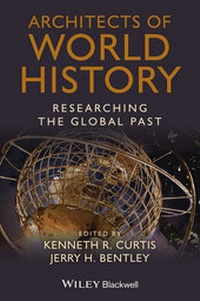
Architects of World History
Description

Reviews / Votes
"This collection clearly frames the methodological andhistoriographical trajectories that give coherence to world historyas a field. The contributions from a wide range of scholarshumanize broad patterns of inquiry and provide a fresh, originalapproach. Architects is essential reading for scholars and teachersat all levels who want to grasp the history and scope of a dynamicfield." --Laura J. Mitchell, University of California,Irvine"The authors of these thoughtful and engaging autobiographicalessays show us that, like most historical change, world history asa modern intellectual and scholastic endeavor emerged not because agroup of innovators had a good plan but through an inchoate processof accident, contingency, and personal encounter. This is afascinating story of how nine distinguished historians,dissatisfied with the severe limits of nation-state history, foundtheir way, often serendipitously, to one another and to largernetworks of like-minded professionals. In the process they helpedestablish world history as a fertile field of research andteaching." --Ross Dunn, San Diego State University "This is a stimulating collection, at once presenting leadingvoices in the field and some of the key topical approaches withinworld history. The goal of attracting and guiding students toward agreater sense of how world history is done is particularlyattractive." --Peter Stearns, George Mason University "Each of the authors is a genuine architect and visionary in thefield of world history. Collectively they provide a richintroduction to current approaches to teaching and research, whileat the same time unfolding their own personal and often remarkableintellectual journeys that brought them to the forefront of worldhistory." --Craig Benjamin, President of the World HistoryAssociation (2014 / 15)More details
Other editions
Additional editions
Persons
Content
2
En Route to World Environmental History
J.R. McNeill
My path to world history must be among the easiest ever trod. I did not have to rebel against upbringing and socialization to embrace the gospel of world history. I was born into a missionary family.
One of my grandfathers, John T. McNeill (1885–1975), was born on a farm in Prince Edward Island in the Canadian Maritimes. He uprooted for Montreal, Vancouver, Toronto, Chicago, and New York, leaving behind the blind certainties of provincial Presbyterianism of a century ago. He preferred the uncertainties of university life and made an academic career, writing church histories as if all Christians were created equal. My other grandfather, a ne’er-do-well named Robert S. Darbishire (1886–1949), was born near Tampa, Florida to parents convinced of the superiority of all things English. He might have liked an academic career, but came no closer than teaching English to Greek schoolboys. He tried to educate himself about Islam and for a while studied Arabic and Turkish in the 1920s and 1930s, when such ambitions were surpassingly rare. He did not get far, but his inclinations were ecumenical. Or so it seems from reading his letters; I never met him.
My father, William H. McNeill, born in Vancouver in 1917, became one of the most visible world historians of his time. As he recounts it (McNeill, 2005), he found the history education offered by his teachers at the University of Chicago and Cornell constraining, and was dazzled by the global vision on display in the work of Arnold J. Toynbee’s A Study of History. He planned from an early age to write his own history of the world, hoping to improve upon Toynbee. While I was learning to read, my father was finishing The Rise of the West (1963), a milestone in the emergence of world history in the United States. The book was a modest popular success and still won admiration from scholars, in part for its emphasis on the interactions among societies. I expect I frequently heard about the virtues of world history at the dinner table growing up, although I am certain I paid little heed.
My grandmothers and my mother, so far as I know, were neither interested in world history nor ecumenical in outlook. They fulfilled the expectations for women in their times and devoted themselves to their families. Their devotion included nourishing any inclinations children might show toward reading and learning.
Environmental History
My own participation in world history has come mainly in the form of environmental history, to which I came accidentally. That story I will relate later, after some historiographical orientation.
The subfield of environmental history is now more than a generation old, pursued by scholars who deliberately write history as if nature existed. They (and I) believe that the natural environment serves not merely as a backdrop to human history, but evolves in its own right, both of its own accord and as a result of human actions. Environmental history, in short, is the history of the relations between human societies and the rest of nature on which they depend.
More than most varieties of history, environmental history is interdisciplinary. In addition to the customary published and archival texts beloved by historians, environmental historians routinely use the findings culled from bio-archives (such as pollen deposits that can tell us about former vegetation patterns) and geo-archives (such as soil profiles that can tell us about past land-use practices). Although the choice of sources emphasized normally differs, the subject matter of environmental history is often much the same as in historical geography or historical ecology.
Like everything in intellectual life, environmental history has tangled roots. Some of humankind’s oldest texts, such as the Epic of Gilgamesh – the earliest versions of which are 4000 years old – deal with environmental change generated by human action (in this case, cutting cedar forests in the Levant). Many scholars of long ago, notably Ibn Khaldun (1332–1406) and the Baron de Montesquieu (1689–1755), found in the geographical variations in the natural world, and in climate especially, a key to human behavior. By today’s standards, they rank as naïve environmental determinists. They did not see environments as changing, except perhaps on local scales. They tended to see nature as enduring, as divine creation, not easily altered by human effort. By the nineteenth century, however, scientists came to recognize that the Earth itself, and life on it, changed over time, affecting the opportunities open to humanity. A few even saw that humanity played a role in changing the biosphere (Agassiz and Gould, 1848; Marsh, 1864; Stoppani, 1871–1873).
Modern environmental history dates only to about 1970. Initially, it drew its energy from trends within society at large. Around the world, the 1960s and 1970s witnessed the coalescence of popular environmentalism as a cultural and political movement, spurred by recognition that people could indeed have profound impacts on the biosphere. In the United States, the new environmentalism helped inspire a few historians, initially almost all scholars of US history, to come together both intellectually and institutionally. They formed the American Society for Environmental History in 1976, the first of several such associations. Elsewhere, especially in Europe but eventually more broadly, historians also began to practice what increasingly came to be called environmental history (or umweltgeschichte or storia ambientale as the case may be).
In the 1970s and early 1980s, most of the influential work concerned US environmental history. A small handful of books acquired status as foundational texts. The first was Roderick Nash’s Wilderness and the American Mind (1967), an intellectual history of nature-writing in the United States. Alfred Crosby’s Columbian Exchange (1972) soon followed, one of the few books whose title became part of nearly every anglophone historian’s vocabulary. Donald Worster’s Dust Bowl (1978) took an iconic subject in US history and gave it a new twist, bringing new detail to historians’ discussions of climate, soil, and grass, as well as to the human tragedies that played out on the southern plains in the 1930s. William Cronon’s Changes in the Land (1984), which explored the transformations of southern New England’s human ecology between 1600 and 1800, enjoyed great success. All these authors, and many more like them, wrote with modern environmentalist concerns looming over them, and typically lamented the changes they wrote about.
Younger recruits to the field often but not always shared this impulse to lamentation. A few of them took their approach beyond national borders, but none as yet sought to tackle environmental history on the world scale. By the early 1980s in the United States, environmental history was an up and coming subfield with professional meetings held once every 2 years and an academic journal. Aside from Crosby, however, no one consistently worked on large canvases. Outside the United States, through the early 1980s, the field remained thoroughly marginal, unless one counts the geographically aware rural histories of historians associated with the journal Annales: E.S.C. (which some do but I do not). In any case, environmental history and world history, both percolating provocatively in the 1970s, did not yet intersect.
Choosing History
None of this excitement penetrated my consciousness until after 1980. As an undergraduate at Swarthmore College (1971–1975), after a doomed flirtation with mathematics, I studied history, but neither world history nor environmental history. The offerings available to me were more conventional national histories, or in the case of Africa and Latin America, continental-scale history. Nonetheless, by accident rather than design, I learned something of the history of China, Russia, Africa, Europe, Latin America, and the foreign policy of the United States. I had plenty of opportunity for comparative world history on my own, although I do not remember ever taking the trouble to compare, say, the Russian and Chinese revolutions, each of which I studied in separate courses. I accepted as givens the national or regional frameworks of my professors, my classes, and the books I read for them.
When allowed to write a double-credit senior thesis at Swarthmore (about 160 double-spaced pages), I chose one of the most tedious subjects imaginable, railway finance in Britain circa 1830–1860. I spent the flower of my youth among the bulky gray microfilm readers of the University of Pennsylvania library, hand-copying data from lists of railway investors preserved in Britain’s parliamentary papers. On one Friday evening I did not notice the library’s closing bell and was locked in the microfilm reading room for the night. Although all my primary sources were from Britain, I did write sections of my thesis about India, Russia, Europe, and Canada, using published accounts. That probably represents my first uncertain lurch in the direction of world history. Although railroad-building would make a fine subject for environmental history, it never occurred to me to include such considerations. Nothing environmental figured anywhere in my undergraduate education. And...
