

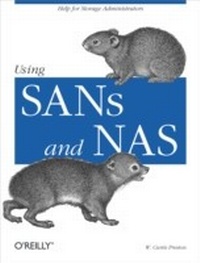
Using SANs and NAS
Help for Storage Administrators
1st Edition
Published on 5. February 2002
226 pages
978-0-596-55207-7 (ISBN)
Description

Data is the lifeblood of modern business, and modern data centers have extremely demanding requirements for size, speed, and reliability. Storage Area Networks (SANs) and Network Attached Storage (NAS) allow organizations to manage and back up huge file systems quickly, thereby keeping their lifeblood flowing. W. Curtis Preston's insightful book takes you through the ins and outs of building and managing large data centers using SANs and NAS.As a network administrator you're aware that multi-terabyte data stores are common and petabyte data stores are starting to appear. Given this much data, how do you ensure that it is available all the time, that access times and throughput are reasonable, and that the data can be backed up and restored in a timely manner? SANs and NAS provide solutions that help you work through these problems, with special attention to the difficulty of backing up huge data stores. This book explains the similarities and differences of SANs and NAS to help you determine which, or both, of these complementing technologies are appropriate for your network. Using SANs, for instance, is a way to share multiple devices (tape drives and disk drives) for storage, while NAS is a means for centrally storing files so they can be shared. Preston exams each technology with a vendor neutral approach, starting with the building blocks of a SAN and how they can be assembled for effective storage solutions. He covers day-to-day management and backup and recovery for both SANs and NAS in detail. Whether you're a seasoned storage administrator or a network administrator charged with taking on this role, you'll find all the information you need to make informed architecture and data management decisions. The book fans out to explore technologies such as RAID and other forms of monitoring that will help complement your data center. With an eye on the future, other technologies that might affect the architecture and management of the data center are explored. This is sure to be an essential volume in any network administrator's or storage administrator's library.
More details
Other editions
Additional editions
Book
03/2002
O'Reilly
€28.50
Shipment within 10-20 days
Content
- Intro
- Table of Contents
- Preface
- Boy, Was This Fun!
- What Is This Book For?
- Conventions Used in This Book
- Comments and Questions
- Acknowledgments
- What Are SANs and NAS?
- From SCSI to SANs
- What Is a SAN?
- Backup and Recovery: Before SANs
- Things Got Better
- Then They Got Worse
- Enter the SAN
- From NFS and SMB to NAS
- SMB/CIFS
- NFS
- NFS and CIFS: Before NAS
- Enter NAS
- SAN Versus NAS: A Summary
- Which Is Right for You?
- The Pros and Cons of NAS
- Pros and Cons of SANs
- It All Depends on Your Environment
- Fibre Channel Architecture
- Fibre Channel: An Ove30
- Why Fibre Channel?
- What Is Fibre Channel?
- Fibre Channel Ports
- Addressing
- Fibre Channel Topologies
- Point-to-Point
- Fabric
- Arbitrated Loop
- FC-AL Versus Fabric
- Arbitration
- Address selection
- Combining Fabric and Arbitrated Loop Topologies
- SAN Building Blocks
- Servers
- Host Bus Adapters (HBAs)
- Switches
- Hubs
- Hub Switches
- Routers and Bridges
- Disk Systems
- Cabling
- Software
- Fibre Channel and SANs: A Summary
- Managing a SAN
- The Different Uses for SANs
- Large, High-Performance Databases
- Filesystems with Many, Many Files
- Databases Requiring Raw Device Access
- Vendors That Don't (or Won't) Support NAS
- SAN Issues to Be Managed
- Multiple Paths to a Single Device
- Multiple Servers Accessing the Same Device
- Storage Devices with Changing Addresses
- Lack of Interoperability
- Access to Storage Resources
- Storage Virtualization
- Slicing
- Striping/RAID
- Implementations of Virtualization
- Controller-based implementation
- Software-based implementation
- Zoning
- Creating zones
- Hard zones
- Soft zones
- Broadcast zones
- Naming your zones
- LUN Masking
- Designing Your SAN for Availability
- Multipathing
- Automatic failover
- Load balancing
- Preventing thrashing
- Persistent Binding
- Ongoing Maintenance
- Managing (Storage Resource Management)
- Monitoring
- Maintenance
- Using SANs to Maximize Your Storage
- Online Storage Maximization
- Is This for Real?
- Offline Storage Maximization
- Online and Offline Storage Maximization Combined
- Truly Highly Available Systems
- Summary
- SAN Backup and Recovery
- Overview
- LAN-Free Backups
- How Does This Work?
- SCSI reserve/release
- Third-party queuing system
- Levels of Drive Sharing
- Restores
- Other Ways to Share Tape Drives
- NDMP libraries
- SCSI over IP
- Shared SCSI
- A Variation on the Theme
- What is a snapshot?
- Problem solved
- Problems with LAN-Free Backups
- Application impact
- Recovery speed
- No other way?
- Client-Free Backups
- How Client-Free Backups Work
- Backing Up the Backup Mirror
- Setup
- Back up the transaction logs
- Back up the datafiles
- Client-Free Recovery
- Recovering from complete destruction of the storage array
- Restore backup mirror from tape
- Recovering after a tape recovery or if you lose the primary disk set and not the backup mirror
- Restore primary disk set from the backup mirror
- Replay transaction logs
- Bring the database online
- Other Variations on the Theme
- Recovery of a snapshot
- A valid option
- Server-Free Backups
- Look, Ma, No Server
- Getting a static view of the data
- Logically mapping the disk to the filesystem
- Transferring the data directly from disk to tape
- Server-Free Restores
- Image-level server-free restores
- File-level server-free restores
- Advantages and Disadvantages
- LAN-Free, Client-Free, or Server-Free?
- NAS Architecture
- What's Wrong with Standard NFS and CIFS?
- Usability
- Manageability
- Performance
- Availability
- Scalability
- Enter Network Attached Storage
- NFS and CIFS Advances
- Advances in NFS
- CIFS Advances
- System Architecture Advances
- Streamlining the Process
- Making It Even Better
- High Availability and Scalability
- Low Total Cost of Ownership (TCO)
- Low Individual Component Cost
- Single Server for NFS, CIFS, and HTTP Services
- Ease of Maintenance
- Multiprotocol Servers
- Simplified Management
- Simplified Physical Architecture
- Ease of Use
- Managing NAS
- The Different Uses for NAS
- Data Consolidation
- Internet Applications
- Business Applications
- Installing a Filer
- Network Setup
- Operating System Installation
- Proprietary operating systems
- Linux-based operating systems
- Embedded Windows
- Configuring a Filer
- Configuration Interfaces
- Console
- Command-line interface (CLI)
- Remote shell: rsh
- Secure shell: ssh
- HTTP
- Configuration Files and Scripting
- Configuration Security
- Configuring the Storage
- Disk space allocation
- User space allocation: quotas
- Configuring the Network Interfaces
- Configuring the Network Protocols
- NFS
- CIFS
- HTTP
- FTP
- Emerging protocols
- Language support
- Configuring Authentication/Directory Services
- Local password databases
- Network Information Service (NIS)
- Microsoft
- User mapping
- Applications
- Home Directories
- Databases
- Data Migration
- Migration from Distributed Local Storage to NAS
- Migration methods and tools
- Migration issues
- Migration Between Filers
- Maintenance
- Hardware Failure
- Hardware Upgrades
- Onsite Spares
- Software Failure
- Software Upgrade
- Monitoring, Analyzing, and Reporting
- Monitoring: Built-in Tools
- Network Management Tools: Vendor-Supplied
- Network Management Tools: Generic
- Storage Resource Management (SRM)
- Performance Tuning
- Measuring Performance
- Measurement Tools
- NAS Backup and Recovery
- Snapshots and Mirroring
- Snapshots
- Server-to-Server Mirroring
- They Work Together
- Native Utilities
- NFS/CIFS
- Issues with NFS/CIFS Backups of Filers
- Reduced performance
- Unicode names
- CIFS ACLs
- Windows alternate data streams
- Push Agent Software
- NDMP
- The History of NDMP
- What Is NDMP?
- Definition of Terms
- NDMP configurations
- NDMP backups aren't portable
- Versions
- Using NDMP
- Robotic support
- Filer to library support
- Filer to server support
- Direct access restore support
- What About LAN-Free, Client-Free, and Server-Free Backup?
- Database Backup and Recovery
- Benefits Summary
- Disruptive Technologies
- DAFS: Direct Access File System
- VI: Virtual Interface
- InfiniBand
- iSCSI
- RAID Levels
- RAID 0
- RAID 1
- RAID 0+1
- RAID 1+0 (RAID 10)
- RAID 2
- RAID 3
- RAID 4 and RAID 5
- Index
