

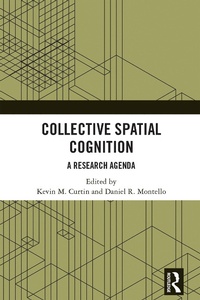
Collective Spatial Cognition
A Research Agenda
1st Edition
Published on 2. October 2023
322 pages
978-1-000-96746-3 (ISBN)
Description

This book integrates the science of spatial cognition and the science of team cognition to explore the social, psychological, and behavioral phenomenon of spatial cognition as it occurs in human collectives such as dyads and work teams.
It represents the culmination of a process of outlining and defining a growing field of research termed Collective Spatial Cognition. It engages contributions from an international and multi-disciplinary community of scholars, who have collaborated to provide a foundation for knowledge discovery regarding how groups of people of varying size acquire information and solve problems involving spatiality as a key component, leading to action that incorporates the spatial information and problem-solving collectively achieved. The collectives under study can be as small as dyads (teams of two) to large teams-of-teams who are working alongside each other to complete a mutual goal. The book lays the foundation for multi- and interdisciplinary work regarding Collective Spatial Cognition in the years to come, and this book documents that foundation.
This book will be of interest to those researching spatial, behavioural, cognitive, and information sciences in the fields of human geography, sociology, psychology, and computer science.
It represents the culmination of a process of outlining and defining a growing field of research termed Collective Spatial Cognition. It engages contributions from an international and multi-disciplinary community of scholars, who have collaborated to provide a foundation for knowledge discovery regarding how groups of people of varying size acquire information and solve problems involving spatiality as a key component, leading to action that incorporates the spatial information and problem-solving collectively achieved. The collectives under study can be as small as dyads (teams of two) to large teams-of-teams who are working alongside each other to complete a mutual goal. The book lays the foundation for multi- and interdisciplinary work regarding Collective Spatial Cognition in the years to come, and this book documents that foundation.
This book will be of interest to those researching spatial, behavioural, cognitive, and information sciences in the fields of human geography, sociology, psychology, and computer science.
More details
Edition
1. Auflage
Language
English
Place of publication
London
United Kingdom
Publishing group
Taylor & Francis Ltd
Target group
College/higher education
Illustrations
12 Tables, black and white; 24 Line drawings, black and white; 5 Halftones, black and white; 29 Illustrations, black and white
ISBN-13
978-1-000-96746-3 (9781000967463)
Copyright in bibliographic data and cover images is held by Nielsen Book Services Limited or by the publishers or by their respective licensors: all rights reserved.
Schweitzer Classification
Other editions
Additional editions
Book
01/2025
1st Edition
Routledge
€63.80
Shipment within 10-20 days
Book
10/2023
1st Edition
Routledge
€206.90
Shipment within 10-20 days
Persons
Kevin M. Curtin is a Professor of Geography and Director of the Laboratory for Location Science at the University of Alabama. He received his B.A. and M.A. from the University of Illinois at Chicago in Urban and Environmental Geography and his Ph.D. in Geography from the University of California-Santa Barbara. He performs primary research in the field of Geographic Information Science with specializations in location science, transportation and logistics, urban resource allocation, spatial statistics, and network GIS. Application areas for his research include autonomous vehicle logistics, transportation geography, crime studies, health and nutrition, and geospatial intelligence, and he teaches extensively at both the undergraduate and graduate university levels. His research program has been supported by the Office for Naval Research, the National Science Foundation, and the Army Research Institute, among others.
Daniel R. Montello is Professor of Geography and Affiliated Professor of Psychological & Brain Sciences at the University of California, Santa Barbara (UCSB). His educational background is in environmental, cognitive, and developmental psychology. His research is in the areas of spatial, environmental, and geographic perception, cognition, affect, and behavior. Dan has authored or co-authored ~100 articles and chapters, and co-authored or edited 7 books, including the Handbook of Behavioral and Cognitive Geography (2018); Space in Mind: Concepts for Spatial Learning and Education (2014) with Karl Grossner and Don Janelle; and An Introduction to Scientific Research Methods in Geography and Environmental Studies, 2nd ed. (2013) with Paul C. Sutton. He co-edits the academic journal Spatial Cognition and Computation.
Daniel R. Montello is Professor of Geography and Affiliated Professor of Psychological & Brain Sciences at the University of California, Santa Barbara (UCSB). His educational background is in environmental, cognitive, and developmental psychology. His research is in the areas of spatial, environmental, and geographic perception, cognition, affect, and behavior. Dan has authored or co-authored ~100 articles and chapters, and co-authored or edited 7 books, including the Handbook of Behavioral and Cognitive Geography (2018); Space in Mind: Concepts for Spatial Learning and Education (2014) with Karl Grossner and Don Janelle; and An Introduction to Scientific Research Methods in Geography and Environmental Studies, 2nd ed. (2013) with Paul C. Sutton. He co-edits the academic journal Spatial Cognition and Computation.
Content
Introduction
1. With a Little Help from My Friends: An Overview of Collective Spatial Cognition
Montello, Daniel R., Kevin M. Curtin, Crystal Bae, and Penelope Mitchell
Navigation
2. Navigation in Collaboration
Ishikawa, Toru
3. Personality Traits and Spatial Skills are Related to Group Dynamics and Success During Collective Wayfinding
Brunye, Tad T., Dalit Hendel. Aaron L. Gardony, Erika K. Hussey, and Holly A. Taylor
4. Facilitating Collective Cognition During Group Wayfinding Through the Human Eye
Giannopoulos, Ioannis, and Daniel R. Montello
5. Virtual Humans and Their Influence on Navigation
Khooshabehadeh, Pollard, Oiknine, Files, Dalangin, Sinatra, Fleming, Raber
Knowledge Acquisition and Reasoning
6. Adverse Consequences of Collaboration on Spatial Problem Solving
Andrews-Todd, Jessica and David N. Rapp
7. Central Coordination and Integration of Diverse Information to Form a Single Map
Chrastil, Elizabeth and You (Lily) Cheng
8. Collective Spatial Cognition: Improving Wayfinding through Transactive Memory Systems
Maupin, Cynthia K., Neil G. MacLaren, Gerald F. Goodwin, and Dorothy R. Carter
Teams
9. The Dynamics and Performance of Groups as Spatial Information Processors
Park, Ernest S. and Verlin B. Hinsz
10. A Review of Multi-team Systems with an Eye Toward Applications for Collective Spatial Reasoning
Baumann, Michael R., Donald R. Kretz, and Qiliang He
Applications and Techniques
11. Wildfire Protective Actions and Collective Spatial Cognition
Cova, Thomas J. and Frank A. Drews
12. Modeling and Simulating the Impact of Human Spatial and Social Behavior on Infection Spread in Hospitals
Esposito, Dario, Davide Schaumann, Megan Rondinelli, Domenico Camarda, Yehuda E. Kalay Kevin M. Curtin, and Penelope Mitchell
13. Spatial Analytic Tools and Techniques to Inform Research on Team Spatial Cognition
Curtin, Kevin, Penelope Mitchell, and Megan Rondinelli
1. With a Little Help from My Friends: An Overview of Collective Spatial Cognition
Montello, Daniel R., Kevin M. Curtin, Crystal Bae, and Penelope Mitchell
Navigation
2. Navigation in Collaboration
Ishikawa, Toru
3. Personality Traits and Spatial Skills are Related to Group Dynamics and Success During Collective Wayfinding
Brunye, Tad T., Dalit Hendel. Aaron L. Gardony, Erika K. Hussey, and Holly A. Taylor
4. Facilitating Collective Cognition During Group Wayfinding Through the Human Eye
Giannopoulos, Ioannis, and Daniel R. Montello
5. Virtual Humans and Their Influence on Navigation
Khooshabehadeh, Pollard, Oiknine, Files, Dalangin, Sinatra, Fleming, Raber
Knowledge Acquisition and Reasoning
6. Adverse Consequences of Collaboration on Spatial Problem Solving
Andrews-Todd, Jessica and David N. Rapp
7. Central Coordination and Integration of Diverse Information to Form a Single Map
Chrastil, Elizabeth and You (Lily) Cheng
8. Collective Spatial Cognition: Improving Wayfinding through Transactive Memory Systems
Maupin, Cynthia K., Neil G. MacLaren, Gerald F. Goodwin, and Dorothy R. Carter
Teams
9. The Dynamics and Performance of Groups as Spatial Information Processors
Park, Ernest S. and Verlin B. Hinsz
10. A Review of Multi-team Systems with an Eye Toward Applications for Collective Spatial Reasoning
Baumann, Michael R., Donald R. Kretz, and Qiliang He
Applications and Techniques
11. Wildfire Protective Actions and Collective Spatial Cognition
Cova, Thomas J. and Frank A. Drews
12. Modeling and Simulating the Impact of Human Spatial and Social Behavior on Infection Spread in Hospitals
Esposito, Dario, Davide Schaumann, Megan Rondinelli, Domenico Camarda, Yehuda E. Kalay Kevin M. Curtin, and Penelope Mitchell
13. Spatial Analytic Tools and Techniques to Inform Research on Team Spatial Cognition
Curtin, Kevin, Penelope Mitchell, and Megan Rondinelli
