

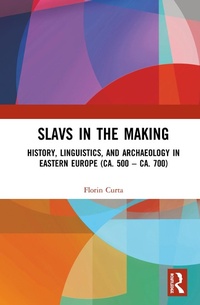
Slavs in the Making
History, Linguistics, and Archaeology in Eastern Europe (ca. 500 - ca. 700)
1st Edition
Published on 28. September 2020
366 pages
978-1-351-33001-5 (ISBN)
Description

Slavs in the Making takes a fresh look at archaeological evidence from parts of Slavic-speaking Europe north of the Lower Danube, including the present-day territories of the Czech Republic, Slovakia, Poland, Belarus, Ukraine, and Russia.
Nothing is known about what the inhabitants of those remote lands called themselves during the sixth century, or whether they spoke a Slavic language. The book engages critically with the archaeological evidence from these regions, and questions its association with the "Slavs" that has often been taken for granted. It also deals with the linguistic evidence-primarily names of rivers and other bodies of water-that has been used to identify the primordial homeland of the Slavs, and from which their migration towards the Lower Danube is believed to have started. It is precisely in this area that sociolinguistics can offer a serious alternative to the language tree model currently favoured in linguistic paleontology. The question of how best to explain the spread of Slavic remains a controversial issue. This book attempts to provide an answer, and not just a critique of the method of linguistic paleontology upon which the theory of the Slavic migration and homeland relies.
The book proposes a model of interpretation that builds upon the idea that (Common) Slavic cannot possibly be the result of Slavic migration. It addresses the question of migration in the archaeology of early medieval Eastern Europe, and makes a strong case for a more nuanced interpretation of the archaeological evidence of mobility. It will appeal to scholars and students interested in medieval history, migration, and the history of Eastern and Central Europe.
Nothing is known about what the inhabitants of those remote lands called themselves during the sixth century, or whether they spoke a Slavic language. The book engages critically with the archaeological evidence from these regions, and questions its association with the "Slavs" that has often been taken for granted. It also deals with the linguistic evidence-primarily names of rivers and other bodies of water-that has been used to identify the primordial homeland of the Slavs, and from which their migration towards the Lower Danube is believed to have started. It is precisely in this area that sociolinguistics can offer a serious alternative to the language tree model currently favoured in linguistic paleontology. The question of how best to explain the spread of Slavic remains a controversial issue. This book attempts to provide an answer, and not just a critique of the method of linguistic paleontology upon which the theory of the Slavic migration and homeland relies.
The book proposes a model of interpretation that builds upon the idea that (Common) Slavic cannot possibly be the result of Slavic migration. It addresses the question of migration in the archaeology of early medieval Eastern Europe, and makes a strong case for a more nuanced interpretation of the archaeological evidence of mobility. It will appeal to scholars and students interested in medieval history, migration, and the history of Eastern and Central Europe.
More details
Edition
1. Auflage
Language
English
Place of publication
London
United Kingdom
Publishing group
Taylor & Francis Ltd
Target group
College/higher education
Product notice
Reflowable
Illustrations
54 Halftones, black and white; 54 Illustrations, black and white
ISBN-13
978-1-351-33001-5 (9781351330015)
Copyright in bibliographic data and cover images is held by Nielsen Book Services Limited or by the publishers or by their respective licensors: all rights reserved.
Schweitzer Classification
Other editions
Additional editions
Florin Curta
Slavs in the Making
History, Linguistics, and Archaeology in Eastern Europe (ca. 500 - ca. 700)
Book
04/2022
1st Edition
Routledge
€73.30
Shipment within 15-20 days
Florin Curta
Slavs in the Making
History, Linguistics and Archaeology in Eastern Europe (Ca. 500-Ca. 700)
Book
10/2020
Taylor & Francis
Unfortunately, price unknown
Available (delivery time upon request)
Florin Curta
Slavs in the Making
History, Linguistics, and Archaeology in Eastern Europe (ca. 500 - ca. 700)
Book
09/2020
1st Edition
Routledge
€186.30
Shipment within 10-20 days
Person
Florin Curta is Professor of Medieval History and Archaeology at the University of Florida, USA. He is the author of The Making of the Slavs: History and Archaeology of the Lower Danube, ca. 500-700 (2004), Southeastern Europe in the Middle Ages, 500-1250 (2006), The Edinburgh History of the Greeks, ca. 500 to 1050: The Early Middle Ages (2011), and Eastern Europe in the Middle Ages (500-1300) (2019).
Content
Introduction 1. Theoretical framework 2. Approaching the early Slavs 3. Written sources 4. The Carpathian Basin 5. The East German and Czech lands 6. Poland 7. Western (Right-Bank) Ukraine and Belarus 8. Eastern (Left-Bank) Ukraine and western Russia 9. Migration 10. Language 11. Ethnicity Conclusion
