

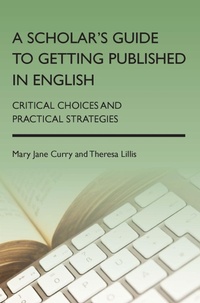
A Scholar's Guide to Getting Published in English
Critical Choices and Practical Strategies
Published on 25. November 2013
224 pages
978-1-78309-062-4 (ISBN)
Description

In many locations around the globe, scholars are coming under increasing pressure to publish in English in addition to other languages. However research has shown that proficiency in English is not always the key to success in English-medium publishing. This guide aims to help scholars explore the larger social practices, politics, networks and resources involved in academic publishing and to encourage scholars to consider how they wish to take part in these practices-as well as to engage in current debates about them. Based on 10 years of research in academic writing and publishing practices, this guide will be invaluable both to individuals looking for information and support in publishing, and to those working to support others' publishing activities.
Reviews / Votes
This guide comes as a most welcome and useful complement to the majority of linguistic and rhetorical guides to writing for scholarly publication in that it focuses on helping scholars explore, identify and understand the social practices, politics, networks and resources involved in academic publishing. -- Francoise Salager-Meyer, University of The Andes, Venezuela If you wish to publish your research in English, or perhaps more of your research in English, then this succinct and practical guide will help you to ask the right questions and to come up with appropriate responses. -- John M. Swales, University of Michigan, USA This very clearly organised and written guide provides an excellent overview of the larger social practices, politics, networks and resources involved in academic publishing. In the process, it shows readers how to formulate and situate their research and gain access to publication in international refereed journals. I thoroughly recommend this book to more or less experienced scholars, both Anglophone and non-Anglophone, wanting to publish in international refereed journals. -- John Flowerdew, City University of Hong Kong, Hong Kong The book more than delivers what it promises to the target audience. Overall, this book provides a very good reference source for scholars, and not just those from multilingual backgrounds. The authors are to be commended for researching and putting together such a userfriendly book on getting published in an English-dominated platform. -- Review in NZ Studies in Applied Linguistics (2015) The whole book presents a kaleidoscope of rich data examples drawn from the authors' long-running project on multilingual scholars' academic writing and publishing practices. These examples are interesting to read and thought-provoking. This practical guide is yet another milestone in the EAP profession. The authors' ground-breaking work has helped to illuminate multilingual scholars' academic lives, and will continue to inspire EAP professionals in their research and teaching endeavors in a great variety of academic contexts. -- Yongyan Li, University of Hong Kong * Journal of Second Language Writing, 25 (2014) * Curry and Lillis's concise volume addresses, in a straightforward, practical manner, important issues pertaining to the creation, dissemination, and validation of knowledge. -- Steven E. Gump, Grinnell College, USA * Scholarly Publishing, Volume 46, Number 1, October 2014, pp. 96-100 * This book is a welcome addition to the body of literature on academic writing/publishing. And I am happy to recommend this guide to non-Anglophone scholars and in particular newcomers to the global academic community, including those who work with writing in graduate and postgraduate courses. It is a valuable reference book that multilingual scholars may consult whenever they need advice or suggestions on academic publishing. -- Junhong Xiao, Shantou Radio and Television University, PR China * Innovation in Language Learning and Teaching, 2015 * A Scholar's Guide to Getting Published in English is a practical manual for novel researchers who need to publish in international journals as well as for teachers and supervisors who support others to publish. This book is a very complete guide for future academic writers, very useful also for supervisors and supporters of novel researchers; an ideal complement to other publications more focused on the linguistic and rhetorical perspective. -- Inmaculada Fortanet Gomez, Universitat Jaume I, Spain * Iberica 232 29 (2015): 223-236 * The focus on publishing as social practice makes the volume a welcome complement to current titles dealing primarily with rhetorical and logistic aspects of writing for publication. It will be a welcome addition to the bookshelves of university writing and career development centres. Curry and Lillis deserve our gratitude for producing this slender volume that makes the results of their research accessible to awider readership. -- Laurie Anderson, University of Siena, Italy * ELT Journal, 2015, 10.1093/elt/ccv022 *
More details
Language
English
Place of publication
Bristol
United Kingdom
Publishing group
Channel View Publications Ltd
Target group
Professional and scholarly
Product notice
Reflowable
ISBN-13
978-1-78309-062-4 (9781783090624)
Copyright in bibliographic data and cover images is held by Nielsen Book Services Limited or by the publishers or by their respective licensors: all rights reserved.
Schweitzer Classification
Other editions
Additional editions
Mary Jane Curry | Theresa Lillis
A Scholar's Guide to Getting Published in English
Critical Choices and Practical Strategies
Book
11/2013
Multilingual Matters
€23.00
Shipment within 10-20 days
Persons
Mary Jane Curry is Associate Professor in Language Education at the University of Rochester, USA, and Theresa Lillis is Professor in English Language and Applied Linguistics, at the Open University, UK. They have both published widely, including Lillis and Curry 'Academic Writing in a Global Context: The Politics and Practices of Publishing in English' (Routledge, 2010).
Content
Introduction
Chapter 1: Identifying your Personal Interests and Commitments to Publishing
Chapter 2: Making Sense of Institutional Evaluation Criteria
Chapter 3: Responding to Different Institutional Pressures to Publish
Chapter 4: Entering Academic 'Conversations'-Finding Out about Scholarly Conferences
Chapter 5: Identifying the 'Conversations' of Academic Journals
Chapter 6: Joining Academic 'Conversations' in a Competitive Marketplace
Chapter 7: Locating your Work and Forging 'Conversations'-Whose Work to Cite and Why?
Chapter 8: Publishing Articles or Book Chapters?
Chapter 9: Understanding Trajectories and Time in the Publishing Process
Chapter 10: Accessing Resources for Writing for Publication
Chapter 11: Doing the Work of Writing in Multiple Languages
Chapter 12: Participating in Academic Research Networks
Chapter 13: Collaborating on Texts for Publication
Chapter 14: Getting Help from Literacy Brokers
Chapter 15: Communicating with Publishing Gatekeepers
Chapter 16: Producing a Journal: Taking on Reviewing and Editing Roles
Chapter 17: Concluding Thoughts- Critical Choices and Practical Strategies for Global Scholarly Publishing
Chapter 1: Identifying your Personal Interests and Commitments to Publishing
Chapter 2: Making Sense of Institutional Evaluation Criteria
Chapter 3: Responding to Different Institutional Pressures to Publish
Chapter 4: Entering Academic 'Conversations'-Finding Out about Scholarly Conferences
Chapter 5: Identifying the 'Conversations' of Academic Journals
Chapter 6: Joining Academic 'Conversations' in a Competitive Marketplace
Chapter 7: Locating your Work and Forging 'Conversations'-Whose Work to Cite and Why?
Chapter 8: Publishing Articles or Book Chapters?
Chapter 9: Understanding Trajectories and Time in the Publishing Process
Chapter 10: Accessing Resources for Writing for Publication
Chapter 11: Doing the Work of Writing in Multiple Languages
Chapter 12: Participating in Academic Research Networks
Chapter 13: Collaborating on Texts for Publication
Chapter 14: Getting Help from Literacy Brokers
Chapter 15: Communicating with Publishing Gatekeepers
Chapter 16: Producing a Journal: Taking on Reviewing and Editing Roles
Chapter 17: Concluding Thoughts- Critical Choices and Practical Strategies for Global Scholarly Publishing
