

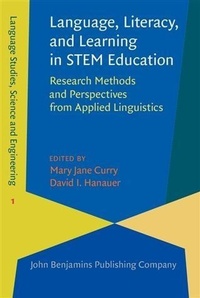
Language, Literacy, and Learning in STEM Education
Research Methods and Perspectives from Applied Linguistics
1st Edition
Published on 12. June 2014
XVI, 180 pages
978-90-272-7011-5 (ISBN)
Description

Language, Literacy, and Learning in STEM Education brings together a range of applied linguistic researchers and projects that address the interface among language studies, science, engineering, and education. The book is premised on the concept that science is of central importance in the twenty-first century and that linguistic knowledge can contribute to the description, understanding, education, and practice of science, technology, engineering, and mathematics. The book introduces various linguistic methodologies and discusses ways in which these have been used to promote STEM education. It offers a first collection of such studies and a wide-ranging introduction to ways in which applied linguistics can serve as a resource for questions, projects, and issues situated within the fields of STEM. The book should be of interest to applied linguists working in STEM, as well as STEM professionals working in education and administrative or funding bodies interested in supporting and enhancing educational practices in the sciences.
More details
Other editions
Additional editions
Mary Jane Curry | David I. Hanauer
Language, Literacy, and Learning in STEM Education
Research Methods and Perspectives from Applied Linguistics
Book
06/2014
John Benjamins Publishing Co
€95.40
Shipment within 10-15 days
Persons
Content
- Language, Literacy, and Learning in STEM Education
- Editorial page
- Title page
- LCC data
- Table of contents
- List of figures
- List of tables
- Contributor biographies
- Book Series Preface
- Integrating applied linguistics and literacies with STEM education
- Introduction
- Integrating applied linguistics and literacies with STEM education
- Book structure and chapter summaries
- References
- Part I. Research studies in science
- Drawing upon applied linguistics to attain goals in an interdisciplinary chemistry-applied linguistics project
- Introduction
- Background
- Contributions of applied linguistics subfields to the write like a chemist project
- English for Specific Purposes
- Discourse analysis and corpus linguistics
- Language teaching pedagogy
- Implications for other STEM areas
- Acknowledgments
- References
- A genre analysis of student microbiologylaboratory notebooks
- The laboratory notebook
- Educational studies of laboratory notebooks
- Methodology
- Results
- Characterizing the genre of microbiology laboratory notebooks: Conclusions and implications
- References
- Writing and becoming a scientist
- Introduction
- Context and methods
- Participants
- Data collection
- Data analysis
- Case 1: April - Tentative steps toward the future
- Case 2: Carla - A teacher emerges
- Case 3: Nedra - Timing is everything
- Conclusions, implications, and limitations
- References
- Appendix
- Examples of Coded Interview Excerpts
- Part II. Research studies in engineering
- Writing as social practice in engineering
- Introduction
- Writing as social practice
- Disciplinary epistemology, ideologies and writing in engineering
- Research methodology
- Aims, context, and participants in the study
- Data collection and collaboration
- Toward a nuanced understanding of writing as social practice in engineering
- Conclusion
- References
- Graphics and invention in academic engineers' writing for publication
- Introduction
- Theoretical framework: Engineering writing as multimodal social practice
- Research on writing for publication in science and engineering
- Methodology of the larger study
- Study setting and participants
- Findings: Graphics as invention in writing for publication
- Text history: Launching a research article
- Discussion and implications
- References
- Part III. Research studies in mathematics
- Mathematics education, cultural practices, and communication
- Introduction
- Mathematical communication and students' cultural contexts
- Research methodology
- Mathematical communication grounded in students' experiences as a way to learn mathematics
- Discussion
- References
- Learning while teaching
- Introduction
- Teacher listening and classroom language patterns
- Theoretical framework
- Research design
- Participants and their curriculum units
- Data collection
- Data analysis
- Curriculum materials
- Analysis of classroom episodes
- Evaluative listening
- Interpretive listening
- Toward hermeneutic listening
- Discussion
- Implications for STEM Educators
- References
- Improving girls' interest in mathematics through writing
- Introduction
- Writing as a tool for improving students' learning of mathematics
- A study of writing in middle-school mathematics classes
- Mixed methods research methodology
- Participating teachers
- Participants' use of writing to teach mathematics
- Research sites
- Data collection: Student survey
- Student participants
- Data analysis
- Students' attitudes toward writing in mathematics classes
- Indications of mathematical knowledge growth
- Female students' open-ended responses
- Male students' open-ended responses
- Conclusion
- References
- Part IV. Final words: Facilitating interdisciplinary collaboration
- Facilitating STEM education through interdisciplinarity
- The context for collaboration
- Bauerle: Facilitating innovative science education through interdisciplinarity
- Hatfull: Lessons from the PHIRE - Interdisciplinarity in an innovative science education program
- Hanauer: Applied linguistics and science education
- Facilitating STEM education through interdisciplinarity
- References
- Index
