

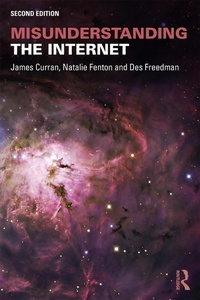
Misunderstanding the Internet
2nd Edition
Published on 5. February 2016
234 pages
978-1-317-44351-3 (ISBN)
Description

The growth of the internet has been spectacular. There are now more than 3 billion internet users across the globe, some 40 per cent of the world's population. The internet's meteoric rise is a phenomenon of enormous significance for the economic, political and social life of contemporary societies.
However, much popular and academic writing about the internet continues to take a celebratory view, assuming that the internet's potential will be realised in essentially positive and transformative ways. This was especially true in the euphoric moment of the mid-1990s, when many commentators wrote about the internet with awe and wonderment. While this moment may be over, its underlying technocentrism - the belief that technology determines outcomes - lingers on and, with it, a failure to understand the internet in its social, economic and political contexts.
Misunderstanding the Internet is a short introduction, encompassing the history, sociology, politics and economics of the internet and its impact on society. This expanded and updated second edition is a polemical, sociologically and historically informed guide to the key claims that have been made about the online world. It aims to challenge both popular myths and existing academic orthodoxies that surround the internet.
However, much popular and academic writing about the internet continues to take a celebratory view, assuming that the internet's potential will be realised in essentially positive and transformative ways. This was especially true in the euphoric moment of the mid-1990s, when many commentators wrote about the internet with awe and wonderment. While this moment may be over, its underlying technocentrism - the belief that technology determines outcomes - lingers on and, with it, a failure to understand the internet in its social, economic and political contexts.
Misunderstanding the Internet is a short introduction, encompassing the history, sociology, politics and economics of the internet and its impact on society. This expanded and updated second edition is a polemical, sociologically and historically informed guide to the key claims that have been made about the online world. It aims to challenge both popular myths and existing academic orthodoxies that surround the internet.
Reviews / Votes
"Fully updated, the second edition of Misunderstanding the Internet speaks more clearly and critically than ever to today's hyperbolic claims, utopian and dystopian, about the internet. By presenting a wealth of data that problematises easy claims of democratisation, the authors issue an urgent call to action to embed public values in the internet of the future."Sonia Livingstone, Professor of Media and Communications, London School of Economics and Political Science
"By updating their authoritative work on the Internet, James Curran, Natalie Fenton and Des Freedman have done scholars, students and concerned citizens an enormous favor. Misunderstanding the Internet remains the single most important book for someone to read to grasp the history and political economy of the digital revolution."
Robert W. McChesney, Professor of Communication, University of Illinois at Urbana-Champaign
"This is a very important book, it offers critical insights to contemporary political and economic power, the role of social media and how mass publics are informed, correcting many false assumptions - an absolute must read for students and academics in social and political sciences, as well as media and communications."
Gregory Philo, Professor of Communications and Social Change, University of Glasgow
"A deliciously fact-driven corrective to Internet hype of all kinds. Highly recommended."
Fred Turner, Professor of Communication, Stanford University
More details
Series
Edition
2nd edition
Language
English
Place of publication
London
United Kingdom
Publishing group
Taylor & Francis Ltd
Target group
College/higher education
Edition type
Revised edition
File size
1,37 MB
ISBN-13
978-1-317-44351-3 (9781317443513)
Copyright in bibliographic data and cover images is held by Nielsen Book Services Limited or by the publishers or by their respective licensors: all rights reserved.
Schweitzer Classification
Other editions
Additional editions
James Curran | Natalie Fenton | Des Freedman
Misunderstanding the Internet
Book
02/2016
2nd Edition
Routledge
€233.10
Shipment within 10-20 days
James Curran | Natalie Fenton | Des Freedman
Misunderstanding the Internet
Book
02/2016
2nd Edition
Routledge
€61.00
Shipment within 10-20 days
Persons
James Curran, Natalie Fenton and Des Freedman teach in the Department of Media and Communications at Goldsmiths, University of London, UK.
Content
Preface
1. The internet of dreams: reinterpreting the internet
2. The internet of history: rethinking the internet's past
3. The internet of capital: concentration & commodification in a world of abundance
4. The internet of rules: critical approaches to online regulation and governance
5. The internet of me (and my 'friends')
6. The internet of radical politics and social change
Conclusion: The internet we want
Index
1. The internet of dreams: reinterpreting the internet
2. The internet of history: rethinking the internet's past
3. The internet of capital: concentration & commodification in a world of abundance
4. The internet of rules: critical approaches to online regulation and governance
5. The internet of me (and my 'friends')
6. The internet of radical politics and social change
Conclusion: The internet we want
Index
