

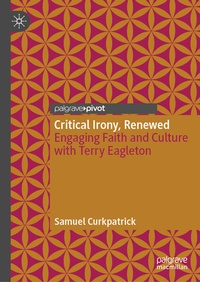
Critical Irony, Renewed
Description

Irony is a pervasive quality of human life, though its creative, comic potential is often overlooked. Traditionally, it has been cast in a subversive role, as the tool of the detached critic or sceptic. In Critical Irony, Renewed, Samuel Curkpatrick offers a fresh take, showing how irony can transform negativity to inspire imagination, hope and ethical action. Drawing on the work of literary theorist Terry Eagleton, this book explores the potential for irony to renew social and political imagination, while retaining a clear-eyed view of human fragility and limitation.
Curkpatrick examines Eagleton's writings alongside the comic tonalities of Christian parables, revealing how irony can function as a means of saying by unsaying - a dynamic and paradoxical form of critical perspective that enriches human creativity, ethical engagement and cultural dialogue. Critical Irony, Renewed demonstrates that irony, far from undermining identity, faith and culture, opens new possibilities for understanding and transforming our world. A compelling exploration for scholars and general readers alike, this work redefines irony's role in literature, culture, philosophy and theology, offering a glimpse of how we might think and act differently amid the very contradictions of human experience.
More details
Other editions
Additional editions
Person
Dr Samuel Curkpatrick is a McKenzie McKenzie Postdoctoral Fellow in the Faculty of Fine Arts and Music, the University of Melbourne. He specialises in Australian Indigenous music, and philosophical issues of language, epistemology and religion. His other books include Singing Bones: Ancestral Creative and Collaboration (Sydney University Press, 2020) and Indigenous Knowledge: Australian Perspectives (ed. Langton, Corn and Curkpatrick, Melbourne University Press, 2024).
Content
Chapter 1. Introduction: The many practices of irony.- Chapter 2. Cultivated loneliness: irony from romanticism to postmodernity.- Chapter 3. Doubled back: ironic visions of religion and power.- Chapter 4. Irony in critical perspective: anticipating social and political renewal.- Chapter 5. Reading Eagleton parabolically: self-estrangement as an impetus to love.- Chapter 6. Eventful language and the comic horizon of irony.- Chapter 7. Negation by excess: the redemptive outworking of the cross.
