

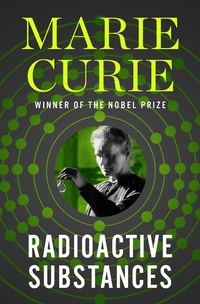
Radioactive Substances
Published on 7. June 2022
219 pages
978-1-5040-7592-3 (ISBN)
Description

The pioneering scientist's doctoral thesis on radioactivity that won her the 1903 Nobel Prize in Physics.
In 1896, Antoine Henri Becquerel discovered the first evidence of radioactivity. Inspired by the physicist's work, Marie Curie began investigating this phenomenon further with the help of her husband, Pierre. For four years, the couple researched various minerals and substances for radioactivity, a term she coined. In Radioactive Substances, Curie outlines with great detail her painstaking research and discoveries, which include the elements radium and polonium. Due to their breakthroughs, Marie and Pierre were awarded the Nobel Prize in Physics in 1903, the first of two for Marie.More details
Person
Marie Curie was a Polish and French Nobel Prize-winning physicist and chemist. She is best known for pioneering research on radioactivity. She was the first woman to win a Nobel Prize, the first person and only woman to ever win the prize twice, and the only person to ever win the prize in two scientific fields.
Content
- Intro
- Cover
- Title
- Radio-Active Substances
- Chapter I. Radio-activity of Uranium and Thorium. Radio-active Minerals
- Chapter II. Method of Research
- Chapter III. Radiation of the New Radio-active Substances
- Chapter IV. Communication of Radio-activity to Substances Initially Inactive
- Copyright
