

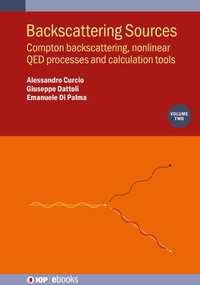
Backscattering Sources, Volume 2
Description

X-rays and gamma rays can penetrate dense matter, offering the possibility to explore characteristics that otherwise would be not observable. They have a wide range of applications in research across different fields, such as medical research, environmental science, and understanding cleaner energy technologies.
The top-performing X-ray and gamma ray sources are synchrotrons and Free Electron Lasers; however, these require large investment. Consequently, more affordable and accessible platforms are required for research and applications based on X-rays and gamma rays. The Compton Back Scattering (CBS) is a subset of Thomson and Compton scattering and is the mechanism through which high energy electrons interacting with low energy photons transfer part of their energy to the photons. Accordingly, an infrared photon can be "transformed" into an X-ray or gamma ray, in a CBS process. Monochromatic and ultrashort X-ray and gamma ray sources are challenging to make; however, CBS provides a compact and accessible platform for this purpose.
Aimed at those entering the field for the first time, this second volume focuses on Compton Backscattering that produces intense gamma rays of higher energy than typical scattering processes. Theoretical problems between the high energy electrons and laser interactions are discussed, along with the possibility of exploring new effects in strong field QED and how they can be observed. CBS 'factories' and their design characteristics are analysed and later chapters take a more detailed examination of CBS applications and the future of the field.
More details
Other editions
Additional editions
Persons
Alessandro Curcio obtained a Ph.D. at the School of Accelerator Physics at the University of Rome La Sapienza, before winning a Research Fellowship at the CERN Linear Accelerator for Research. Afterwards, he joined the National Polish Synchrotron SOLARIS as Section Leader in beam diagnostics and instrumentation. Later, he has been Senior Scientist at CLPU and, currently, he is Senior Scientist at the Italian National Institute for Nuclear Physics (INFN). His research interests have always been particle acceleration, innovative radiation sources and particle-matter interactions for applications.
Giuseppe Dattoli is an ENEA Researcher and has been involved in different research projects, including high-energy accelerators, free electron lasers, and applied mathematics networks since 1979. Dr Dattoli has taught in Italian and universities overseas and has received the FEL Prize Award for his outstanding achievements in the field.
Emanuele Di Palma received the Laurea degree in mathematics from La Sapienza University of Rome Italy, in 1996, a master's degree in 'Fusion Energy: Science and Engineering' from Tor Vergata University of Rome Italy, in 2013 and the PhD degree in 'Fusion Science and Engineering' from the University of Padova Italy, in 2018. His research interests are in the fields of physics and applications of intense electron beams, computer-aided design and development of CARM device for various novel application as in-space solar energy harvesting, in fusion energy for high-field Tokamaks and in biomedical applications to develop compact device for nuclear diagnostics.
Content
Chapter I : An introduction to high intensity lasers and to non linear QED
Chapter II: QED and Feynman diagrams: an elementary exposition
Chapter III: Non-linear QED of Compton Backscattering Radiation
Chapter IV: Advanced CBS sources
