

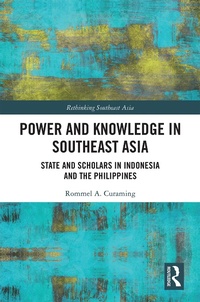
Power and Knowledge in Southeast Asia
State and Scholars in Indonesia and the Philippines
1st Edition
Published on 10. October 2019
232 pages
978-0-429-79631-9 (ISBN)
Description

Examining two state-sponsored history writing projects in Indonesia and the Philippines in the 1970s, this book illuminates the contents and contexts of the two projects and, more importantly, provides a nuanced characterization of the relationship between embodiments of power (state, dictators, government officials) and knowledge (intellectuals, historians, history).
Known respectively as Sejarah Nasional Indonesia (SNI) and the Tadhana project, these projects were initiated by the Suharto and Marcos authoritarian regimes against the backdrop of rising and competing nationalisms, as well as the regimes' efforts at political consolidation. The dialectics between actors and the politico-academic contexts determine whether scholarship and politics would clash, mutually support, or co-exist parallel with one another. Rather than one side manipulating or co-opting the other, this study shows the mutual need or partnership between scholars and political actors in these projects. This book proposes the need to embrace rather than deny or transcend the entwined power/knowledge if the idea is for scholarship to realize its truly progressive visions.
Analyzing the dynamics of state-scholar relations in the two countries, the book will be of interest to academics in the fields on Southeast Asian history and politics, nationalism, historiography, intellectual history, postocolonial studies, cultural studies, and the sociology of knowledge.
Known respectively as Sejarah Nasional Indonesia (SNI) and the Tadhana project, these projects were initiated by the Suharto and Marcos authoritarian regimes against the backdrop of rising and competing nationalisms, as well as the regimes' efforts at political consolidation. The dialectics between actors and the politico-academic contexts determine whether scholarship and politics would clash, mutually support, or co-exist parallel with one another. Rather than one side manipulating or co-opting the other, this study shows the mutual need or partnership between scholars and political actors in these projects. This book proposes the need to embrace rather than deny or transcend the entwined power/knowledge if the idea is for scholarship to realize its truly progressive visions.
Analyzing the dynamics of state-scholar relations in the two countries, the book will be of interest to academics in the fields on Southeast Asian history and politics, nationalism, historiography, intellectual history, postocolonial studies, cultural studies, and the sociology of knowledge.
More details
Series
Edition
1. Auflage
Language
English
Place of publication
London
United Kingdom
Publishing group
Taylor & Francis Ltd
Target group
College/higher education
Illustrations
5 Tables, black and white
ISBN-13
978-0-429-79631-9 (9780429796319)
Copyright in bibliographic data and cover images is held by Nielsen Book Services Limited or by the publishers or by their respective licensors: all rights reserved.
Schweitzer Classification
Other editions
Additional editions
Rommel Curaming
Power and Knowledge in Southeast Asia
State and Scholars in Indonesia and the Philippines
Book
06/2021
1st Edition
Routledge
€58.00
Shipment within 10-20 days
Rommel Curaming
Power and Knowledge in Southeast Asia
State and Scholars in Indonesia and the Philippines
Book
10/2019
1st Edition
Routledge
€193.50
Shipment within 10-20 days
Person
Rommel A. Curaming is Senior Assistant Professor at the Universiti Brunei Darussalam (UBD). His areas of research include comparative historiography, history and memory of violence, historical theory, and knowledge politics in Southeast Asia, mainly Indonesia and the Philippines.
Content
List of tables
Preface
Acknowledgments
Abbreviations
Introduction: power and knowledge
1 Indonesia and the Philippines: a contextual comparison
2 Genesis of Tadhana project
3 Tadhana in political and historiographic contexts
4 The making of Sejarah Nasional Indonesia (SNI)
5 SNI: contents and contexts
6 The calculus of power-knowledge relations
Conclusion
Glossary
Index
Preface
Acknowledgments
Abbreviations
Introduction: power and knowledge
1 Indonesia and the Philippines: a contextual comparison
2 Genesis of Tadhana project
3 Tadhana in political and historiographic contexts
4 The making of Sejarah Nasional Indonesia (SNI)
5 SNI: contents and contexts
6 The calculus of power-knowledge relations
Conclusion
Glossary
Index
