

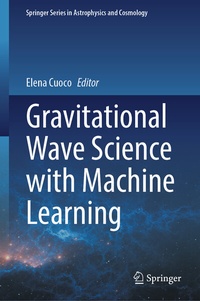
Gravitational Wave Science with Machine Learning
Description

This book highlights the state of the art of machine learning applied to the science of gravitational waves. The main topics of the book range from the search for astrophysical gravitational wave signals to noise suppression techniques and control systems using machine learning-based algorithms. During the four years of work in the COST Action CA17137-A network for Gravitational Waves, Geophysics and Machine Learning (G2net), the collaboration produced several original publications as well as tutorials and lectures in the training schools we organized. The book encapsulates the immense amount of finding and achievements.
It is a timely reference for young researchers approaching the analysis of data from gravitational wave experiments, with alternative approaches based on the use of artificial intelligence techniques.
More details
Other editions
Additional editions
Person
Dr. Elena Cuoco is Full Professor at the University of Bologna since 2024, she conducts research in the field of gravitational waves. She is a member of the LIGO/Virgo/KAGRA collaboration, where she works on data analysis and the application of artificial intelligence techniques for detector characterization and the search for gravitational signals of astrophysical origin. From 2018 to 2023, she served as the Action Chair for COST Action CA17137, dedicated to the application of machine learning to gravitational wave science. Author of numerous scientific publications, she is involved in various initiatives at the European and international levels.
Content
1. Neural network time-series classifiers for gravitational-wave searches in single-detector periods.- 2. A simple self similarity-based unsupervised noise monitor for gravitational-wave detectors.- 3 Simulation of transient noise bursts in gravitational wave interferometers.- 4. Efficient ML Algorithms for Detecting Glitches and Data Patterns in LIGO Time Series.- 5. Denoising gravitational-wave signals from binary black holes with dilated convolutional autoencoder.
