

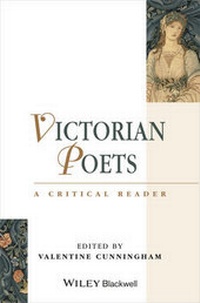
Victorian Poets
Description

Reviews / Votes
"A judiciously made and vigorously introduced gathering of themost telling voices in modern Victorian poetry criticism. ValentineCunningham's selection, wide and diverse, will be an excellentfirst stop for the savvy student of the period." --Seamus Perry, University of OxfordMore details
Other editions
Additional editions
Person
Content
Contributors
Isobel Armstrong is Emeritus Professor of English at Birkbeck College, University of London, and a Senior Research Fellow at the London University Institute of English Studies. An eminent scholar-critic especially of Victorian poetry, her publications include Arthur Hugh Clough (1962), The Major Victorian Poets: Reconsiderations (1969), Victorian Scrutinies (1972), Robert Browning (1974), Language as Living form in Nineteenth-Century Poetry (1982), Victorian Poetry: Poetry, Politics and Poetics (1993), Women’s Poetry, Late Romantic to late Victorian: Gender and Genre (1999), The Radical Aesthetic (2000), Victorian Glassworlds (2008).
Joseph Bristow is a Professor of English at UCLA, the University of California, Los Angeles. A specialist in nineteenth- and twentieth-century literature, with strong lines on gender and gay writing. His books include The Victorian Poet: Poetics and Persona (1987), Robert Browning (1991), Empire Boys: Adventures in a Man’s World (1991), Sexuality (1997), Effeminate England: Homoerotic Writing after 1885 (1997), The Fin-de-Siècle Poem: English Literary Culture and the 1890s (2005). His many editions include Victorian Women Poets: Emily Brontë, Elizabeth Barrett Browning, Christina Rossetti (1995), Nineteenth-Century Women Poets: An Oxford Anthology (1996, with Isobel Armstrong), Oscar Wilde’s The Picture of Dorian Gray (2004), Wilde Writings: Contextual Conditions (2003), The Cambridge Companion to Victorian Poetry (2000), and Oscar Wilde and Modern Culture: the Making of a Legend (2008).
Timothy A J Burnett has retired from his job as a manuscript librarian in the Department of Western Manuscripts at the British Library, London. Writing as T A J Burnett, he is the author of The Rise and Fall of a Regency Dandy: The Life and Times of Scrope Berdmore Davies (1981), and the editor of Charlotte Brontë’s The Search after hapiness (sic): a Tale (1969), Childe Harold’s Pilgrimage Canto III: a Facsimile of the Autograph Fair Copy found in the ‘Scrope Davies’ Notebook (1988), and of The British Library Catalogue of the Ashley Manuscripts (1998) – the collection of the notorious faker-bibliographer T J Wise.
Mary Wilson Carpenter is Professor Emerita of English, Queen’s University, Kingston, Ontario, Canada. She writes as a literary historian about Victorian literature with an emphasis on feminism and gender. Her main publications are George Eliot and the Landscape of Time: Narrative Form and Protestant Apocalyptic History (1986), Imperial Bibles, Domestic Bodies: Women, Sexuality and Religion in the Victorian Market (2003) and Health, Medicine and Society in Victorian England (2010).
Mary Ann Caws is distinguished Professor of English, French and Comparative Literature at the Graduate School of City University, New York. An art historian, literary critic, and biographer of Proust, Virginia Woolf, Henry James, Picasso and Salvador Dalí, she has edited anthologies on Manifestoes, Surrealism, and twentieth-century French literature. Her many translations of modern French poets include Stéphane Mallarmé.
Carol T Christ became the tenth President of Smith College, Northampton, Massachusetts in 2002 after a distinguished career as Professor of English and administrator at the University of California, Berkeley. A strong champion of women’s issues and diversity, her critical interests have focussed on Victorian women poets and novelists. As a Professor of English at Smith she teaches seminars on science and literature and on the arts. Her books include The Finer Optic: the Aesthetic of Particularity in Victorian Poetry (1975), Victorian and Modern Poetics (1984), the Norton edition of George Eliot’s The Mill on the Floss (1994), and Victorian Literature and the Victorian Visual Imagination, edited with John O Jordan (1995).
Valentine Cunningham is a Professor of English Language and Literature at Oxford University and a Senior Research Fellow of Corpus Christi College, Oxford. His books include Everywhere Spoken Against: Dissent in the Victorian Novel (1975), British Writers of the Thirties (1988), In the Reading Gaol: Texts, Postmodernity and History (1993), Victorian Poetry Now: Poets, Poems, Poetics (2011), The Connell Guide to King Lear (2012). He has edited The Penguin Book of Spanish Civil War Verse (1980), Spanish Front: Writers on the Civil War (1986), Adam Bede (1998), and The Victorians: An Anthology of Poetry and Poetics (2000).
Eric Griffiths is a Fellow in English at Trinity College, Cambridge. He teaches, and writes widely about, poetry from the Restoration to the present. Poetry of all sorts: like his critical father-in-the-faith Christopher Ricks, he’s a devotee of Bob Dylan. His books are The Printed Voice of Victorian Poetry (1989) and his Penguin edition Dante in English (2005, with Matthew Reynolds).
Antony Harrison is Distinguished Professor of English at North Carolina State University, at Raleigh, North Carolina. An eminent Victorianist, editor, critical theorist and student of gender, his books are Christina Rossetti in Context (1988), Swinburne’s Medievalism: a Study in Victorian Love Poetry (1988), Victorian Poets and Romantic Poems: Intertextuality and Ideology (1990), Victorian Poets and the Politics of Culture: Discourse and Ideology (1998), and The Cultural Production of Matthew Arnold (2009). He’s the editor of The Letters of Christina Rossetti (4 vols., 1997–2004), and coeditor of Gender and Discourse in Victorian Literature and Art (1992), The Culture of Christina Rossetti: Female Poetics and Victorian Contexts (1999), and of The Blackwell Companion to Victorian Poetry (2002).
Geoffrey Hill is widely regarded as the greatest living English poet. Professor Emeritus of English Literature and Religion at Boston University, Massachusetts; former co-director (with Christopher Ricks) of the Boston University Editorial Institute; currently Professor of Poetry at Oxford. He has published many volumes of poetry since his first, For the Fallen (1959). The best of his agonistic critical writing, amounting to a radically conservative, compellingly ethical and religious philosophy of literature, is generously gathered in his bumper Collected Critical Writings (2008).
Gerhard Joseph is Professor of English at Lehman College and the Graduate Centre of the City University of New York. He’s a theoretically clued-up critic of modern literature with a special stake in Victorian writing, whose books are Tennysonian Love: The Strange Diagonal (1969), Tennyson and the Text: The Weaver’s Shuttle (1992) and the edited volume Victorian Classicism (1982).
Angela Leighton is a Professor of English, and Fellow of Trinity College, Cambridge University. A poet in her own right (Sea Level, 2007), she’s a leading feminist critic with main, though not exclusive, interests in the nineteenth century. Her books are Shelley and the Sublime (1984), Elizabeth Barrett Browning (1986), Victorian Women Poets: Writing Against the Heart (1992), and On Form: Poetry, Aestheticism and the Legacy of a Word (2007). She has edited Victorian Women Poets: An Anthology, with Margaret Reynolds (1995), and Victorian Women Poets: A Critical Reader (1996).
Dorothy Mermin is Professor Emerita of English, Cornell University, with a concentration on Victorian literature and women’s poetry. Her main publications are The Audience in the Room: Five Victorian Poets (1983), Elizabeth Barrett Browning: The Origins of a New Poetry (1989), and Godiva’s Ride: Women of Letters in England, 1830–1880 (1993). She edited Victorian Literature 1830–1900 (2001) with Herbert Tucker.
J Hillis Miller is Distinguished Research Professor of English and Comparative Literature of the University of California, at Irvine (to which he moved from Yale where he was member of the so-called Yale School of deconstruction, which also included Jacques Derrida, Paul de Man, Geoffrey Hartman and Harold Bloom). A very influential American deconstructionist, he started off as a rather straightforward literary-historical critic specializing in the nineteenth-century (best early book: The Disappearance of God: Five Nineteenth-Century Writers, 1963), but from the later 1970s works of a deconstructive, and soon post-deconstructive cast (he was rather scarred like his colleagues and graduate students by the Paul de Man scandal), have poured out. Representative titles (and concerns): Fiction and Repetition (1982), Tropes, Parables, Performatives (1990), Ariadne’s Thread (1992), Topographies (1995), Black Holes (1999), Others (2001), For Derrida (2009), The Conflagration of Community: Fiction Before and After Auschwitz (2011).
Christopher Ricks is William M and Sarah B Warren Professor of the Humanities at Boston University, Massachusetts, and co-director with Archie Burnett of the Boston University...
