

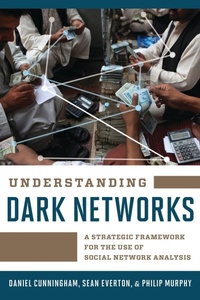
Understanding Dark Networks
A Strategic Framework for the Use of Social Network Analysis
1st Edition
Published on 7. March 2016
388 pages
979-8-7651-8215-4 (ISBN)
Description

Dark networks are the illegal and covert networks (e.g, insurgents, jihadi groups, or drug cartels) that security and intelligence analysts must track and identify to be able to disrupt and dismantle them. This text explains how this can be done by using the Social Network Analysis (SNA) method. Written in an accessible manner, it provides an introduction to SNA, presenting tools and concepts, and showing how SNA can inform the crafting of a wide array of strategies for the tracking and disrupting of dark networks.
More details
Edition
1. Auflage
Language
English
Place of publication
United States
Publishing group
Bloomsbury Publishing Plc
Illustrations
33 b/w illustrations; 92 b/w photos; 27 tables
ISBN-13
979-8-7651-8215-4 (9798765182154)
Copyright in bibliographic data and cover images is held by Nielsen Book Services Limited or by the publishers or by their respective licensors: all rights reserved.
Schweitzer Classification
Other editions
Additional editions
Daniel Cunningham | Sean Everton | Philip Murphy
Understanding Dark Networks
A Strategic Framework for the Use of Social Network Analysis
Book
03/2016
Rowman & Littlefield Publishers
€157.20
Shipment within 10-20 days
Persons
Daniel Cunningham is associate faculty for instruction in the Defense Analysis Department at the Naval Postgraduate School (NPS) in Monterey, CA. He is also a research associate in the Defense Analysis Department's Common Operational Research Environment (CORE) Lab.
Sean Everton is an associate professor in the Department of Defense Analysis and the co-director of the CORE Lab at the Naval Postgraduate School (NPS) in Monterey, CA.
Philip Murphy is an assistant professor and the director of the Mixed-methods Evaluation and Training (META) Lab at the Middlebury Institute of International Studies in the Graduate School of International Policy Studies and a research fellow at the Naval Postgraduate School's CORE Lab.
Sean Everton is an associate professor in the Department of Defense Analysis and the co-director of the CORE Lab at the Naval Postgraduate School (NPS) in Monterey, CA.
Philip Murphy is an assistant professor and the director of the Mixed-methods Evaluation and Training (META) Lab at the Middlebury Institute of International Studies in the Graduate School of International Policy Studies and a research fellow at the Naval Postgraduate School's CORE Lab.
Content
List of Figures
List of Tables
Introduction
Part I: Introduction to Social Network Analysis
Chapter 1: Social Networks
Chapter 2: Strategic Options for Disrupting Dark Networks
Chapter 3: Collecting, Coding, and Manipulating Social Network Data
Part II: Exploratory Social Network Analysis
Chapter 4: Topographical Features of Dark Networks
Chapter 5: Detecting Subgroups In Networks
Chapter 6: Identifying Central Actors In Networks
Chapter 7: Brokerage within Networks
Chapter 8: Positional Approaches to Analyzing Networks
Part III: Confirmatory Social Network Analysis
Chapter 9: Digging Deeper and Testing Hypotheses
Chapter 10: More Hypothesis Testing: Using Exponential Random Graph Models (Ergms) To Explain Tie Formation
Chapter 11: Longitudinal Analyses of Dark Networks
Part IV: Conclusion
Chapter 12: Lessons Learned
Appendix 1: Data Description And Codebook
Appendix 2: Glossary of Terms
Appendix 3: Analytic Software
References
Index
About the Authors
List of Tables
Introduction
Part I: Introduction to Social Network Analysis
Chapter 1: Social Networks
Chapter 2: Strategic Options for Disrupting Dark Networks
Chapter 3: Collecting, Coding, and Manipulating Social Network Data
Part II: Exploratory Social Network Analysis
Chapter 4: Topographical Features of Dark Networks
Chapter 5: Detecting Subgroups In Networks
Chapter 6: Identifying Central Actors In Networks
Chapter 7: Brokerage within Networks
Chapter 8: Positional Approaches to Analyzing Networks
Part III: Confirmatory Social Network Analysis
Chapter 9: Digging Deeper and Testing Hypotheses
Chapter 10: More Hypothesis Testing: Using Exponential Random Graph Models (Ergms) To Explain Tie Formation
Chapter 11: Longitudinal Analyses of Dark Networks
Part IV: Conclusion
Chapter 12: Lessons Learned
Appendix 1: Data Description And Codebook
Appendix 2: Glossary of Terms
Appendix 3: Analytic Software
References
Index
About the Authors
