

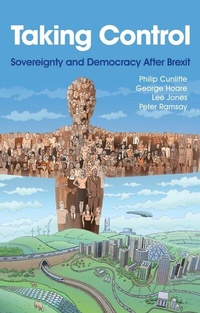
Taking Control
Description

This book makes the democratic case for national sovereignty, arguing for a radical, forward-looking reconstitution of the British nation-state through strengthening representative democracy. It is essential for anyone who wonders why British politics is so dysfunctional and who wants to do better.
More details
Other editions
Additional editions
Persons
George Hoare is an independent researcher and co-host of the Bungacast podcast.
Lee Jones is Professor of Political Economy and International Relations at Queen Mary University of London.
Peter Ramsay is Professor of Law at the London School of Economics.
The authors write about politics at thenorthernstar.online.
Content
Introduction
1 From Nation-States to Member-States
2 Voiding National Sovereignty
3 The Vote
4 Leaving the EU, Remaining in the Void
5 Constituting the Nation
6 Taking Control: Towards a Democratic Britain
References
Index
Introduction
The title of this book riffs on the famous slogan of the Vote Leave campaign in the 2016 European Union referendum: 'Take back control'. That slogan summarized a widespread feeling in 2016 that the electorate had lost any real influence over the political life of Britain as an EU member-state. Taking Control embraces the democratic impulse of Dominic Cummings' masterpiece of political communication, but its implications are very different.
Our core argument is that there can be no going 'back' to national sovereignty. Many of the old ways in which the British people once sought to control our nation-state in the days before it became an EU member-state are gone, degraded by the very experience of member-statehood. The process of leaving the EU has only served to prove the exhaustion of British politics. The demand for national sovereignty that the electorate made in 2016 therefore poses tasks that, for the most part, still lie ahead of us. Brexit was a necessary condition of real national sovereignty, but it was not sufficient to restore it.
Indeed, as we wrote this book, the British state, despite having left the EU, seemed to be as far out of the control of its people as it had ever been. From March 2020, the British people were subjected to emergency rule, authorized with barely any scrutiny or criticism by a compliant parliament in which the opposition parties' only complaint has been that restrictions on political, civil and social freedoms have not been far-reaching enough. The contingent reason for this was the COVID-19 pandemic. But, as we shall argue, the choices made by the British political elite in responding to the virus were characteristic of the political pathologies that had long afflicted Britain as a member-state of the EU, and that are all but universal across the West. The disastrous economic and public health impacts of that panicky and draconian technocratic repression will be felt for years to come. Solving these problems will require the re-engagement of the population in the political life of the nation, something that the EU was deliberately designed to frustrate.
Although the first four chapters of this book give an account of the recent past, the perspective of Taking Control is rigorously forward-looking. We discuss the nature of Britain as a member-state of the EU, the reasons why British voters voted against EU membership, and the tortured process of leaving the EU and its aftermath. But Taking Control is not an exhaustive history of Brexit. That story is told only to explain the circumstances that we find ourselves in now, so that in the last two chapters we can draw out some important lessons for those who want to find a way out of the political stagnation that accompanies EU member-statehood in Britain and beyond. Above all, we emphasize the critical importance of reviving national sovereignty if we are ever truly to take control of our lives together.
For liberals and leftists, who dominate our literary political culture, sovereignty is generally to be feared or derided. It is to be feared as the source of nationalism and war, derided as a hangover of a parochial past, out of touch with the realities of a globalized economy and a cosmopolitan worldview. We neither fear sovereignty nor hold it in contempt. We argue that it is only through embracing the challenges of sovereignty that we can solve our contemporary political malaise. National sovereignty is ultimately a question of the authority of those public institutions through which we represent ourselves as a singular people, as opposed to a multitude of atomized, fearful, mutually hostile individuals, tribes or identities. The sovereignty of the people is also necessarily the sovereignty of the nation. The political authority of the nation-state is the precondition of democracy. Sovereign nations are not necessarily democratic, but no true democracy can exist without sovereignty. Democratic sovereignty involves all kinds of conflicts, but in democracy these conflicts are addressed to the problem of how we live together on the basis of our equality, as opposed to merely policing our differences. True respect for sovereignty also means respect for the sovereignty of other peoples too, and it is the only stable basis for true internationalism and peace.
Taking Control is therefore a political book. It is about the politics of Brexit and what they tell us about our current predicament. It is not a book about the economics or sociology of Brexit, although we touch on those subjects in passing. Our subject is not merely the particular political tendencies we discuss. Above all, it is the realm of politics as such, the realm in which our conflicts of interest are raised and resolved; how that realm has failed and fallen into disrepute in the years of EU membership; and what is to be done about that. We use the experience of Brexit to shed light on the intimate connection between national sovereignty, effective political representation and democratic self-government. Here, Brexit teaches wider lessons to anyone interested in inspiring the people of their own nation to take democratic control of its affairs, especially to those in Europe who realize that advancing the cause of democracy requires them to leave the EU.
The book's first two chapters explain the anti-democratic character of the EU and how Britain was drawn into it. They also provide the conceptual grounding for the rest of the book. Chapters 3 and 4 discuss the struggle over Brexit, and what it revealed about the degraded state of Britain's national democracy. The final two chapters discuss what must happen for EU member-states to overcome the void at the heart of their politics.
In chapter 1, we investigate the nature of the EU itself. We demonstrate firstly that neither Eurosceptics nor Europhiles understand the EU for what it really is, and that both sides have good reason to misrepresent it. The EU is neither a foreign superstate that dominates its member-states from without, nor a benign democratic pooling of their sovereignty. Its intergovernmental decision and law making is the external institutional form of the internal political transformation of European states - specifically, the retreat of governing classes from representing their own domestic constituencies, and the formation of a transnational economic constitution that locks in neoliberal policies. European institutions permit national elites to look more to one another than to their fellow citizens for legitimation and support, and to evade responsibility and accountability for their policy decisions and outcomes. In other words, EU member-statehood is the form taken by the failure of representative democracy within Europe's nation-states. Member-statehood institutionalizes what Peter Mair called a 'void' between ruling elites and ordinary citizens. We contrast this political structure with that of national sovereignty, in which the state's authority derives from lawmakers' political relations with the people they claim to represent.
In chapter 2 we explain how this cosmopolitan political structure emerged in the UK context - though comparable stories could be told of the other member-states. We find the source of Britain's turn to member-statehood, and the emergence of the political void, in the decay of the British nation as a political association. In the early post-war decades, European integration was strictly limited by the strength of national democracy, with the left in particular rejecting international rule-making and championing national sovereignty in order to enact social and economic change in response to popular demands. However, the crisis of the capitalist economy in the 1970s, and the subsequent defeat of the organized working class and the political left, led to the acceptance of the Thatcherite doctrine that 'There is no alternative' to the market. This stripped democratic politics of its capacity to represent societal interests and to present contending visions of the future, denuding both social-democratic and conservative politics of their old rationales. With similar developments all over Europe, the way was open for the EU as a project of 'Thatcherism in one continent'. The British nation-state was transformed into an EU member-state, as its domestic politics were hollowed out and national sovereignty decayed from within. The EU is thereby revealed not as a new form of supranational sovereignty or statehood but rather as the means by which Europe's elites govern the void where representative politics used to be.
Chapter 3 deals with the United Kingdom's 2016 EU referendum, exploring both the reasons behind the vote to Leave, and the elite's reactions to it. We recall the dramatic political shock that the vote delivered to the British political system, and how that shock fully exposed the void between the political class and the cultural elite, on the one hand, and the wider population, on the other. Most parliamentary representatives, despite having enacted the referendum in the first place, could not bring themselves to enact the outcome. The call for it to be run again, so as to get the 'right' result, was immediate. The shock was just as great for the cultural elite and the chattering classes - the journalists, academics, think-tankers, lawyers and literati who articulate the political life of the nation, and seek to form public opinion and influence the decisions of those tasked with political representation. Their knee-jerk explanations of the vote accused the majority of...
