

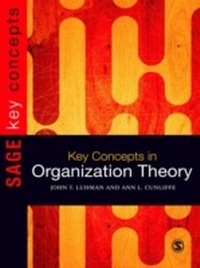
Key Concepts in Organization Theory
1st Edition
Published on 16. August 2012
192 pages
978-1-4462-9002-6 (ISBN)
Description

From agency theory to power and politics, this indispensable guide to the key concepts of organization theory is your compass as you navigate through the often complex and abstract theories about the design and functioning of organizations. Designed to complement and elucidate your textbook or reading list, as well as introduce you to concepts that some courses neglect, this historical and interdisciplinary account of the field: - Helps you understand the basics of organization theory
- Allows you to check your understanding of specific concepts
- Fills in any gaps left by your course reading, and
- Is a powerful revision tool
Each entry is consistently structured, providing a definition of the concept and why it's important to theory and practice, followed by a summary of current debates and a list of further reading. This companion will provide you with the nuts and bolts of an understanding that will serve you not just in your organization studies course, but throughout your degree and beyond.
Key concepts include: agency theory; business strategy; corporate governance; decision making; environmental uncertainty; globalization; industrial democracy; organizational change; stakeholder theory; storytelling and narrative research; technology and organization structure.
- Allows you to check your understanding of specific concepts
- Fills in any gaps left by your course reading, and
- Is a powerful revision tool
Each entry is consistently structured, providing a definition of the concept and why it's important to theory and practice, followed by a summary of current debates and a list of further reading. This companion will provide you with the nuts and bolts of an understanding that will serve you not just in your organization studies course, but throughout your degree and beyond.
Key concepts include: agency theory; business strategy; corporate governance; decision making; environmental uncertainty; globalization; industrial democracy; organizational change; stakeholder theory; storytelling and narrative research; technology and organization structure.
Reviews / Votes
'Luhman and Cunliffe have provided a glossary of organization theory terms from agency to storytelling to transaction cost economics. In doing so they provide an important resource to any course on organizations, so students can make their path through the terminological jungle. Each chapter is a rest stop on the journey, providing helpful hints, pointing out the dangers of the terrain and the safest paths to follow' -Professor David Boje
New Mexico State University
'Luhman and Cunliffe perform a valuable service, helping to capture and make accessible the richness of current organizational theory and behaviour' -
Richard J. Badham, Professor of Management
Macquarie Graduate School of Management, Macquarie University, Austrailia
More details
Series
Edition
1. Auflage
Language
English
Place of publication
London
United Kingdom
Target group
College/higher education
Product notice
Reflowable
ISBN-13
978-1-4462-9002-6 (9781446290026)
Copyright in bibliographic data and cover images is held by Nielsen Book Services Limited or by the publishers or by their respective licensors: all rights reserved.
Schweitzer Classification
Other editions
Additional editions
Ann L. Cunliffe | John Teta Luhman
Key Concepts in Organization Theory
Book
10/2012
1st Edition
SAGE Publications Ltd
€148.50
Shipment within 15-20 days
Ann L. Cunliffe | John Teta Luhman
Key Concepts in Organization Theory
Book
10/2012
1st Edition
SAGE Publications Ltd
€79.50
Shipment within 15-20 days
Persons
Ann Cunliffe is Professor of Organization Studies at the Escola de Administracao da Fundacao Getulio Vargas, Brazil and Visiting Professor at the Universita Cattolica del Sacro Cuore, Milano, Italy; Aalborg University, Denmark; and the University of Bath, UK. She previously held positions as 50th Anniversary Chair at Bradford University, UK, as Professor at the University of Leeds, UK, the University of New Mexico, USA, and California State University, USA.
Her current research interests include ethical leadership, embodied sensemaking, non-traditional qualitative research methods, and reflexive approaches to research, practice and learning. In particular, she is interested in exploring how we can engage in collaborative, responsive and ethical ways of managing organizations.
Ann's recent publications include co-editor of the Sage Handbook of Qualitative Business and Management Research Methods (2018), and articles in Organizational Research Methods, the British Journal of Management, Human Relations, and the Journal of Business Ethics. She received the 2016 Lasting Impact Award from Sage Publications for her 2004 article in the Journal of Management Education and was the 2017 CMS Division Distinguished Keynote Speaker at the Academy of Management. Ann organizes the biennial Qualitative Research in Management and Organization Conference.
Her current research interests include ethical leadership, embodied sensemaking, non-traditional qualitative research methods, and reflexive approaches to research, practice and learning. In particular, she is interested in exploring how we can engage in collaborative, responsive and ethical ways of managing organizations.
Ann's recent publications include co-editor of the Sage Handbook of Qualitative Business and Management Research Methods (2018), and articles in Organizational Research Methods, the British Journal of Management, Human Relations, and the Journal of Business Ethics. She received the 2016 Lasting Impact Award from Sage Publications for her 2004 article in the Journal of Management Education and was the 2017 CMS Division Distinguished Keynote Speaker at the Academy of Management. Ann organizes the biennial Qualitative Research in Management and Organization Conference.
Content
Introduction
Agency Theory
Alienation
Authority
Bureaucracy
Business Strategy
Complexity Science
Contested Exchange Theory
Control
Cooperativism
Corporate Governance
Decision Making
Discourse in Organizations
Environmental Uncertainty
Environment-Organization Interaction
Flexibility
Globalization
Industrial Democracy
Institutional Theory
Labor Process Theory
Life Cycle Models
Materiality
Organization Structure and Design
Organizational Change
Organizational Culture
Organizational Learning and Knowledge Management
Organizational Space
Postmodern Turn and Organization Studies
Power and Politics
Scientific Management
Stakeholder Theory
Storytelling and Narrative Research
Structuration Theory
Systems Theory
Technology and Organization Structure
Transaction Cost Economics
Agency Theory
Alienation
Authority
Bureaucracy
Business Strategy
Complexity Science
Contested Exchange Theory
Control
Cooperativism
Corporate Governance
Decision Making
Discourse in Organizations
Environmental Uncertainty
Environment-Organization Interaction
Flexibility
Globalization
Industrial Democracy
Institutional Theory
Labor Process Theory
Life Cycle Models
Materiality
Organization Structure and Design
Organizational Change
Organizational Culture
Organizational Learning and Knowledge Management
Organizational Space
Postmodern Turn and Organization Studies
Power and Politics
Scientific Management
Stakeholder Theory
Storytelling and Narrative Research
Structuration Theory
Systems Theory
Technology and Organization Structure
Transaction Cost Economics
