

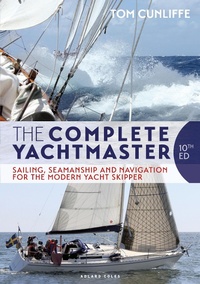
The Complete Yachtmaster
Sailing, Seamanship and Navigation for the Modern Yacht Skipper 10th Edition
10th Edition
Published on 30. September 2021
320 pages
978-1-4729-8299-5 (ISBN)
Description

The Complete Yachtmaster has been a bestseller since first publication and has established itself as the standard reference for Yachtmaster students as well as skippers of all levels of experience.
In this fully revised and up-to-date 10th edition, Tom Cunliffe brings together all the essentials of modern cruising in one volume. He presents an analysis of a good skipper, the theory and practice of sailing and sail trim, the art of seamanship, accurate navigation including chart plotters and PCs, understanding meteorology, heavy weather preparation, understanding yacht stability and coping with emergencies.
The Complete Yachtmaster builds knowledge as it builds sailing confidence, guiding examination candidates as authoritatively and reassuringly through the RYA syllabus as a sea pilot bringing a ship safely to harbour. Required reading for all skippers and budding skippers, both on board or in the classroom.
'A gem, distilled from decades of experience' Yachting Monthly
'Cunliffe's competence and authority radiate from the pages... thoroughly recommended' Little Ship Club
'There are all too few authors who not only know their subject but can write well about it. Tom Cunliffe is one' Cruising
In this fully revised and up-to-date 10th edition, Tom Cunliffe brings together all the essentials of modern cruising in one volume. He presents an analysis of a good skipper, the theory and practice of sailing and sail trim, the art of seamanship, accurate navigation including chart plotters and PCs, understanding meteorology, heavy weather preparation, understanding yacht stability and coping with emergencies.
The Complete Yachtmaster builds knowledge as it builds sailing confidence, guiding examination candidates as authoritatively and reassuringly through the RYA syllabus as a sea pilot bringing a ship safely to harbour. Required reading for all skippers and budding skippers, both on board or in the classroom.
'A gem, distilled from decades of experience' Yachting Monthly
'Cunliffe's competence and authority radiate from the pages... thoroughly recommended' Little Ship Club
'There are all too few authors who not only know their subject but can write well about it. Tom Cunliffe is one' Cruising
More details
Edition
10th edition
Language
English
Place of publication
London
United Kingdom
Publishing group
Bloomsbury Publishing PLC
Target group
Professional and scholarly
File size
105,52 MB
ISBN-13
978-1-4729-8299-5 (9781472982995)
Copyright in bibliographic data and cover images is held by Nielsen Book Services Limited or by the publishers or by their respective licensors: all rights reserved.
Schweitzer Classification
Other editions
Additional editions

Tom Cunliffe
The Complete Yachtmaster
Sailing, Seamanship and Navigation for the Modern Yacht Skipper 10th edition
Book
09/2021
10th Edition
Adlard Coles Nautical
€37.50
Article exhausted; check different version
Person
Tom Cunliffe has many years of experience cruising all round Europe and from the Caribbean to Russia and Brazil to the Arctic. He is an RYA Yachtmaster examiner and a training consultant for Sailing USA - the governing body of yachting in the USA. He is a regular columnist for Sailing Today, Classic Boat and Yachting World in the UK, and SAIL in the USA.
Content
- Cover
- Half-title
- Title
- Copyright
- Contents
- Introduction
- 1. The Skipper
- 2. The Theory of Sailing
- Sails
- 3. Efficient Sailing
- Shaping the headsail
- Shaping the mainsail
- Sail combinations
- Hull balance
- Shortening sail
- 'Code zero' sails
- Cruising chutes
- 4. Basic Seamanship Under Sail
- Tacking
- Gybing
- Poling out a genoa
- Painless sail reduction
- Heaving to
- Reefing
- Single-line reefing
- In-mast mainsails
- In-boom mainsails
- Headsail changes
- 5. Boat Handling Under Sail
- No brakes
- Wind awareness
- Tide awareness
- Sailing slowly
- Mooring under sail
- Anchoring
- Berthing
- 6. Boat Handling Under Power
- Pivoting
- Blowing off
- Rudder effect
- Propeller effects
- Moving ahead
- The set piece short turn
- Motoring astern
- Berthing
- Coming alongside
- Leaving an alongside berth
- Bow thrusters
- 7. Ropes And Ropework
- Types of rope
- Wire halyards
- Knots, splices and whippings
- Eyes and ends
- Rope handling
- Securing the yacht
- Coming alongside
- Towing
- Towing with the dinghy
- 8. Anchoring
- Holding ground
- Types of anchor
- Types of cable
- Weighting the cable
- Selecting an anchorage
- Laying an anchor
- Weighing anchor
- Fouled anchors
- Anchoring stern- or bow-to
- Kedging off
- Storm anchoring
- 9. Yacht Engines
- Basic maintenance
- Trouble shooting
- Fuel problems
- 10. Sailing In Heavy Weather
- Preparing the boat
- Sails
- Steering in waves
- Survival tactics
- 11. Navigation - An Introduction
- 12. Charts, Publications And Chart Table Tools
- Latitude, longitude and the globe
- Chart projections
- Direction
- Scale and passage requirements
- Chart symbols
- Other information on the chart
- Chart datums
- Yachting charts
- Electronic charts
- Chart corrections
- The Nautical Almanac
- Pilot books and sailing directions
- Chart table tools
- 13. Aids To Navigation
- Lighthouses
- Offshore marks
- Inshore marks
- 14. Tidal Heights
- Tide tables
- Times
- Secondary ports
- Tidal definitions
- Intermediate tidal heights
- Tidal curves
- Non-astronomical factors in tide movements
- The essence of a tidal height question
- Using tidal height calculations safely
- 15. Tidal Streams
- Tidal gates
- Tide-induced sea states
- Information on tidal streams
- 16. Traditional Navigational Inputs
- The compass
- Variation
- Deviation
- Heeling error
- Local magnetic anomalies
- Compass dip
- The log
- Depth
- 17. The Estimated Position
- Leeway
- Plotted vectors
- The tide vector
- The echo sounder
- Plotting
- The log book
- 18. Classical Position Fixing
- The eyeball fix and the position line
- Sources of position line
- Preplotting and use of ship's heading
- The running fix
- Evaluation of fixes
- 19. Satellites And Radar
- Global Positioning System (GPS)
- Chart datums
- Beyond the fix
- Electronic chart plotters
- Marine computers
- Radar
- 20. Course Shaping
- Course to steer at the turn of the tide
- The longer passage
- Leeway
- Cross-tide sailing with GPS
- 21. Navigational Strategy
- Wind, tide, light and darkness
- Wind shifts
- Beating in water free of currents
- The favoured tack
- Unpredicted wind shifts
- Anticipated wind shifts
- Beating in a cross-current
- Beating in a cross-tide
- Tacking downwind
- 22. Passage Planning
- Charts and overall distances
- Alternative destinations
- Waypoints
- Waypoint lists
- Passage planning with chart plotters
- Weather
- Tidal streams
- Traffic Separation Schemes (TSS)
- Tidal heights
- Daylight
- Fuel
- Courses to steer
- Tactics and strategy
- Pilotage plan
- 23. Pilotage
- Safe track
- Piloting with a plotter
- Forward planning
- Cockpit-mounted plotters
- 24. Passage Navigation
- The passage plan
- The passage without electronics
- The passage using GPS and a paper chart
- The passage with a plotter
- 25. Domestics Of A Passage
- Food
- Sleep
- Warmth
- Space
- Seasickness
- 26. Fog
- Maintain your plot
- Fog seamanship
- Fog tactics
- 27. Collision Avoidance In Poor Visibility
- Responsibility for lookout
- AIS
- Digital radar
- Display options
- Simple collision avoidance
- MARPA
- Top tips for radar collision avoidance
- 28. Tactics And Navigation In Heavy Weather
- Navigation in poor conditions
- 29. Damage Control
- Tool kits and spare parts
- Fire prevention and fighting
- Jury rigs
- Ropes around the propeller
- Steering failure
- Dismasting
- 30. Emergencies
- Lifeboat rescue
- Helicopter rescue
- First on the scene
- Taking to the liferaft
- Pyrotechnics
- 31. Man Overboard
- The reach-turn-reach
- Crash stop
- Bringing the casualty aboard
- Search and rescue
- 32. Weather
- The frontal depression
- Mutually exclusive air masses
- Air circulation
- Depression formation
- Depression tracks
- Frontal anatomy
- Occlusions
- Secondary depressions
- Locating a low-pressure centre
- Wind strengths in depressions
- Cyclonic winds
- Depressions in the southern hemisphere
- High pressure
- Fog
- Sea breezes
- Significant local winds
- Appendix 1: Stability in Sailing Yachts
- The GZ curve
- Appendix 2: Commercial Endorsement of the RYA/MCA Yachtmaster Certificate
- Professional practices and responsibilities (PPR)
- Index
