

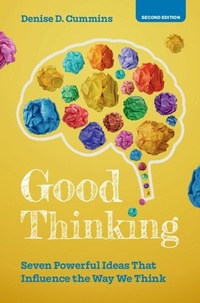
Good Thinking
Seven Powerful Ideas That Influence the Way We Think
2nd Edition
Published on 24. February 2021
978-1-108-90841-2 (ISBN)
Description

This book is for anyone who wonders whether to trust the media, seeks creative solutions to problems, or grapples with ethical dilemmas. Cognitive scientist Denise D. Cummins clearly explains how experts in economics, philosophy, and science use seven powerful decision-making methods to tackle these challenges. These techniques include: logic, moral judgment, analogical reasoning, scientific reasoning, rational choice, game theory and creative problem solving. Updated and revised in a second edition, each chapter now features quizzes for course use or self-study.
Reviews / Votes
'This book is a must-read in uncertain times. Drawing from real-life current events, Denise Cummins shows us how to apply powerful strategies to decide whether to trust what politicians and medical experts tell us, how to think clearly about ethical dilemmas, and how to overcome blocks to creative problem-solving.' Philip Fernbach, cognitive scientist and Professor of Marketing, University of Colorado at Boulder, USA, and co-author of the best-selling book The Knowledge Illusion 'This second edition could not be more timely. The volume's excellent thesis leads us to make better decisions ourselves and to understand how professionals in science, business, finance, the law, and politics should reason and make decisions. I'd recommend this book as essential reading for courses on formal methods in reasoning and decision making.' Mike Oaksford, Professor of Psychology and Head of the Department of Psychological Sciences, Birkbeck College, University of London, UK 'How can we regulate our inborn propensity to tribalism and other cognitive biases? Good Thinking provides scientifically grounded, practical knowledge to empower us to think clearly and rationally. A must-read for anyone interested in making good decisions in everyday lives.' Jean Decety, Irving Harris Distinguished Professor, University of Chicago, USA 'This book makes all revival critical thinking textbooks obsolete. It combines the best work in game theory, neuroscience, evolutionary biology, cognitive psychology, and social psychology. The use of concrete examples from political discourse magnifies its relevance. Dismantling the thinking that is threatening democracy will be difficult, but widespread adoption of this text would be a first step.' Allen Buchanan, James B. Duke Professor of Philosophy, Duke University, USA, and Professor of Philosophy of International Law, King's College London, UK 'Most educated people have learned a lot about particular domains of knowledge and have developed problem-solving skills within them. What they don't know is how that ability actually works. This book provides a fantastic tutorial to core thought modes that allow people to reflect on their thought processes. It is a valuable resource to anyone who wants to improve their reasoning.' Art Markman, Professor of Psychology, University of Texas at Austin, USA, and author of Bring Your Brain to Work, and co-host of Two Guys on Your Head 'This is a beautiful book. I am envious of the style and grace with which Cummins describes each piece of the game and how each piece fits together. Readers who immerse themselves in these ideas emerge with a priceless toolkit. How to play the game is then up to those who now have the tools.' W. Jake Jacobs, Professor of Psychology and Director of the Anxiety Research Group, USA 'Cummins has added 107 new footnotes referencing recent literature, and includes many new examples from current public life (e.g., COVID-19, Trump era public communications), making this an excellent, state-of-the-art textbook balancing thoroughness, concision, and clarity.' S. A. Mason, ChoiceMore details
Edition
2nd Revised edition
Language
English
Place of publication
Cambridge
United Kingdom
Target group
College/higher education
Edition type
Revised edition
Illustrations
Worked examples or Exercises
File size
3,12 MB
ISBN-13
978-1-108-90841-2 (9781108908412)
Copyright in bibliographic data and cover images is held by Nielsen Book Services Limited or by the publishers or by their respective licensors: all rights reserved.
Schweitzer Classification
Other editions
Additional editions
Book
03/2021
2nd Edition
Cambridge University Press
€81.80
Shipment within 15-20 days
Book
03/2021
2nd Edition
Cambridge University Press
€49.70
Shipment within 15-20 days
Content
Part I: 1. The game of logic - what follows from what; 2. Moral judgment - how we tell right from wrong; 3. Analogical reasoning - the heart and soul of insight, discovery, and genius; 4. Scientific reasoning - proving what causes what; 5. Decision-making - choosing what is most likely to give you what you most want; 6. Game theory - when you're not the only one choosing; 7. Creative problem solving - turning what you don't want into what you do want; Part II: 8. Into the weeds of logic - how it's done; 9. Into the weeds of moral judgment - how it's done; 10. Into the weeds: analogical reasoning - how it's done; 11. Into the weeds of scientific reasoning - how it's done; 12. Into the weeds rational decision-making - how it's done; 13. Into the weeds of game theory - how it's done; 14. Into the weeds of problem-solving - how it's done; Appendix A; References.
