

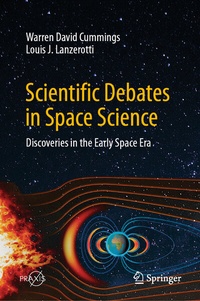
Scientific Debates in Space Science
Description

This book features several of the significant scientific debates and controversies that helped develop space science in the early space era. The debates led to significant new understandings of the constituents and processes occurring beyond Earth's atmosphere, and often opened new research directions. Scientific speculations with their resultant debates have played an important role in the development and furthering of research in general. The book thus has broad intellectual importance in illustrating how science advances.
The book includes debates in the subject areas of heliophysics (physics in the cosmic region that covers particles and magnetic fields flowing from the Sun), Earth's moon, solar system asteroids and comets, and the origin of cosmic gamma-ray bursts. A final chapter describes two important and surprising early scientific discoveries that involved no debates.
The target audience for this book includes (a) active and retired space scientists, (b) space enthusiasts, and (c) students as supplemental (or even prime) reading in an introductory astronomy and/or space science course. The topics of the debates and controversies, their resolutions, and their pointing to further research and understanding of nature are of both historical and contemporary interest, appeal, and value.
Reviews / Votes
"This book, it is highly recommended for early-career scientists. By offering a historical perspective on scientific debates, it helps young researchers develop the right attitude towards controversies and disagreements. I personally find this to be particular necessary for those who grew up in Asian cultures like myself, where harmony is emphasized and conflicts are avoided. Secondly, for senior researchers, the book serves as a reminder to remain objective during controversies." (Huixin Liu, HGSS, History of Geo- and Space Sciences, September 24, 2024)
"The authors, both well-known practitioners of the art and practice of the space sciences, provide fascinating insight into the nature and consequence of debates arising from disparities between theoretical prediction and observation, and between competing theories moderated by observation, in the early NASA era. . The value of this book to the wider historical and scientific astronomical communities." (David DeVorkin, HAD NEWS, Historical Astronomy Division of the American Astronomical Society, Issue 103, May, 2024)
More details
Other editions
Additional editions
Persons
Louis J. Lanzerotti is a Distinguished Research Professor of Physics at the New Jersey Institute of Technology. He is retired from Alcatel Lucent Bell Laboratories. He has had a long career in space research, both ground-based and satellite-based, and has one co-authored and five coeditedvolumes.
