

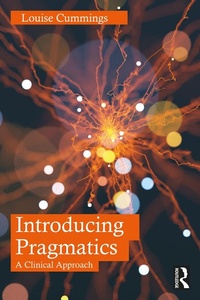
Introducing Pragmatics
A Clinical Approach
1st Edition
Published on 23. June 2023
236 pages
978-1-000-88566-8 (ISBN)
Description

This innovative, comprehensive course textbook uses a clinical approach to explore pragmatics and pragmatic language skills.
Drawing on authentic, real-life examples of pragmatic breakdown in children and adults who have developmental or acquired language disorders, Louise Cummings expertly guides readers to core insights and principles for understanding where context and meaning in human communication meet. Key features include:
Chapter-opening learning objectives and chapter-closing summaries
Authentic illustrative cases of atypical pragmatic interaction
Exercises for checking knowledge and understanding
Annotated recommended further reading
A detailed glossary of important terms in pragmatics and clinical linguistics
Aimed equally at undergraduate and graduate students who are coming to pragmatics for the first time, the text discusses the key issues and concepts of this field in a fascinating new way. With a common, easy-to-follow structure across chapters and a wealth of pedagogical resources, this is an essential text for students of linguistics and applied linguistics, communication studies, speech-language pathology, psychology and cognitive science, and beyond.
Drawing on authentic, real-life examples of pragmatic breakdown in children and adults who have developmental or acquired language disorders, Louise Cummings expertly guides readers to core insights and principles for understanding where context and meaning in human communication meet. Key features include:
Chapter-opening learning objectives and chapter-closing summaries
Authentic illustrative cases of atypical pragmatic interaction
Exercises for checking knowledge and understanding
Annotated recommended further reading
A detailed glossary of important terms in pragmatics and clinical linguistics
Aimed equally at undergraduate and graduate students who are coming to pragmatics for the first time, the text discusses the key issues and concepts of this field in a fascinating new way. With a common, easy-to-follow structure across chapters and a wealth of pedagogical resources, this is an essential text for students of linguistics and applied linguistics, communication studies, speech-language pathology, psychology and cognitive science, and beyond.
Reviews / Votes
Comprehensive, innovative, and easy-to-use, Introducing Pragmatics is an indispensable resource for scientists and students interested in how real-life pragmatic language failures shape our understanding of effective communication. Not only does the textbook contain a wealth of material on theory and experimental studies, but also wide-ranging topics from a multi-disciplinary perspective.Professor Elly Ifantidou, National and Kapodistrian University of Athens, Greece
Introducing Pragmatics: A Clinical Approach is an introductory popularization of pragmatics and clinical pragmatics, and its publication will undoubtedly help to further arouse the interest and attention of the linguistic community, especially of scholars in pragmatics, to devote their intellectual effort to pragmatic impairment. In addition, this book can steer linguists to enhance their interdisciplinary awareness and gain insights from cognitive science, speech pathology, clinical science, etc., and to seek interdisciplinary cooperation for better solutions to pragmatic disorders.
Jiegen Zhang, Australian Review of Applied Linguistics (August 2024)
By presenting a novel clinical perspective on pragmatics, this insightful volume enhances our grasp of key pragmatic concepts and principles. The in-depth analysis of
the different ways in which pragmatics can break down in children and adults makes for compelling reading.
Yulan Gong, Guangdong University of Foreign Studies, China for Discourse Studies 2025, Vol. 27(2)
More details
Edition
1. Auflage
Language
English
Place of publication
London
United Kingdom
Publishing group
Taylor & Francis Ltd
Target group
College/higher education
Illustrations
1 Tables, black and white; 2 Line drawings, black and white; 2 Illustrations, black and white
ISBN-13
978-1-000-88566-8 (9781000885668)
Copyright in bibliographic data and cover images is held by Nielsen Book Services Limited or by the publishers or by their respective licensors: all rights reserved.
Schweitzer Classification
Other editions
Additional editions
Book
06/2023
1st Edition
Routledge
€206.40
Shipment within 10-20 days
Book
06/2023
1st Edition
Routledge
€61.60
Shipment within 10-20 days
Person
Louise Cummings is Professor in the Department of English and Communication at the Hong Kong Polytechnic University, Hong Kong. She is author or editor of many books, including Pragmatic Disorders, Clinical Linguistics, Clinical Pragmatics, The Cambridge Handbook of Communication Disorders, Pragmatics: A Multidisciplinary Perspective and The Routledge Pragmatics Encyclopedia. She is also Editor of the Routledge Research in Speech-Language Pathology book series.
Content
Acknowledgements
Preface
Introduction
Chapter 1: Speech acts
1.1 Introduction
1.2 How to realise a speech act
1.3 A new approach to meaning
1.4 Happy and unhappy performatives
1.5 Explicit and implicit performatives
1.6 Saying and doing
1.7 Searle on speech acts
1.8 Indirect speech acts
Suggestions for further reading
Questions
Chapter 2: Implicatures
2.1 Introduction
2.2 Grice and the cooperative principle
2.3 The cooperative principle and implicatures
2.4 Types of implicature
2.5 Properties of implicatures
2.6 Relevance theory
Suggestions for further reading
Questions
Chapter 3: Presuppositions
3.1 Introduction
3.2 The economic rationale for presupposition
3.3 Presupposition triggers
3.4 Properties of presuppositions
3.5 Presuppositions in the real world
Suggestions for further reading
Questions
Chapter 4: Deixis
4.1 Introduction
4.2 Person and social deixis
4.3 Place deixis
4.4 Time deixis
4.5 Discourse deixis
4.6 Anaphora
Suggestions for further reading
Questions
Chapter 5: Figurative language
5.1 Introduction
5.2 Idioms
5.3 Metaphors
5.4 Irony
5.5 Hyperbole
5.6 Proverbs
Suggestions for further reading
Questions
Chapter 6: Politeness
6.1 Introduction
6.2 Brown and Levinson on politeness
6.3 Politeness and face in clinical settings
6.4 Criticisms of Brown and Levinson
Suggestions for further reading
Questions
Chapter 7: Topic management
7.1 Introduction
7.2 Topic management in clinical settings
7.2.1 Topic selection
7.2.2 Topic introduction
7.2.3 Topic development
7.2.4 Topic termination
7.3 Analysing topic management in conversation
7.4 Analysing topic management in narration
Suggestions for further reading
Questions
Chapter 8: Clinical pragmatics
8.1 Introduction
8.2 The communication cycle
8.3 Cognition and the communication cycle
8.4 Theory of mind
8.5 Executive function
Suggestions for further reading
Questions
Answers
Glossary
Bibliography
Index
Appendix
Preface
Introduction
Chapter 1: Speech acts
1.1 Introduction
1.2 How to realise a speech act
1.3 A new approach to meaning
1.4 Happy and unhappy performatives
1.5 Explicit and implicit performatives
1.6 Saying and doing
1.7 Searle on speech acts
1.8 Indirect speech acts
Suggestions for further reading
Questions
Chapter 2: Implicatures
2.1 Introduction
2.2 Grice and the cooperative principle
2.3 The cooperative principle and implicatures
2.4 Types of implicature
2.5 Properties of implicatures
2.6 Relevance theory
Suggestions for further reading
Questions
Chapter 3: Presuppositions
3.1 Introduction
3.2 The economic rationale for presupposition
3.3 Presupposition triggers
3.4 Properties of presuppositions
3.5 Presuppositions in the real world
Suggestions for further reading
Questions
Chapter 4: Deixis
4.1 Introduction
4.2 Person and social deixis
4.3 Place deixis
4.4 Time deixis
4.5 Discourse deixis
4.6 Anaphora
Suggestions for further reading
Questions
Chapter 5: Figurative language
5.1 Introduction
5.2 Idioms
5.3 Metaphors
5.4 Irony
5.5 Hyperbole
5.6 Proverbs
Suggestions for further reading
Questions
Chapter 6: Politeness
6.1 Introduction
6.2 Brown and Levinson on politeness
6.3 Politeness and face in clinical settings
6.4 Criticisms of Brown and Levinson
Suggestions for further reading
Questions
Chapter 7: Topic management
7.1 Introduction
7.2 Topic management in clinical settings
7.2.1 Topic selection
7.2.2 Topic introduction
7.2.3 Topic development
7.2.4 Topic termination
7.3 Analysing topic management in conversation
7.4 Analysing topic management in narration
Suggestions for further reading
Questions
Chapter 8: Clinical pragmatics
8.1 Introduction
8.2 The communication cycle
8.3 Cognition and the communication cycle
8.4 Theory of mind
8.5 Executive function
Suggestions for further reading
Questions
Answers
Glossary
Bibliography
Index
Appendix
