

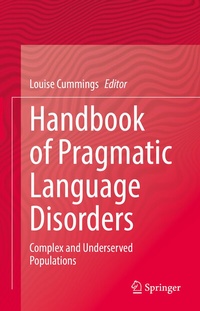
Handbook of Pragmatic Language Disorders
Description

This reference work is the first to examine pragmatic language disorders of clients in complex and underserved populations. In chapters written by a range of experts, the unique pragmatic language skills of clients are examined, allowing for a broad overview. The text gives focus to client groups with complex cognitive and psychiatric problems and children and adults that have been underserved by clinical language services because of maltreatment and social exclusion. Pragmatic disorders are examined in children with sensory loss, children who have been exposed to HIV and substance abuse, and adults with Huntington's disease and other complex neurodegenerative pathologies. This Handbook is an essential reference for researchers and clinicians in speech-language pathology, linguistics, psychology, and education.
More details
Other editions
Additional editions
Person
Louise Cummings is Professor in the Department of English and Communication and Associate Dean for Research in the Faculty of Humanities at The Hong Kong Polytechnic University. She teaches and conducts research in pragmatics, clinical linguistics and public health. Publications in these areas include Language and Dementia (Cambridge University Press, 2020), Fallacies in Medicine and Health (Palgrave Macmillan, 2019), Reasoning and Public Health (Springer, 2015), and Pragmatic Disorders (Springer, 2014).
Content
Preface.- Acknowledgements.- Biographical notes.- Chapter 1: Pragmatic disorders in the 21 st century.- PART A: COMPLEX POPULATIONS IN CHILDHOOD.- Chapter 2: Social (pragmatic) communication disorder.- Chapter 3: Autism spectrum disorder.- Chapter 4: Fragile X syndrome.- Chapter 5: Down syndrome.- Chapter 6: Williams syndrome.- Chapter 7: 22q11.2 deletion syndrome.- Chapter 8: Tourette's syndrome.- Chapter 9: Sensory loss.- Chapter 10: Selective mutism.- Chapter 11: Attention deficit hyperactivity disorder.- PART B: COMPLEX POPULATIONS IN ADULTHOOD.- Chapter 12: Right-hemisphere language disorder.- Chapter 13: Psychiatric disorders.- Chapter 14: Dementia of the Alzheimer type.- Chapter 15: Parkinson's disease.- Chapter 16: Multiple sclerosis.- Chapter 17: Amyotrophic lateral sclerosis.- Chapter 18: Huntington's disease.- Chapter 19: Traumatic brain injury.- PART C: UNDERSERVED POPULATIONS.- Chapter 20: Infants and children adopted internationally.- Chapter 21: Infants and children exposed to HIV and substance abuse.- Chapter 22: Maltreated and traumatized children and young people.- Chapter 23: African American children and adolescents.- Chapter 24: Children and young people with written language disorders.- Chapter 25: Children, young people and adults who use AAC.- Chapter 26: Adults in the prison population.- Index.
