

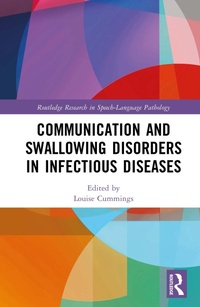
Communication and Swallowing Disorders in Infectious Diseases
1st Edition
Published on 12. May 2026
290 pages
978-1-040-53841-8 (ISBN)
Description

This book examines communication and swallowing disorders in the context of infectious diseases.
The COVID-19 pandemic brought infectious disease to prominence in speech-language pathology. But the SARS-CoV-2 virus is only the latest pathogen in a long list of viruses, bacteria, parasites, and fungi that can compromise communication and swallowing in children and adults. This volume examines several infectious diseases that are known to disrupt speech, language, voice, hearing, and swallowing. These diseases include HIV; herpes simplex virus; cytomegalovirus; Zika virus; human papilloma virus; COVID-19; streptococcus; candidiasis; syphilis; and tuberculosis. Each chapter examines a different infectious disease and discusses its epidemiology, onset, clinical course, and, where relevant, neurological sequelae. The impact of infectious diseases on speech, voice, hearing, language, and swallowing is the focus of each chapter. Chapters also address assessment and treatment considerations in this diverse clinical population.
This book is suitable reading for students, clinicians, and researchers in speech-language pathology, audiology, psychology, education, pediatric medicine, neurology, and ENT medicine.
The COVID-19 pandemic brought infectious disease to prominence in speech-language pathology. But the SARS-CoV-2 virus is only the latest pathogen in a long list of viruses, bacteria, parasites, and fungi that can compromise communication and swallowing in children and adults. This volume examines several infectious diseases that are known to disrupt speech, language, voice, hearing, and swallowing. These diseases include HIV; herpes simplex virus; cytomegalovirus; Zika virus; human papilloma virus; COVID-19; streptococcus; candidiasis; syphilis; and tuberculosis. Each chapter examines a different infectious disease and discusses its epidemiology, onset, clinical course, and, where relevant, neurological sequelae. The impact of infectious diseases on speech, voice, hearing, language, and swallowing is the focus of each chapter. Chapters also address assessment and treatment considerations in this diverse clinical population.
This book is suitable reading for students, clinicians, and researchers in speech-language pathology, audiology, psychology, education, pediatric medicine, neurology, and ENT medicine.
More details
Series
Edition
1. Auflage
Language
English
Place of publication
London
United Kingdom
Publishing group
Taylor & Francis Ltd
Target group
Professional and scholarly
Illustrations
18 Tables, black and white; 6 Line drawings, black and white; 6 Halftones, black and white; 12 Illustrations, black and white
File size
4,54 MB
ISBN-13
978-1-040-53841-8 (9781040538418)
Copyright in bibliographic data and cover images is held by Nielsen Book Services Limited or by the publishers or by their respective licensors: all rights reserved.
Schweitzer Classification
Other editions
Additional editions
Louise Cummings
Communication and Swallowing Disorders in Infectious Diseases
Book
05/2026
1st Edition
Routledge
€193.50
Shipment within 10-20 days
Person
Louise Cummings is Adjunct Professor at the Hong Kong Polytechnic University and Visiting Professor at York St John University in the UK.
Content
Preface Louise Cummings, PART I: Speech, voice, and swallowing disorders 1. Speech and swallowing in adults with oropharyngeal cancer related to human papillomavirus Sinead Rothrie, Kate Baker, Kate Ashforth and Grainne Brady 2. Voice disorders in adults with laryngeal tuberculosis Andrea Migliorelli, Marianna Manuelli, Andrea Ciorba, Stefano Pelucchi, and Chiara Bianchini 3. Laryngeal dystonia and upper respiratory tract infections Lisa A. Vinney and Maia Braden 4. Voice disorders in recurrent respiratory papillomatosis Lindsey A. Parker and Melda Kunduk 5. Stuttering and Group A streptococcal infections Per A. Alm 6. Candidiasis in adults with swallowing disorders Simple Futarmal Kothari, Lene Odgaard, and Mohit Kothari PART II: Hearing and language disorders 7. Hearing loss in children with congenital Zika virus infection Milaine Dominici Sanfins, Adriana Neves de Andrade Daniela Gil, and Piotr Henryk Skarzynski 8. Hearing loss in children with congenital syphilis Ryan Rochat 9. Hearing loss in children with congenital cytomegalovirus Ryan Rochat and Gail J. Demmler-Harrison 10. Language disorders in adults with herpes simplex virus encephalitis Simone Mangelsdorf-Collett, Camille Paynter, Wendy Kelso, and Dennis Velakoulis 11. Language disorders in adults with COVID-19 Louise Cummings 12. Language disorders in children with HIV infection Dorian Lee-Wilkerson, 13. Language disorders in adults with human immunodeficiency virus Lorena Abusamra, Barbara Sampedro,and Valeria Abusamra Index
