

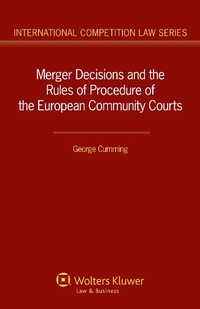
Merger Decisions and the Rules of Procedure of the European Community Courts
Published on 22. November 2011
464 pages
978-90-411-4286-3 (ISBN)
Description

Article 340 TFEU, which provides a method of compensation for victims of the Commission's errors, is invoked as the basis for actions against Commission decisions under the Merger Control Regulation. Accordingly, the rules of procedure of the Community Courts come into play. This probing analysis asks the important questions: What limits can be imposed on the discretion of the Community Courts acting within their own rules of procedure? Is the manner in which the Court of Justice interprets those rules sufficient? Focusing on the crucial Court responsibilities of investigating facts and assessing economic damage in relation to the type of non-contractual liability apparent in antitrust cases, the author convincingly demonstrates that the scope for 'case management' by the Courts is strictly limited, and may engender information or evidentiary deficits that contravene ECHR Art 6.1 as well as the principles of effective judicial protection and rectitude of decision. A claim for compensation pursuant to Art 340 TFEU may be struck merely because the basic elements of the cause of action cannot be established to a minimal level.
More details
Other editions
Additional editions
Book
12/2011
1st Edition
Kluwer Law International
€285.23
Shipment within 10-20 days
Content
- Intro
- Title Page
- Copyright Page
- Contents
- Acknowledgements
- Introduction
- Chapter 1 Summary of Objectives of the Analysis
- 1. Summary of Objectives of the Analysis
- 2. Principles to be used in this Analysis
- 2.1. Article 6(1) ECHR: The Absolute Right to Due Process and the Derived Right of Access to a Court
- 3. Rectitude of Decision
- 3.1. Effective Judicial Protection
- 4. Judicial Control of the Express and the Derived Rights of Article 6(1) ECHR
- 4.1. Conformity with ECHR Article 6.1
- 4.2. The Derived Right of Access to a Court Pursuant to Article 6(1)
- 4.3. Procedural Restrictions on Article 340(2) TFEU and Compliance with Article 6(1) ECHR, Rectitude of Decision and Effective Judicial Protection
- 4.3.1. Substantive Scope of Article 340(2) TFEU
- 4.3.2. The Nature of the procedurally based restrictions on Article 340(2) TFEU
- 4.4. The Merger Control Regulation and Article 6(1) ECHR
- 4.5. Article 6(1) ECHR and the Commission Procedure
- 4.6. Difficulties Caused by the Rules of Procedure of the GC and the ECJ
- 5. Theoretical Context of the Analysis
- 5.1. Absence of an Active Duty to Ensure Case Management
- 6. Automec: Admissibility of the Claim Damages
- 7. The Obligation to Manage Cases Actively
- 8. Court Experts and Expert Opinion
- 9. Conclusion of the Introduction
- Chapter 2 Civil Procedure Rules of the ECJ and the GC
- 1. Introduction
- 2. Rules of Civil Procedure
- 2.1. Basic Elements of the Rules of Pleading
- 2.2. Analysis of the ECJ and GC Rules of Pleading
- 2.3. Case Law Dealing with Pleadings in the ECJ and GC
- 3. Principles of Procedure
- 4. Contrast with the CPR and the CAT Rules of Procedure
- 4.1. CAT Rules of Pleading
- 5. Consequences of the Use of Imprecise Rules of Pleading on Internal Rules
- 6. Breach of Article 6(1) ECHR, of Rectitude of Decision and Effective Judicial Protection
- 6.1. Summary of the Non-compliance:
- 6.2. Violation of the Article 6(1) ECHR
- 6.3. Violation of the Principle of Effective Judicial Protection
- 6.4. Violation of the Principle of Rectitude of Decision
- 7. Additional Problems: Problems with Lack of Enforcement Powers
- Chapter 3 Lack of Obligation for Active Case Management
- 1. Infringement by the Rules of the GC and the ECJ
- 1.1. Definition of Case Management
- 2. Case Management in the Civil Procedure Rules (CPR)
- 3. Competition Appeal Tribunal (CAT) Rules
- 4. The First Case Management Conference: Planning the Case
- 4.1. Part of a Process of Active Case Management
- 4.2. Rules of Case Management in the GC
- 4.3. Analysis of the Rules of Civil Procedure and their Violations
- 4.4. Rectitude of Decision
- 4.4.1. Analysis of Cases
- 4.4.1.1. Rules of Procedure: Measures of Inquiry
- 4.4.2. Cases Relevant to Dismissal
- Chapter 4 Analysis of Cases
- 1. Introduction: Expert Evidence
- 2. The Rules of procedure dealing with Expert Evidence
- 2.1. Rules of the ECJ
- 2.2. Considerations of Expert Evidence in English Law
- 3. Expert Opinion: The Substantive Scope Therefore
- 3.1. Scope of Expert Evidence as Regards the ECJ and GC
- 3.2. Purpose or Reason for the Use of Expert Evidence
- 3.3. Conclusion as to Scope of Evidence in EU Law
- 4. Consequences of the Restrictions upon the Appointment of an Expert
- 4.1. Initial Restrictions
- 4.2. Alternative Classification of the Restrictions
- 4.3. Costs and the Use of Expert Evidence
- 5. The Breach of Article 6(1) ECHR
- 5.1. The Restriction Based upon the Strength of the Substantive Case
- 5.2. Analysis of Additional Restrictions upon the Commissioning of an Expert's Report
- Chapter 5 Conclusion
- 1. Overview of the Salient Points
- 1.1. Comparative Law and the Procedural Deficits of the ECJ and the GC
- 1.2. Need for Active Case Management, Clearer Rules of Pleading Particulars of Fact and Wider Discretion to Commission Experts Reports
- 1.3. Separation of the Adjudicative and the Investigatory Roles
- Appendix 1
- Appendix 2
- Appendix 3
- Appendix 4
- Appendix 5
- Bibliography
- Index
