

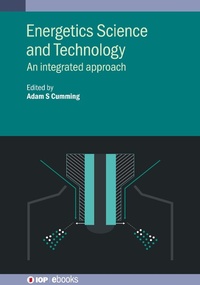
Energetics Science and Technology
Description

This research and reference text demonstrates how the science of energetic materials technology can and should link various technologies in the physical sciences to provide an integrated approach to this interdisciplinary field. The approach covers physics, chemistry, materials science, theory and modelling, and will help the discipline to adapt to future needs and research.
The book provides a coherent and detailed study of what is possible and indeed necessary for effective solutions for energetic materials and systems, including present and future needs. It includes the integration of modelling based on sound theory and validated experiments. The approach also covers the design and nature of energetic materials in both molecular and crystalline states, including formulation, processing, assessment, modelling, vulnerability, life assessment and management, environmental constraints, safety and disposal, with consideration of future needs.
Energetics technology is a fragmented research area and there is a strong need for a book that provides an interdisciplinary view and introduces the topics along with the connections between them. This book meets this need, encourages interdisciplinary research in the field and is invaluable for researchers in the area of energetic materials.
More details
Other editions
Additional editions

Person
Professor Adam Cumming has over 40 years of experience in energetic materials research. He is an established world expert in the field with current interests in environmental issues and the design of new materials. From 1976-2014, he provided technical advice within the UK Ministry of Defence, where he managed several international research activities. Since 2013, he has been an honorary professor in the School of Chemistry at the University of Edinburgh.
Content
1. Introduction: formulation design-an integrated approach
2. From raw ingredients to energetic materials
3. Crystal form and morphology
4. Application of machine learning and artificial intelligence methods to energetics science and technology
5. The impact of acoustic resonance mixing on the production of solid propellants and explosives
6. Reducing vulnerability and insensitive munitions
7. Ignition and detonation in energetic materials: an introduction
8. Submillimetre spatially resolved observation of detonation phenomena
9. A traditional approach to munition life management
10. Improved systematic life management of munitions
11. Recursive molecular similarity (R.Mo.S): an innovative algorithm for selecting a subset useful for toxicology prediction
12. Sustainable energetic materials
13. Sustainable disposal solutions for weapons, ordnance, munitions, and explosives (WOME)
14. Small-calibre gun propellants
15. Recent advances in solid and hybrid rocket propulsion
16. Current trends in liquid and gel rocket propulsion
17. Recent progress in the development of less toxic pyrotechnic smoke compositions for military applications
