

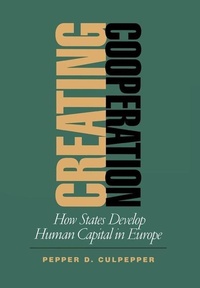
Creating Cooperation
How States Develop Human Capital in Europe
1st Edition
Published on 5. July 2018
264 pages
978-1-5017-2362-9 (ISBN)
Description

In Creating Cooperation, Pepper D. Culpepper explains the successes and failures of human capital reforms adopted by the French and German governments in the 1990s. Employers and employees both stand to gain from corporate investment in worker skills, but uncertainty and mutual distrust among companies doom many policy initiatives to failure. Higher skills benefit society as a whole, so national governments want to foster them. However, business firms often will not invest in training that makes their workers more attractive to other employers, even though they would prefer having better-skilled workers.Culpepper sees in European training programs a challenge typical of contemporary problems of public policy: success increasingly depends on the ability of governments to convince private actors to cooperate with each other. In the United States as in Europe, he argues, policy-makers can achieve this goal only by incorporating the insights of private information into public policy. Culpepper demonstrates that the lessons of decentralized cooperation extend to industrial and environmental policies. In the final chapter, he examines regional innovation programs in the United Kingdom and the clean-up of the Chesapeake Bay in the United States-a domestic problem that required the coordination of disparate agencies and stakeholders.
More details
Series
Language
English
Place of publication
NY
United States
Target group
College/higher education
Professional and scholarly
Edition type
Digital original
Illustrations
1 chart, 20 tables
1 chart, 20 tables
ISBN-13
978-1-5017-2362-9 (9781501723629)
Copyright in bibliographic data and cover images is held by Nielsen Book Services Limited or by the publishers or by their respective licensors: all rights reserved.
Schweitzer Classification
Other editions
Additional editions
Book
12/2002
Cornell University Press
€79.23
Shipment within 10-20 days
Person
CulpepperPepper D.:
Pepper D. Culpepper is Assistant Professor of Public Policy at the Kennedy School of Government, Harvard University. He is coeditor of The German Skills Machine: Sustaining Comparative Advantage in a Global Economy.
Pepper D. Culpepper is Assistant Professor of Public Policy at the Kennedy School of Government, Harvard University. He is coeditor of The German Skills Machine: Sustaining Comparative Advantage in a Global Economy.
Content
- Cover
- Creating Cooperation
- Title
- Copyright
- Dedication
- Contents
- Preface
- Abbreviations
- 1. The Political Problem of Decentralized Cooperation
- 2. Relational Information and Embedded Policy-Making
- 3. Employers, Public Policy, and the High-Skill Equilibrium in Eastern Germany and France
- 4. Embedded Policy-Making and Decentralized Cooperation in Eastern Germany
- 5. French Policy Failure and the Surprising Success of the Valley of the Arve
- 6. Private Puzzling and Public Policy
- Appendix A. Issues of Measurement
- Appendix B. Training Results from the Firm Sample
- Appendix C. Interview Sources
- References
- Index
