

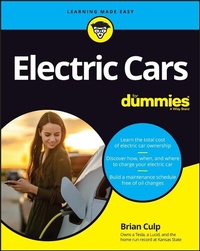
Electric Cars For Dummies
Description

With falling cost of ownership, expanded incentives for purchasing, and more model and body type options than ever, it may finally be time to retire the old gas-guzzler and dive into the world of electric car ownership. Electric Cars For Dummies is your guide to becoming lightning powered, reducing your carbon footprint, and saving money on gas while you do it. This book teaches you how to select the battery-charged vehicle that fits your need and budget. It also offers insight into how to maintain your electric car, including answering all your questions about charging your vehicle. Calculate the total cost of ownership, prep your home to become one huge charger, and demystify the battery, the tune-ups and more.
* Learn the difference in cost of ownership and emissions between electric and gas-powered vehicles
* Explore your options and find an electric car that fits in your budget
* Know when and how to charge your vehicle, and what kind of maintenance it needs
* Figure out how to charge your car on the go
This is the perfect book for new and would-be electric car owners looking for guidance on buying and maintaining one of these super sleek machines.
More details
Other editions
Additional editions
Person
Content
Part 1: Getting In On the Popularity of Electric Cars 7
Chapter 1: So You're Thinking About Buying an Electric Car 9
Chapter 2: The Fascinating Tech That's (Sort of) Under the Hood 37
Chapter 3: Electric Vehicles and a Safer Drive 59
Part 2: Buying Wisely 87
Chapter 4: Consider the Cost (of an Electric Vehicle) 89
Chapter 5: Researching Your EV Options 109
Chapter 6: Buying Your New Electric Car 155
Part 3: Maintaining Your Newfangled Horseless Carriage 181
Chapter 7: Charge 'Er Up! 183
Chapter 8: Protecting the Battery (and Your Investment) 207
Chapter 9: Keeping Your Car in Top Shape 231
Part 4: Futurethink and Fun with EV Engineering 259
Chapter 10: Faster, Farther, and More Fun 261
Chapter 11: Our Autonomous Future 289
Chapter 12: Other Vehicles That Are Going Electric 311
Chapter 13: The Best Car Is No Car: Electric Bikes and the Morning Commute 333
Part 5: The Part of Tens 351
Chapter 14: Ten Countries Leading the Way -- and What They're Doing 353
Chapter 15: Ten Companies Leading the Way -- and a Look at What They're Doing 361
Chapter 16: Ten Predictions from EV Insiders (with Plenty of Commentary and Opinion Because It's My Book There, Bub) 369
Index 379
Introduction
So you're thinking about buying an electric car?
Congrats!
You've come to the right place. Also, you've come to the right person, or at least I think you'll agree that's the case by the time you're done reading this intro. (Oh, and note to self: That first intro sentence might make a great chapter title.)
I won't hold it against you if you skip ahead right now to start getting answers to questions about vehicle range, charging, and cost of operation, especially when compared to internal combustion vehicles.
Don't worry. By the end of this book, you'll have explored almost every topic that someone new to electric cars might have on their mind. You'll get up close and personal with some fascinating engineering and future-looking topics, like why electric cars go so damn fast, why they tend to be much safer, what to expect in terms of battery longevity, and how and why the car you buy today is likely to improve over time.
Along with the topics covering the purchase and ownership experience - information especially relevant if you're new to the idea of electric cars - you can find a wealth of ancillary material about everything from autonomous driving, regen braking, electric trucks and bikes, all the way to suggestions about YouTubers that would be worth a follow as you continue down the electrification rabbit hole.
I'll even work in an anecdote about the Norwegian pop band A-ha and how their lead singer fits into humanity's movement toward electric transportation. Trust me: It'll make sense once we get there.
Most of all, here's what I want you to know about the person writing about the current landscape of electric vehicles - a confession that should provide some insight into your tour guide's brain.
I'm not really a car guy.
Instead, I'm more of an easier-way-to-get-from-point-A-to-B guy. I'm also an amazed-at-what-human-ingenuity-has-been-able-to-pull-off-and-we're-just-getting-started guy.
Here's what I mean: We humans are amazing creatures. Of course, plenty of said humans vex and frustrate on the daily, but to get a sense of what I'm talking about, simply look up the next time you're out for a drive.
When you pause to glance toward the horizon, you're likely to see majestic buildings of glass and rock and steel. You might see a metal tube hovering in midair, carrying people from one cluster of buildings to another cluster half a world away. You might see bridges spanning otherwise uncrossable bodies of water. You might notice towers carrying currents of electricity. These currents are capable of making toast, or lighting up the dark, or powering massive cars and trains. You might notice other towers that can send more information than a single human can read in a lifetime into the palm of your hand - all in a matter of seconds.
Amazing. More amazing still? We've made all these things by digging them out of the mud.
I'm a technical writer at Lucid Motors, a relatively new company that manufactures electric-only vehicles. My wife is a software engineer at Tesla Motors, another relatively new company that only makes electric vehicles (EVs, for short). We also drive these very same vehicles, having begun our journey of EV ownership starting in 2018. What I've realized over the past couple of years, however, is that the most important part of all the astounding things humans make - all the buildings and bridges and phones and planes - isn't the glass, steel, rubber, or silicon. Not by a long shot.
So, what is the most important part?
Information.
At its core, an electric vehicle - as it is with a laptop, suspension bridge, or life-saving medical implant - is an idea. All these inventions, along with everything else that humans have plucked out of the mud, have started with, and are perpetuated by, someone putting an idea on a page.
What makes my job so fulfilling is that I get to be part of a team that captures Lucid's idea for electric transportation. This idea is bigger and more enduring than any one man or woman. In fact, it's bigger than any one company. Lucid and Tesla and everyone else builds its electric vehicles by leveraging ideas that have been around for over a century.
The idea of an electric vehicle can therefore be revised, enhanced, or added to. Complementary technologies can converge for a multiplier effect. A more efficient motor can make use of a denser battery pack, which can increase car range and reduce costs, which can result in more EV purchases, which can incentivize further electric motor improvement - a true virtuous cycle of innovation.
Over time, the superfluous or useless can be cast aside while the better parts endure. Because the most important part of a good idea is that it survives, that the idea is passed from group to group, from generation to generation, and that those who succeed us will make the idea their own.
That's my mindset as we begin: I get to capture and present the ideas surrounding electric transportation as I think most directly relates to you, and I couldn't be more excited about this opportunity. I'll do the best I can to present the same kinds of information I've been exposed to over the past several years that have left me, a non-car guy, so enthusiastic about the future of electric mobility, and in turn cautiously optimistic about the future of humankind.
So buckle up, adjust the seats and mirrors, and prepare for an exhilarating ride as we take the idea of electric vehicles out for a spin.
About This Book
Books in the For Dummies brand are organized in a modular, easy-to-access format that lets you use the book more or less the way you would an owner's manual for a car. I guess the conceptual difference is that, rather than serve as the owner's manual for one EV, this is an owner's manual for any EV.
Because electric transportation is a spectrum of topics, and each of these topics is relevant at different stages of the electric-car-ownership experience, you can think of this book as a road map or guidebook to several of the considerations facing electric-car purchase and operation. Some of the topics, for example, are most relevant when considering an EV for the first time. On the other hand, some are more relevant after having owned an EV for a few months. Others still are of interest when thinking about your next EV.
This book's chapters are organized to first address common questions and concerns about EV ownership and then to move to more in-depth considerations. For example, Chapter 3 addresses questions of EV safety; everyone wants a safe vehicle - whether it's powered by batteries, hydrogen, or a flux capacitor - and Chapter 3 talks about just how safe most of today's electric vehicles are.
Still, it's not critical that you read the book from cover to cover in the chapter order presented. (I do, however, think you'll enjoy experiencing the book in its entirety.) You suffer no penalty for heading directly to concepts that interest you the most, although there's a chance you might need to jump to earlier chapters to review basic ideas or gain foundational context. I guess the penalty may be a cognitive one.
Anyway, web addresses, which are cited frequently as sources, appear in their own distinctive font. If you're reading a digital version of this book on a device connected to the Internet, you can click a web address to visit that website, like this: www.dummies.com.
Foolish Assumptions
For one existential reason above all others, I'd argue that the idea of electric transportation is relevant to nearly every human on the planet today - especially to those humans who are either too young to research electric vehicles or who may not have the financial wherewithal to purchase a personal vehicle.
That said, I'm working on the assumption that at least 95 percent of readers drawn to this title are now driving some kind of internal combustion engine (ICE) vehicle and are considering purchasing an EV as their next car, which I also assume will be sometime in the next three to six months.
A subset within that group of 95 percent may not be interested in an EV anytime soon, but may instead be looking for a single source of information about electric vehicles that will satisfy their curiosity without having to spend hours sifting through a trove of articles. Rest assured, I've done the research so that you don't have to. If this describes you, this book should do a very good job of addressing questions like these: "What's all this EV fuss about, anyway?" "Should I install upgraded electrical service in the garage of the house I rent out on Airbnb?" "My pension plan has a stake in three EV makers - is that gonna be good or bad for my retirement plans?"
For the other 5 percent: Why are you reading? I'd be curious to know, so feel free to drop me a line. My personal email is: hmsbrian@gmail.com.
Icons Used in This Book
As you make your way through this book (if that's how you're reading it), you see the following icons in the margins:
The Tip icon marks bits...
