

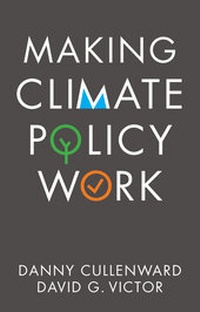
Making Climate Policy Work
Description

Danny Cullenward and David Victor show how the politics of creating and maintaining market-based policies render them ineffective nearly everywhere they have been applied. Reforms can help around the margins, but markets' problems are structural and won't disappear with increasing demand for climate solutions. Facing that reality requires relying more heavily on smart regulation and industrial policy - government-led strategies - to catalyze the transformation that markets promise, but rarely deliver.
More details
Other editions
Additional editions
Persons
David G. Victor is Professor of International Relations at the School of Global Policy and Strategy at UC San Diego. He co-heads the initiative on energy and climate at the Brookings Institution.
Content
Preface
We are two scholars who have spent nearly all of our professional lives intersecting with the problem of climate change. For Danny, that has meant a career at the nexus of law, economics, and engineering, looking at how energy systems might evolve in the future. For David, that has meant a career trained in political science and focused on how industrial transformations actually occur. When you spend this much time on one big issue that keeps getting worse, you live a life of constant reminder that the climate problem is really hard to solve.
Realism about the scale of the challenge is often discouraged in climate policy circles because it is easy to confuse with pessimism. Precisely because the climate problem has proven so stubborn, the whole ecosystem of climate activism and scholarship spends a lot of time painting stiff smiles on inconvenient facts. Yet any serious analysis must start by understanding climate solutions for what they are: requirements for profound industrial change that are difficult to initiate, sustain, and run to completion. The river of industrial investment and climate pollution runs deep and fast with powerful incumbents. Elements of change are becoming visible, but most to date are minnows swimming against that strong current.
This level of difficulty, we think, is a call not for pessimism but for realism about solutions. Because it is so hard to make deep cuts in global emissions - deep decarbonization, as it is called - effective solutions require clear thinking and strategy. Efforts spent tilting at ephemeral, magical policy solutions waste scarce resources that should instead be invested in things that work.
For the last decade, both of us have observed a rapidly growing disconnect between the solutions that are most popular among policy and academic elites and the facts on the ground. Conventional wisdom in elite circles holds that market-based solutions work best; decades of policy advocacy and design within this paradigm have produced a network of fledgling cap-and-trade systems that portend to lay foundations for solutions. In a few places, carbon taxes have emerged as well. These pockets of market-based action have been created, in part, with the belief that they will spread - ultimately to global coverage and with big leverage on emissions. The realities are different, however. Those who are watching closely know those promises are largely failing and, we argue, will continue to fail.
What drew us together as collaborators is that while both of us are rooted in academia - and thus steeped in debates around which policy instruments are best from the perspective of theory - we spend much of our professional lives elsewhere. We work with governments, regulators, NGOs, firms, and investors - institutions whose leaders are all grappling in practical terms with the challenges of deep decarbonization. Everyone is asking about the theory of change. "What moves the needle?" is a common refrain. Outside of the academy we see policymakers and CEOs talking a lot about market-based strategies to address climate change. Yet when they actually do something that moves the needle - such as adopt a policy that makes a big dent in emissions, redirect investment toward low-carbon solutions, or craft a business strategy based on the reality that deep cuts in emissions are essential - they make those choices without much attention to abstract market forces such as carbon pricing. Rather, they respond to policy and political pressures rooted in other concerns - such as fear of losing access to vital markets, rising social opposition to their business models, or regulatory requirements and industrial policies that require big changes in behavior. From Davos to Washington DC, Sacramento, and Brussels, most elites who talk about the climate crisis from an altitude of 30,000 feet are talking about markets. Meanwhile, at sea level, pretty much all the serious work of deep decarbonization is being done by industrial policy and strategy.
This book is about that disconnect.
Our goal is to explain why market-oriented climate policies have fallen far short. This is not an accident, we argue, but a reflection of the political structure of the climate problem and the administrative tools that modern governments can apply in response. Reducing emissions in the world as it is requires understanding that world. It requires understanding why, after thirty years of diplomatic meetings - most of them tilting at market-oriented policy - we haven't made more progress. That failure is rooted in the difficulty of the challenges of industrial transformation. It is also rooted partly in the fact that policy elites, business leaders, and even some environmental groups that want serious action have imagined they live in a world where the massive changes required for deep decarbonization will emerge with a technocratic nudge from the market's invisible hand.
It is vital that policy designers and advocates start making a sharper distinction between the world as it is and a fantasy in which market policies could do most of the work in creating deep decarbonization. Failure to grapple with that difference means that growing pressure to act on climate change can't be channeled in the most productive ways. Many parts of the world are, plausibly, on the cusp of a huge surge of interest in and action on climate change. Nearly all the evidence from climate science is dark - warming is happening faster than expected, impacts such as rising seas are looking more dire than initially forecast - and a catalog of unknowns mostly points darker. Growing public awareness and concern among corporate leaders and politicians is not leading to swift action everywhere, but it is leading already to a lot more action in some places. The global effort is deepening and widening. Yet most of the key actors pushing for a coherent strategy are pushing a playbook we believe is outdated and ineffective. Market-based strategies haven't just fallen short in the past, but they will keep failing to deliver the elements of deep decarbonization that will be demanded as awareness of the climate crisis grows. We explain why and offer alternatives.
We come to this project from very different political backgrounds.
For Danny, insights into the climate problem are intertwined with understanding how the left wing of American politics is pushing the country to get serious - whether on economic policy, financial regulation, or energy system transitions. Time and time again the left has expressed a prescient understanding of climate policy dysfunction. The environmental justice community, for example, has sounded the alarm about offsets and other failures of carbon markets much more loudly and accurately than practically any other segment of the political debate. Yet many of the same voices have struggled to articulate alternative policy strategies that are practical to implement at scale. In recent years Danny has been active in Sacramento, participating in regulatory processes, testifying at legislative oversight hearings, and serving on an expert advisory panel focused on California's carbon market. If most of the action on climate change is happening in a few places like California that are willing and able to invest heavily in solutions, how do these leaders channel their resources into actions that really matter for deep decarbonization?
For David, the climate problem began as a topic to be understood through the lens of effective international cooperation and viable corporate strategy. Most of the global climate efforts to date have failed because they were disconnected from facts on the ground - from what governments and firms were willing and able to do. From that perspective, David's career has involved bouncing between the worlds of industrial incumbents (such as electric power companies) and the worlds of Silicon Valley (which is all about disruption, innovation, and dethroning incumbents). If the climate problem is largely about industrial transformation, what really guides the process?
Starting from these two different perspectives, we puzzled through the questions surrounding how to seed and nurture the technological and political transformations needed to address climate change. Many of these conversations were, frankly, a litany of vents. In our different worlds we separately observed a lot of talk about solutions that didn't seem to solve much. We also saw a lot of actual problem-solving - real companies and governments investing in risky new technologies and building new lines of business - that didn't seem to follow any of the standard academic prescriptions for "first-best" climate policy that relied on simple market signals.
The journey from catharsis to synthesis began when we realized a lot of the conventional wisdom had the story backwards. In a globalizing world where markets seemed to be triumphing over states, we saw serious solutions to the climate crisis rooted in the opposite approach - where the state was playing a much bigger role. And if the state could play an even larger role, so too would firms. That realization is bad news for governments and political parties that have spent a lot of time de-skilling or trashing the state. Firms, left to their own devices, aren't going to decarbonize the world. Governments without the capability to lead transformations won't steward much change. Incumbents are perfectly happy to stay the course.
The standard wisdom about the role of markets will, we think, be shaken badly by the...
