

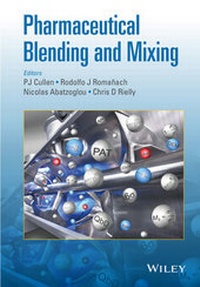
Pharmaceutical Blending and Mixing
Description

More details
Other editions
Additional editions

Persons
Dr PJ Cullen is a lecturer in?the Faculty of Engineering at the University of New South Wales. His current research interests include rheology, mixing, chemical imaging and non-thermal plasmas for biological applications in food. He has published over 35 journal papers, 15 book chapters and edited 1 book on food mixing.
Professor Rodolfo J. Romañach is Professor of Chemistry at the University of Puerto Rico. He has over 20 years of experience in vibrational spectroscopy, and worked in Puerto Rico's pharmaceutical industry for 12 years prior to joining the UPR-Mayagüez faculty. In the pharmaceutical industry he worked extensively in assay and cleaning validation, and in providing analytical support for API and pharmaceutical process related problems.
Professor Nicolas Abatzaglou is Director of the?Chemical Engineering and Biotechnological Engineering Department and Holder of the Pfizer Chair: PAT in Pharmaceutical Engineering at the Universite de Sherbrooke, Canada. He is the current recipient of Quebec's Minister of Education (MELS Chantier II) Fellowship award for his excellence in research and teaching.
Professor Chris Rielly is Head of the Department of Chemical Engineering at Loughborough University. He has taught chemical engineering for over 20 years at Cambridge and Loughborough Universities and is a Fellow of the Institution of Chemical Engineers with more than 20 years of experience working in experimental and computational fluid mechanics. His interests include multi-phase flow, mass transfer and turbulent mixing in chemical processing equipment. He has served on the Scientific Committees of the European Conference on Mixing, the International Conference on Gas-Liquid-Solid Reaction Engineering and the Process Innovation and Intensification Conference. He is an academic consultant to BHR Group's Fluid Mixing Processes Industrial Consortium and Chairman of the IChemE's Fluid Mixing Subject Group. He has previously edited books.
Content
Preface xvii
Part I Fundamentals of Mixing 1
1 Mixing Theory 3
Chris D. Rielly
1.1 Introduction 3
1.2 Describing Mixtures 5
1.3 Scale of Scrutiny 6
1.4 Quantifying Mixedness for Coarse and Fine-Grained Mixtures 8
1.4.1 Coarse and Fine-Grained Mixtures 8
1.4.2 Scale and Intensity of Segregation 9
1.5 Determining the End-Point of Mixing: Comparison of Mixing Indices 15
1.6 Continuous Flow Mixers 19
1.6.1 Idealized Mixing Patterns 19
1.6.2 Residence Time Distributions 21
1.6.3 Back-Mixing and Filtering of Disturbances Using a CSTR 23
References 24
2 Turbulent Mixing Fundamentals 27
Suzanne M. Kresta
2.1 Introduction 27
2.2 The Velocity Field and Turbulence 28
2.3 Circulation and Macro-Mixing 29
2.4 Fully Turbulent Limits and the Scaling of Turbulence 32
2.5 The Spectrum of Turbulent Length Scales, Injection of a Scalar (Either Reagent or Additive) and the Macro-, Meso- and Micro-Scales of Mixing 34
2.6 Turbulence and Mixing of Solids, Liquids, and Gases 37
2.7 Specifying Mixing Requirements for a Process 38
2.8 Conclusions 39
Notation 39
Roman Characters 39
Greek Characters 40
References 40
3 Laminar Mixing Fundamentals 43
P.J. Cullen and N.N. Misra
3.1 Laminar Flows 43
3.2 Mixing in Laminar Flows 44
3.2.1 Chaos and Laminar Chaotic Mixing 45
3.2.2 Granular Chaotic Mixing 50
3.3 Recent Advances 53
References 54
4 Sampling and Determination of Adequacy of Mixing 57
Rodolfo J. Romañach
4.1 Introduction, Process Understanding, and Regulations 57
4.2 Theory of Sampling 59
4.3 Sampling of Pharmaceutical Powder Blends 63
4.4 Stratified Sampling Approach 65
4.5 Testing 67
4.6 Process Knowledge/Process Analytical Technology 68
4.7 Real Time Spectroscopic Monitoring of Powder Blending 70
4.8 Looking Forward, Recommendations 73
4.9 Conclusion 74
4.10 Acknowledgments 75
References 75
Part II Applications 79
5 Particles and Blending 81
Reuben D. Domike and Charles L. Cooney
5.1 Introduction 81
5.2 Particle Geometry 82
5.2.1 Particle Size and Size Distribution 82
5.2.2 Particle Shape and Shape Distribution 83
5.3 Particle Interactions 84
5.3.1 van der Waals Forces 84
5.3.2 Electrostatic Forces 85
5.3.3 Adsorbed Liquid Layers and Liquid Bridges 85
5.3.4 Solid Bridges 86
5.3.5 Use of AFM to Measure Interparticle Forces 87
5.3.6 Interparticle Friction 89
5.4 Empirical Investigations of Particles and Blending 90
5.4.1 Blending of Powders 90
5.4.2 Impact of Particle Geometry on Blending 92
5.4.3 Impact of Interparticle Forces on Blending 93
5.4.4 Impact of Blender Conditions on Blending 95
5.5 Simulation Techniques 95
5.5.1 Full Physics Models Using Discrete Element Modeling 96
5.5.2 Continuum Models 97
5.5.3 Cellular Automata 98
References 98
6 Continuous Powder Mixing 101
Juan G. Osorio, Aditya U. Vanarase, Rodolfo J. Romañach, and Fernando J. Muzzio
6.1 Introduction 101
6.2 Overview 102
6.3 Theoretical Characterization 107
6.3.1 Residence Time Distribution (RTD) Modeling 107
6.3.2 Variance Reduction Ratio 108
6.4 Experimental Characterization 108
6.4.1 Hold-Up 109
6.4.2 Residence Time Distribution (RTD) Measurements 109
6.4.3 Mean Strain 110
6.5 Continuous Mixing Efficiency 110
6.5.1 Variance Reduction Ratio 110
6.5.2 Blend Homogeneity 111
6.6 Effects of Process Parameters on Mixing Behavior and Performance 112
6.6.1 Hold-Up 113
6.6.2 RTD Measurements 113
6.7 Mixing Performance 118
6.7.1 Modeling 120
6.7.2 PAT, QbD, and Control 122
6.8 Conclusions and Continuing Efforts 124
References 125
7 Dispersion of Fine Powders in Liquids: Particle Incorporation and Size Reduction 129
Gül N. Özcan-Tas¿kin
7.1 Particle Incorporation into Liquids 129
7.1.1 Wetting 130
7.1.2 Stirred Tanks for Particle Incorporation 132
7.1.3 In-Line Devices Used for Particle Incorporation 140
7.2 Break Up of Fine Powder Clusters in Liquids 143
7.2.1 Mechanisms of Break Up 146
7.2.2 Process Devices for Deagglomeration\Size Reduction of Agglomerates 147
References 150
8 Wet Granulation and Mixing 153
Karen P. Hapgood and Rachel M. Smith
8.1 Introduction 153
8.2 Nucleation 154
8.2.1 Drop Penetration Time 156
8.2.2 Dimensionless Spray Flux 158
8.2.3 Nucleation Regime Map 160
8.3 Consolidation and Growth 162
8.3.1 Granule Consolidation 162
8.3.2 Granule Growth Behaviour 164
8.3.3 Granule Growth Regime Map 165
8.4 Breakage 167
8.4.1 Single Granule Strength and Deformation 167
8.4.2 In-Granulator Breakage Studies 170
8.4.3 Aiding Controlled Granulation via Breakage 172
8.5 Endpoint Control 174
8.5.1 Granulation Time 175
8.5.2 Impeller Power Consumption 176
8.5.3 Online Measurement of Granule Size 176
8.5.4 NIR and Other Spectral Methods 177
References 178
9 Emulsions 183
Andrzej W. Pacek
9.1 Introduction 183
9.2 Properties of Emulsions 185
9.2.1 Morphology 185
9.2.2 Volumetric Composition 185
9.2.3 Drop Size Distributions and Average Drop Sizes 186
9.2.4 Rheology 191
9.3 Emulsion Stability and Surface Forces 195
9.3.1 Surface Forces 195
9.3.2 Emulsion Stability 199
9.4 Principles of Emulsion Formation 203
9.4.1 Low Energy Emulsification 204
9.4.2 High Energy Emulsification 205
9.5 Emulsification Equipment 216
9.5.1 Stirred Vessels 216
9.5.2 Static Mixers 218
9.5.3 High Shear Mixers 219
9.5.4 High-Pressure Homogenizers 223
9.5.5 Ultrasonic Homogenizers 225
9.6 Concluding Remarks 226
Nomenclature 226
Greek symbols 228
References 228
10 Mixing of Pharmaceutical Solid-Liquid Suspensions 233
Mostafa Barigou and Frans L. Muller
10.1 Introduction 233
10.1.1 Linking Solid-Liquid Processing to Critical Quality Attributes 233
10.1.2 Material Properties and Composition 234
10.1.3 Impact of Blending and Homogenization 234
10.1.4 Impact of Turbulence 237
10.1.5 Impact of Heat Transfer 237
10.2 Scale-Up of Operations Involving Solid Suspensions 237
10.2.1 The Nature of Suspensions 237
10.2.2 Scale-Up and Scale-Down Rules 239
10.2.3 Identification of Agitator Duties 240
10.2.4 Solid-Liquid Unit Operations 242
10.3 General Principles of Solid-Liquid Suspensions 243
10.3.1 Rheological Behaviour of the Continuous Phase 243
10.3.2 Rheology of Suspensions 246
10.3.3 Terminal Velocity of Particles 249
10.3.4 Turbulence 254
10.4 Solids Charging 257
10.4.1 Charging to Batch Vessels 257
10.4.2 Charging Difficult Powders 261
10.5 Solid Suspension 261
10.5.1 States of Solid Suspension 261
10.5.2 Prediction of Minimum Speed for Complete Suspension 262
10.6 Solid Distribution 269
10.6.1 Agitator Speed 269
10.6.2 Homogeneity 270
10.6.3 Geometry 271
10.6.4 Practical Guidelines 272
10.7 Blending in Solid-Liquid Systems 272
10.7.1 Mixing Time 272
10.7.2 Viscoplastic Slurries Yield Stress and Cavern Formation 272
10.8 Mass Transfer 275
10.9 Size Reduction, Deagglomeration and Attrition 277
10.9.1 Breaking Particles through Turbulent Forces 277
10.9.2 Breaking Particles through Impact 278
Nomenclature 281
Greek symbols 281
Abbreviations 282
References 282
Part III Equipment 287
11 Powder Blending Equipment 289
David S. Dickey
11.1 Introduction 289
11.2 Blending Mechanisms 290
11.3 Blend Time 290
11.4 Fill Level 291
11.5 Segregation 291
11.6 Powder Processing Difficulties 292
11.7 Blender Classification 292
11.7.1 Tumble Blenders 293
11.7.2 Rotating Element Blenders 298
11.7.3 Granulators 303
11.7.4 Other Blenders - Mullers and Custom Blenders 304
11.8 Continuous Blenders 305
11.9 Blender Selection 306
11.10 Equipment Specifications 307
11.10.1 Materials of Construction 309
11.10.2 Electrical Classification 309
11.10.3 Drives and Seals 309
References 310
12 Fluid Mixing Equipment Design 311
David S. Dickey
12.1 Introduction 311
12.2 Equipment Description 312
12.2.1 Laboratory Mixers 312
12.2.2 Development Mixers 313
12.2.3 Portable Mixers 313
12.2.4 Top-Entering Mixers 315
12.2.5 High-Shear Dispersers 318
12.2.6 High Viscosity Mixers 319
12.2.7 Multi-Shaft Mixers 319
12.2.8 Bottom-Entering Mixers 320
12.2.9 Glass-Lined Mixers and Vessels 321
12.2.10 Side-Entering Mixers 322
12.2.11 Vessel Geometry 322
12.2.12 Baffles 323
12.3 Measurements 323
12.3.1 Power 324
12.3.2 Torque 326
12.3.3 Tip Speed 327
12.3.4 Blend Time 327
12.4 Mixing Classifications 328
12.4.1 Liquid Mixing 328
12.4.2 Solids Suspension 330
12.4.3 Gas Dispersion 332
12.4.4 Viscous Mixing 333
12.5 Mechanical Design 334
12.5.1 Shaft Design 334
12.5.2 Shaft Seals 335
12.5.3 Materials of Construction 336
12.5.4 Surface Finish 337
12.5.5 Motors 338
12.5.6 Drives 339
12.6 Static Mixers 339
12.6.1 Twisted Element 339
12.6.2 Structured Element 339
12.6.3 Basic Design 340
12.7 Challenges and Troubleshooting 341
12.7.1 Careful Observations 341
12.7.2 Process Problems 341
Nomenclature 342
Greek 343
References 343
13 Scale-Up 345
David S. Dickey
13.1 Introduction 345
13.2 Similarity and Scale-Up Concepts 346
13.2.1 Dimensional Analysis 346
13.2.2 Similarity 347
13.2.3 Applied Scale-Up 349
13.3 Testing Methods 350
13.4 Observation and Measurement 352
13.5 Scale-Up Methods 354
13.5.1 Scale-Up with Geometric Similarity 354
13.5.2 Example of Geometric Similarity Scale-Up 358
13.5.3 Scale-Up Without Geometric Similarity 359
13.5.4 Example of Non-Geometric Scale-Up 361
13.5.5 Scale-Up for Powder Mixing 364
13.6 Summary 367
Nomenclature 367
Greek 368
References 368
14 Equipment Qualification, Process and Cleaning Validation 369
Ian Jones and Chris Smalley
14.1 Introduction 369
14.2 Blending Equipment Commissioning and Qualification 370
14.2.1 Outline of the Verification Approach 370
14.2.2 Requirements Phase 371
14.2.3 Specifications and Design Review Phase 373
14.2.4 Verification Phase 375
14.3 Blending and Mixing Validation 380
14.3.1 Why do You Need to Validate Pharmaceutical Blends/Mixes? 382
14.3.2 When do You Need to Validate Blending/Mixing? 384
14.3.3 Components of Blending/Mixing Validation 385
14.3.4 What to Validate 386
14.4 Blending Cleaning Validation 389
14.4.1 Cleaning Development Studies 389
14.4.2 Cleaning Validation 395
14.5 Conclusion 398
14.6 Acknowledgements 399
References 399
Part IV Optimization and Control 401
15 Process Analytical Technology for Blending 403
Nicolas Abatzoglou
15.1 Introduction 403
15.1.1 The Role of PAT in Pharmaceutical Manufacturing: Is PAT Really New? 404
15.1.2 Why PAT is Feasible 405
15.1.3 Where PAT can be Applied in Pharmaceutical Manufacturing 406
15.1.4 The Regulatory Framework 406
15.2 Chemometrics and Data Management 408
15.2.1 PAT Data Management and Interpretation 409
15.3 Near-Infrared Spectroscopy (NIRS) 412
15.4 Raman Spectroscopy (RS) 419
15.5 Image Analysis 422
15.6 LIF Spectroscopy 424
15.7 Effusivity 426
15.8 Other Potential Sensor Technologies 426
15.9 Comments on PAT in Liquid Formulation Mixing 427
References 427
16 Imaging Fluid Mixing 431
Mi Wang
16.1 Introduction 431
16.2 Point Measurement Techniques 433
16.3 Photographic Imaging 435
16.4 Digital Particle Image Velocimetry 439
16.5 Magnetic Resonance Imaging 443
16.6 Positron Emission Particle Tracking Imaging 444
16.7 Electrical Process Tomography 446
References 452
17 Discrete Element Method (DEM) Simulation of Powder Mixing Process 459
Ali Hassanpour and Mojtaba Ghadiri
17.1 Introduction to DEM and its Application in Pharmaceutical Powder Processing 459
17.2 DEM Simulation of Powder Mixing 461
17.3 Validation and Comparison with the Experiments 468
17.4 Concluding Remarks 474
References 475
Index 479
1
Mixing Theory
Chris D. Rielly
Department of Chemical Engineering, Loughborough University, UK
1.1 Introduction
Mixing of ingredients, or dispersion of one phase in another, is an essential step in many pharmaceuticals processes. For example, the vast majority of manufacturing routes to form an active pharmaceutical ingredient (API) make use of crystallization, which involves a number of mixing steps in a liquid phase, such as: dispersion and dissolution of solid reagents into a solvent, blending of liquid reagents with the solvent phase, creation of super-saturation through mixing, for example with an anti-solvent addition, chemical reaction, or heat removal and suspension of the API crystals during subsequent growth (Kirwan & Orella, 2002; Paul et al., 2004). Each of these operations involves a mixing step, which is aimed at removing gradients of concentration, temperature or solids mass fraction within the crystallizer vessel, to give a more uniform environment for chemical reaction and/or crystal growth.
A second example may be taken from later in a pharmaceutical manufacturing process: during the formulation of solid dosage forms, dry-powder mixing of an API with excipients (themselves mixtures of binders, diluents, flow modifiers and granulating agents) is required to produce suitable physical, flow and mechanical properties for tableting (for example Lee, 2002). Here, the objective is to remove concentration differences within the dry powder mix, so that each tablet contains a mixture with exactly the same properties and with a tightly-controlled amount of the API. Other forms of oral dosage may involve the blending of suspensions, emulsions and syrups to give a formulated liquid product; again the objective of mixing is to ensure that each dosage contains almost exactly the same amount of the active ingredient.
These examples demonstrate that in a mixing process the objective is to reduce inhomogeneities in composition to an acceptable level, to provide a more uniform processing environment and/or a more uniform product. The examples also illustrate that there are differences between fluid mixtures of miscible phases and particle mixtures, which can, in principle, unmix; for example, by segregation effects (Sommier et al., 2001). Segregation often occurs in free-flowing powders and is driven by differences in particle size and density. The phenomenon occurs when particulate mixtures are shaken (Rosato et al., 1987), or during flow within or between vessels (e.g. discharge from a vessel). During shaking or shear flow, there is relative motion between particles and small particles can fall into gaps beneath larger particles. Thus, the larger particles tend to rise to the surface, whereas small particles percolate downwards. Therefore, segregation can cause a previously well-mixed material to undergo unmixing into a non-uniform solid form; a way to counteract the tendency to segregate is to introduce a binder or adjust the moisture content to produce cohesion within the particulate mixture. In many processes a granulation operation follows the blending stage to prevent segregation in subsequent processing steps (Fung & Ng, 2003).
A distinction may also be drawn between batch and continuous flow mixing processes, although similar measures of mixing quality may be defined for both. Almost all current pharmaceutical processes operate by transferring batches of material between stages of the manufacturing process, rather than by continuous inflow and outflow to process equipment. Therefore this chapter will focus mainly on batch mixing processes, where the purpose is to use fluid mechanics, molecular diffusion and dispersion effects to produce spatially homogeneous mixtures; up to a point, an increase in the batch time will lead to an improvement in the mixture quality, that is a reduction in the level of spatial inhomogeneities, but thereafter, the degree of mixedness will not improve. The chapter will address the question of what is an 'acceptable' measure of mixedness; the idea of a scale of scrutiny of the mixture will be introduced in Section 1.3 and various measures of the quality of a mixture will be discussed. The examples given here consider two rather different situations of mixing (1) between components in a liquid and (2) between different types of solid particles. In this context it is useful to differentiate between fine and coarse-grained mixtures and this is discussed in Section 1.4. Selection of different definitions of the end-point for a mixing process will be considered in Section 1.5, to consider their sensitivity at various stages of mixing and their sensitivity to sampling methods.
Recently the pharmaceuticals industries have paid increasing attention to continuous manufacturing operations, as potentially they could significantly reduce production costs and provide more reliable manufacturing routes; see, for example, Schaber et al. (2011). Therefore, the final section (Section 1.6) of this chapter will consider continuous mixing of ingredients. In such operations the mixing objective is to obtain a product with a homogeneous distribution of ingredients in the correct proportions, which requires careful metering of the feed flow rates, as well as achieving a high degree of homogeneity. In continuous flow devices, the output product composition should not vary in time and the processing history of each element of the mixture should be the same. Variations in the feed composition to a continuous flow mixer can be compensated to an extent by allowing 'mixing in time', that is not all elements of fluid spend the same amount in the mixer, allowing materials that have arrived early, to mix with materials that have arrived late. Thus the concept of a residence time distribution will be introduced in Section 1.6 to describe the process of back-mixing, or mixing in time. Furthermore it will be shown that back-mixing can effectively filter out higher frequency variations in feed composition and still give a uniform product. Thus, there are processing advantages and disadvantages in having some width to the residence time distribution.
Throughout this chapter, the term concentration will be used quite generally to described the composition of a material within a mixture; for a single liquid phase the term can be interpreted as mass (or mole) fraction, or mass (or moles) per unit volume of a specific component; for particulate mixtures it could represent mass fraction, number fraction or volume fraction of one type of solid; for a multi-phase mixture it could be the volume or mass fraction of a specific phase. In general, the mixedness will be judged from a statistical measure of the distribution of concentrations of key components within samples drawn from a mixture.
1.2 Describing Mixtures
In practice, the whole of the composition of a mixture cannot be determined at a single time, so sampling is often used to assess the state of mixedness; sampling at an appropriate scale of scrutiny will be discussed in Section 1.3, but first the degree of uniformity between samples will be considered. The average concentration of a species in the whole mixture is determined by the amounts of all components added and can be calculated straightforwardly from a mass balance. The average species concentrations obtained from samples drawn from this mixture ought to have values distributed about the average for the whole mixture; it is the width of this distribution that provides information about the quality of the mixture, not the average value from the various samples.
Figure 1.1 shows an example of an idealized mixture comprising 50% white particles and 50% black particles. The whole mixture is divided into 36 samples, each containing 16 particles. Figure 1.1(a) is a homogeneous, but non-random mixture; each sample contains exactly eight white particles (or 50% white particles), which is exactly the same as the mean concentration of the mixture. Figure 1.1(b) shows the number of particles in each sample and indicates that there are no spatial differences in concentration; hence the mixture can be regarded as perfectly mixed. This mixture is 'perfect' in the sense that each sample contains exactly the same concentration as the whole mixture average; in other words there is no variance between the samples. The probability of forming such a mixture by a stochastic process is rather small, so this situation is very unlikely to occur in a conventional mixing process.
Figure 1.1 Idealized mixtures of 50% white and 50% black particles (a) non-random perfect mixture, (b) number of white particles in each 4 × 4 sample of the non-random mixture (c) random mixture and (d) number of white particles in each 4 × 4 sample of the random mixture
In contrast, Figure 1.1(c) shows a mixture that has been generated entirely randomly by giving each particle an equal probability of being black or white; the overall composition of the whole mixture is still 50% white particles, but each sample now shows deviations from the whole mixture mean, as shown in Figure 1.1(d). Some samples contain as few as four particles, whereas others have 12 or 13, compared to the expected eight, which might lead to the conclusion that the material is not well mixed. However, further mixing, or randomization, of the particles will not lead to any significant improvement in the distribution of white...
