

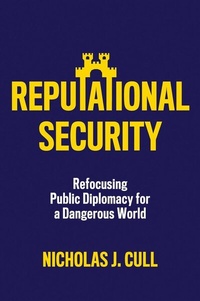
Reputational Security
Description

Nicholas J. Cull, the distinguished historian of propaganda, revisits the international media campaigns of the past in the light of the challenges of the present. His concept of Reputational Security deftly links issues of national image and outreach to the deepest needs of any state, rescuing them from the list of low-priority optional extras to which they are so often consigned in the West. Reputational Security, he argues, comes from being known and appreciated in the world. With clarity and determination, Cull considers core tasks, approaches, and opportunities available for international actors today, including counterpropaganda, media development, diaspora diplomacy, cultural work, and - perhaps most surprisingly of all - media disarmament. This book is crucial for all who care about responding to the threat of malign media disruption, revitalizing international cooperation, and establishing the Reputational Security we and our allies need to survive and flourish.
Reputational Security is enlightening reading for students and scholars of public diplomacy, international relations, security studies, communications, and media, as well as practitioners.
More details
Other editions
Additional editions
Person
Content
List of Figures
Introduction: Reputation and Soft Power: Image and Action in World Affairs
Chapter One: Reputational Security: Frame, Objective and Agenda
Chapter Two: Technology and Reputational Security: Historical Cases of Media Disruption and Adoption
Chapter Three: Pushing Back: Counter-Propaganda and Reputational Security
Chapter Four: Media Development: A Tool for Reputational Security
Chapter Five: Information Disarmament: A Forgotten Element of Reputational Security
Chapter Six: Diaspora Diplomacy: From History to Reputational Security
Chapter Seven: Cultural Diplomacy, Cultural Relations, and Reputational Security
Chapter Eight: Rethinking US Public Diplomacy: The Apparatus of Reputational Security
Conclusion: The Reckoning: Reputational Security and Russia's War in Ukraine
Notes
Selected Bibliography
Index
Preface
Our world changed on 24 February 2022 when Russian armed forces began their all-out invasion of Ukraine. The spectacle of a land war in Europe on a scale not seen since World War II underlined the extent to which international affairs had fallen back into the realm of intense global competition. But even without the outbreak of a shooting war, the outlines of a new global landscape were already clear. The COVID-19 pandemic could have been a textbook opportunity for cooperation and collective effort. It did not play out that way. Rather, the pandemic was dominated by hostile messages as certain countries looked to associate their adversaries with the calamity, to talk up their own successful responses and denigrate the efforts of others. Some commentators have spoken of a return to the Cold War, and many argue that attitudes and strategies from that period are relevant once again. Yet there is much new about the world in which we find ourselves. One of the big changes would seem to be the role of mass media and the central role of reputation in contemporary international relations, sharpened by the role of digital social media. Of course, the Cold War was also a media struggle - a contest for the imagination of the world played between the Western allies and the Eastern Bloc - but it was a two-player game played at analog speed. Today there are more players, and the volumes of data being shared dwarf the flows of information that characterized the Cold War. How are we to understand this world and conduct diplomacy within it? This book provides pointers.
Reputational Security: Refocusing of Public Diplomacy and Soft Power
In 2019, I published an overview of one of the most significant but underappreciated tools of contemporary statecraft: Public Diplomacy. I argued that an understanding of the processes and approaches by which international actors can conduct foreign policy through global public engagement is a necessary foundation for success. I also argued that the history of work in this area provided an important roadmap for progress, whether we communicate with electronic tweets or quill, pen, and ink. I explained the difference between the generally two-way activity of Public Diplomacy and one-way focused propaganda. I discussed five core elements: listening (which I consider to be the most important and foundational activity), advocacy, cultural diplomacy, exchange diplomacy, and international broadcasting. I presented the practice of nation branding as a misstep in Public Diplomacy as it obstructed the key approach of contemporary international relations: partnership. In my conclusion to that book, I argued that the dominant frame used to understand the role of image in international relations - Joseph Nye's term Soft Power (the ability of states to do more on the international stage if their values, policies, and culture are admired) - had been seriously diluted by the range of practice around the world and, moreover, was a poor fit for an era of renewed great power conflict. I argued that it was time to adopt a revised terminology that more explicitly reflects the damage that could come to states whose image has slipped. I proposed Reputational Security as a suitable frame. The present book is an opportunity to pick up where I left off and provide a more detailed exploration of what I mean by the term Reputational Security and to apply it to the challenges that have emerged since I completed that text in 2018.
As with the previous volume, this book is first and foremost the work of a historian. While I draw on other disciplines, including those of international relations and communication studies, history is the thread that holds the argument together. Readers will note that I tend to revert to US history, and some chapters are told almost entirely from the point of view of the US experience. My treatment of mechanisms available for Reputational Security (chapter 8) deals only with the US. I hope non-US readers will find relevant and applicable insights in these chapters and find them more readily than by reading my detailed histories of US Public Diplomacy, which loom large in the footnotes. The self-citation reflects the extent to which this book is not just a work of the four years since 2019 but a synthesis of ideas that I have been working with across nearly forty years of study and research into issues of reputation and communication in international history.
I do not intend this book and its terminology as a replacement for Soft Power or as some patricidal swipe at its creator and our field's most distinguished scholar. I see it as an alternate way to think about the same processes and one I hope will resonate differently with core audiences in very different international circumstances to those in which Soft Power was coined.
How This Book Came to Be Written
This book has its roots in discomfort. While the concept of Soft Power had carried my own thinking about issues of reputation a great distance forward, I began to notice a mismatch between the term Soft Power as understood by practitioners of Public Diplomacy and the world as I knew it. The term did not quite fit either with my observations of the past as a historian or my experience of the present as an analyst and sometime consultant on issues of Public Diplomacy. I felt that a core concept of the kind that Soft Power had become should have some ability to describe experiences in all times or all places. The experience of Ukraine in 2014 was instructive. I had visited briefly in 2008 and noticed an absence of a clear narrative of what the country was for. Ukraine's experience in 2014 - losing territory without sparking outrage among the general citizenry of the West - seemed like a clear case of what could befall a state whose national narrative was unclear or even unknown to the global community. Ukraine in 2014 seemed burdened by a specific lack quite beyond the presence of invaders and their local sympathizers.
My alternative frame of Reputational Security came to me in a moment of clarity in the summer of 2017 during a series of conversations with foreign policy practitioners in Kazakhstan. As I remember it, we were sitting in a Starbucks in the city then known as Astana. My interlocutor - Anuar Ayazbekov, director of Kazakhstan's Institute of Diplomacy - explained that "building Soft Power" just did not describe his country's mindset or the stakes as Kazakhstan sought to engage the outside world. I offered Reputational Security as an alternative way to pull together the threads of concern he had expressed: a way to encapsulate his belief that part of security comes from being known and appreciated in the world and that countries that are largely unknown by the outside world but are burdened with hungry neighbors can lose provinces. Ayazbekov went so far as to say that the comedian Sacha Baron Cohen had done Kazakhstan a favor by inventing his hapless Kazakh alter ego Borat Sagdiyev and making the country the butt of jokes. Global audiences now knew one thing about Kazakhstan and even if it was untrue, it was one more thing than they knew about Tajikistan, Uzbekistan, or Kyrgyzstan. The inaccuracy of Borat was a foundation on which further accurate knowledge could be built. The seed of Reputational Security had been planted. I kept the term in mind and began to routinely pitch it to other practitioners I met, most especially during a research trip to the Western Balkans that autumn. Officials in Kosovo recognized their own dilemma in the concept and saw it as fitting their own journey along a pathway to recognition and safety. Reputational Security also seemed to fit a world in which elements of individual nations' lives and, indeed, the values of entire regions were being actively targeted by malign media. The experience fitted the experience described by senior communication officials from Nordic countries as they described their region becoming the target of a sustained Russian media narrative linking Scandinavia to the abuse of children and animals.
As the world veered away from collaboration and sunk deeper into a mire of conflict, resurgent nationalism, Reputational Security seemed all the more important. Recent years have only served to point up the need to attend both to Reputational Security as a whole and to the particular tools and approaches that should necessarily figure in any strategy to develop a comprehensive Reputational Security strategy. This book draws those lessons together. I look to history as a key source for strategies and answers. This book benefits from my direct contact with public diplomats around the world, past and present, including diplomats and communicators working in and around Ukraine, China, and other key locations.
The Plan of the Book
This introduction provides an overview of the development of reputation in international relations and the specific career of Soft Power from its coining around 1990 to its apparent crisis in 2015 and since. I argue, for example, that Soft Power has come to be seen as an optional extra for the top-tier countries, whereas Reputational Security links the realm of image and foreign public engagement with the most significant responsibility of statecraft: national defense. The first chapter presents the concept of Reputational Security and explains the policy priorities necessary to ensure its development and maintenance. It also explains the benefits of Reputational Security. I contend that Reputational Security can insulate a well-known or well-liked place from attack and, if disaster strikes, rally international support that would not be available to less well regarded places. I...
