

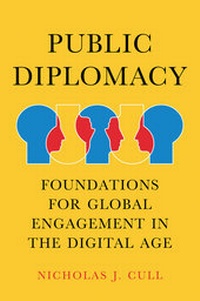
Public Diplomacy
Description

More details
Other editions
Additional editions
Person
Nicholas J. Cull is Professor of Public Diplomacy in the Annenberg School for Communication and Journalism at the University of Southern California.
Content
Preface and Acknowledgments ix
List of Abbreviations xiii
1 Diplomacy through Foreign Public Engagement: Core Terminology and History 1
2 Listening: The Foundational Skill 20
3 Advocacy: The Cutting Edge 39
4 Culture: The Friendly Persuader 60
5 Exchange and Education: The Soul of Public Diplomacy 80
6 International Broadcasting: The Struggle for News 101
7 Nation Brands and Branding: The Metaphor Run Amok 120
8 Partnership: The Emerging Paradigm 141
Conclusion: Public Diplomacy and the Crisis of Our Time 162
Notes 171
Select Bibliography 205
Index 211
Preface and Acknowledgments
This is a book about what Bruce Gregory of George Washington University has called "the public aspects of diplomacy." It is written to provide a single foundational text for diplomat students and student diplomats. This book is not only about the emergence of new approaches to global public opinion; it was born because of them. At the turn of the millennium, I was Professor of American Studies at the University of Leicester in the United Kingdom. I had been writing and researching about the history of British and American propaganda for some years but had little opportunity to integrate that work into my teaching. I worked from time to time with the British Council but my role was to apply a multidisciplinary approach to the study of British identity. I got to talk about British science fiction television in Turkey and "Englishness" in Finland. The advent of the Blair government, with its focus on issues of international image, opened new avenues. My British Council contact - Nick Wadham Smith - was seconded to a new in-house think tank within the Council called Counterpoint, with a mandate to examine the future of British cultural relations. Nick and his boss Martin Rose invited me to give a keynote talk to the Council's board and I found myself commenting explicitly on the contemporary implications of my historical research to an audience of British cultural figures. That was the first time I presented what became my five-element breakdown of public diplomacy. More seminars followed. The terrorist attacks of 9/11 accelerated this work. Suddenly, government and scholarly interest in public diplomacy kicked into high gear on both sides of the Atlantic. It was only to be expected that an academic institution would spot a gap in the market. The University of Southern California moved first. In 2003, working with the School of International Relations, the USC Annenberg School for Communication, as it was then known, launched its Center on Public Diplomacy. The next step was to offer a master's degree in public diplomacy, and I was hired to direct it.
I arrived at USC in September 2005 but, before the master's degree in public diplomacy had truly got underway, I was persuaded to take part in a further project from which these essays derive. The distinguished Israeli scholar Eytan Gilboa was attached to the Center on Public Diplomacy as a visiting fellow for my first year and proposed that he and I organize a summer institute in advanced public diplomacy for diplomats. The institute ran in the last two weeks of 2006 and the chapters in this book have evolved from lectures delivered at that time. In the intervening years, my research and teaching have happily converged. My first attempt to set these ideas in print came in 2007 when the UK Foreign and Commonwealth Office commissioned me to write a short primer on public diplomacy for their own use. That work reached its final form as the booklet Public Diplomacy: Lessons from the Past (2008). This book is an expansion and updating of that work. In the years since, I've had wonderful opportunities to deliver and develop this material in classes for foreign ministries and diplomatic academies around the world, including those of Canada, Chile, India, Mexico, Netherlands, South Africa, South Korea, and Switzerland. Some audiences deserve special mention. For some years, I've served as a guest lecturer at the US Department of State's Foreign Service Institute in Arlington, Virginia. Chapters 1 and 3 will be familiar to FSI students. I am also honored to have taught this material as a guest lecturer at Beijing Foreign Studies University's Center on Public Diplomacy as a guest of Professor Zhou Xinyu and for the Masters of Cultural Diplomacy of Catholica University of Milan as a guest of Professor Federica Olivares. This book was also shaped by the Spring Institute in Internet Diplomacy which I organized in March 2016, so thanks are due to Fadi Chehadi, then CEO of the Internet Corporation on Assigned Names and Numbers (ICANN), and his colleague Nora Abusita for making that happen. My motive for writing this was to pull together the lectures and material developed for reports into a fuller synthesis.
Any writing and research process requires support from family, friends, and colleagues. In writing this book, I am grateful to the directors of the USC Center on Public Diplomacy for keeping the Summer Institute going: Jay Wang, Philip Seib, Geoffrey Wiseman, and most especially Joshua Fouts, who gave Eytan and I the go-ahead for the original iteration and thoroughly spoiled us for his successors. The forays into psychology were inspired by the work of the third man in the original Summer Institute lineup, my USC Annenberg colleague Kelton Rhoads. Soumi Chattergee of UCLA has helped to clarify some of the finer points of what was new territory for me. I appreciate the rest of the public diplomacy team at USC, especially Bob Banks, Doug Becker, Pam Starr, and Conrad Turner, and my interlocutors around campus, especially Mina Chow, David Craig, Jerry Giaquinta, Garry Wexler, and the incomparable Robert Scheer. Colleagues beyond USC whose work has been influential on me or who have provided help include Amelia Arsenault, Martha Bayles, Caitlin Byrne, Ali Fisher, Kathy Fitzpatrick, Vasily Gatov, Jessica Gienow-Hecht, Robert Govers, Bruce Gregory, Craig Hayden, Charlotte Lerg, Jonathan McClory, Jan Melissen, Ben Nimmo, James Pamment, Peter Pomerantsev, Sean Powers, Monroe Price, J. P. Singh, Nancy Snow, Cesar Villanueva Rivas, Rhonda Zaharna, and the late Benjamin Barber. James Pamment deserves a double mention for reading the whole work in draft and making it better by frankly pointing out its limits. I am grateful to friends who have allowed me to try this material on their students especially Barry Sanders at UCLA, Derek Shearer at Occidental College, and Senem Cevik at UC Irvine, and, further afield, Odette Tomescu-Hatto and Ronald Hatto at Sciences Po, Paris. Dalia Kaye and Sohaela Ameri at the RAND Center for Middle East Public Policy were kind enough to invite me to try out my conclusion on their colleagues. The influence of Joseph Nye and Simon Anholt is present throughout. I've valued the opportunity to discuss US elements with the small band of practitioner/scholars Matthew Armstrong, Dick Arndt, Don Bishop, John Brown, Katherine A. Brown, Bill Rugh, and Mike Schneider. Adam Clayton Powell III and his colleagues at the Public Diplomacy Council have been a terrific home crowd for a number of relevant presentations and panel discussions in DC. The mentions of Canada show the influence of Evan Potter, Daryl Copeland, and Sarah E. K. Smith. I have learned much from friends in the UK foreign policy community and have been privileged to chew over some of these issues with distinguished retirees Ian Cliff and Martin Rose. A book like this also needs many conversations with serving diplomats of many nations over the years. I'll spare blushes. You know who you are!
An eclectic work requires advice from unusual quarters. My old friend and airline pilot Paul Ambrose provided an example for the chapter on listening. Another old friend, Arnar Gudmundsson of Reykjavik provided advice on bird calls for the same chapter. I appreciate the help of the distinguished church historian Thomas McCoog, SJ, of Fordham University with the material relating to the Jesuit Order, the originators of the term "propaganda," and of the great German artist Gunter Demnig on the international use of his stolperstein. Catalan scholar Marc Argemí Ballbè helped with Spanish folk sayings. This work has been shaped by input from students at USC and further afield. Anna Loup has been a terrific assistant. Neftalie Williams has demonstrated the power of sport diplomacy. Saltanat Kerimbayeva opened the door to Kazakhstan. Caitlin Schindler, whose Leeds University PhD I co-supervised, picked up my own phrase "foreign public engagement" as a useful alternative to public diplomacy and encouraged me to do the same. I have also benefited from being examiner on the excellent PhDs written by Alice Srugies and Molly Bettie.
I have appreciated the support of Polity Press, especially Ellen MacDonald-Kramer and Mary Savigar, and the attentive editor Gail Ferguson. The wonderful cover design by Jason Anscomb inspired by the Council of Europe's European Day of Languages. This book was supposed to have been ready by the middle of 2016 but was overtaken by events and my diversion to practical projects in the public diplomacy field. Glad we got there in the end!
Friends in Redondo have been part of the story. So many happy working days have begun with Joel Futerer's summons to breakfast at Classic Burger on Torrance Boulevard and I appreciate the company of Brian Kastner, Peter Kurbikoff, and Bob Reid, the co-recipients of those electronic invites. My three young sons, Alex, Magnus, and Olly, have provided a welcome distraction from the screen and gave this project meaning. They are the embodiments of the future that the best public diplomacy is working to create. My youngest son was recently challenged by a fellow eight-year-old in an exchange that is relevant to this book:
Girl: Your dad's job is bogus. Public Diplomacy is not a real thing.
Olly: It certainly is. It has stopped a bunch of wars.
Girl: OK. Name them.
Olly: Easy. They were all called World War III.
If lawmakers around the world had Olly's confidence, public diplomacy work would have fewer...
