

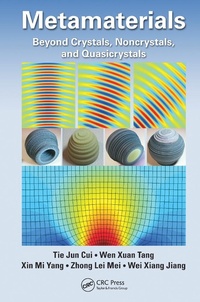
Metamaterials
Beyond Crystals, Noncrystals, and Quasicrystals
Published on 19. December 2017
341 pages
978-1-4822-2311-8 (ISBN)
Description

Metamaterials: Beyond Crystals, Noncrystals, and Quasicrystals is a comprehensive and updated research monograph that focuses on recent advances in metamaterials based on the effective medium theory in microwave frequencies. Most of these procedures were conducted in the State Key Laboratory of Millimeter Waves, Southeast University, China.
The book conveys the essential concept of metamaterials from the microcosmic structure to the macroscopic electromagnetic properties and helps readers quickly obtain needed skills in creating new devices at microwave frequencies using metamaterials. The authors present the latest progress on metamaterials and transformation optics and provide abundant examples of metamaterial-based devices accompanied with detailed procedures to simulate, fabricate, and measure them.
Comprised of ten chapters, the book comprehensively covers both the fundamentals and the applications of metamaterials. Along with an introduction to the subject, the first three chapters discuss effective medium theory and artificial particles. The next three chapters cover homogeneous metamaterials (super crystals), random metamaterials (super noncrystals), and inhomogeneous metamaterials (super quasicrystals). The final four chapters examine gradient-index inhomogeneous metamaterials, nearly isotropic inhomogeneous metamaterials, and anisotropic inhomogeneous metamaterials, after which the authors provide their conclusions and closing remarks. The book is completely self-contained, making it easy to follow.
The book conveys the essential concept of metamaterials from the microcosmic structure to the macroscopic electromagnetic properties and helps readers quickly obtain needed skills in creating new devices at microwave frequencies using metamaterials. The authors present the latest progress on metamaterials and transformation optics and provide abundant examples of metamaterial-based devices accompanied with detailed procedures to simulate, fabricate, and measure them.
Comprised of ten chapters, the book comprehensively covers both the fundamentals and the applications of metamaterials. Along with an introduction to the subject, the first three chapters discuss effective medium theory and artificial particles. The next three chapters cover homogeneous metamaterials (super crystals), random metamaterials (super noncrystals), and inhomogeneous metamaterials (super quasicrystals). The final four chapters examine gradient-index inhomogeneous metamaterials, nearly isotropic inhomogeneous metamaterials, and anisotropic inhomogeneous metamaterials, after which the authors provide their conclusions and closing remarks. The book is completely self-contained, making it easy to follow.
More details
Language
English
Place of publication
London
United Kingdom
Publishing group
Taylor & Francis Ltd
Target group
College/higher education
Illustrations
204 s/w Abbildungen, 3 s/w Tabellen
3 Tables, black and white; 204 Illustrations, black and white
File size
10,31 MB
ISBN-13
978-1-4822-2311-8 (9781482223118)
Copyright in bibliographic data and cover images is held by Nielsen Book Services Limited or by the publishers or by their respective licensors: all rights reserved.
Schweitzer Classification
Other editions
Additional editions
Tie Jun Cui | Wen Xuan Tang | Xin Mi Yang
Metamaterials
Beyond Crystals, Noncrystals, and Quasicrystals
Book
06/2020
1st Edition
CRC Press
€69.80
Shipment within 15-20 days
Tie Jun Cui | Wen Xuan Tang | Xin Mi Yang
Metamaterials
Beyond Crystals, Noncrystals, and Quasicrystals
Book
06/2016
1st Edition
CRC Press
€293.50
Article not available for order
Persons
Tie Jun Cui is the full professor of the School of Information Science and Engineering, Southeast University, Nanjing, China, and associate director of the State Key Laboratory of Millimeter Waves. Since 2013, he has served as a representative of the People's Congress of China. Dr. Cui earned his BSc, MSc, and PhD degrees in electrical engineering from Xidian University, Xi'an, China, in 1987, 1990, and 1993, respectively. He is coeditor of the book Metamaterials: Theory, Design, and Applications and the author of six book chapters. He has published over 350 peer-reviewed journal articles in Science, PNAS, Nature Communications, Physical Review Letters, Physical Review X, Advanced Materials, Light Science & Applications, and IEEE Transactions.
Wen Xuan Tang earned her bachelor's degree in electronic engineering and her MSc degree in electromagnetic field and microwave technology from Southeast University, Nanjing, China, in 2006 and 2009, respectively, and her PhD degree in electromagnetics from Queen Mary University of London, London, United Kingdom, in 2012. In November 2012, she joined the School of Information Science and Engineering, Southeast University, Nanjing, China, as a lecturer. She has published over 20 technical articles in highly ranked journals, including IEEE Transactions on Antenna and Propagation, New Journal of Physics, Optics Express, Applied Physics Letters, and Scientific Reports.
Xin Mi Yang was born in Suzhou, Jiangsu Province, China, in March 1982. He earned his BS and PhD degrees from Southeast University, Nanjing, China, in 2005 and 2010, respectively, both in the School of Information Science and Engineering. Since November 2010, he has been with the School of Electronics and Information Engineering, Soochow University, Suzhou, China. His current research interests include metamaterials, metasurfaces, LTCC technology, and their applications in antennas and microwave engineering.
Zhong Lei Mei is a professor in the School of Information Science and Engineering, Lanzhou University, Lanzhou, China. He is also deputy dean of the school. He received his BSc, MSc, and PhD degrees in radio physics from Lanzhou University, China, in 1996, 1999, and 2007, respectively. Dr. Mei is a visiting research fellow in the State Key Laboratory of Millimeter Waves. His current research interest includes metamaterials and computational electromagnetics. He has published over 30 peer-reviewed journal articles in international journals, including Physical Review Letters, IEEE Transactions on Antenna and Propagation, New Journal of Physics, Optics Express, and Applied Physics Letters.
Wei Xiang Jiang earned his PhD degree in electrical engineering from Southeast University, Nanjing, China, in October 2010. He joined the State Key Laboratory of Millimeter Waves, Southeast University, in November 2010, and was promoted to the post of associate professor in April 2011 and professor in April 2015. He has published more than 60 peer-reviewed journal articles in Advanced Materials, Advanced Functional Materials, Materials Today, and Applied Physics Letters. His current research interests include electromagnetic theory, illusion optics, and metamaterials. Dr. Jiang's research has been selected as Research Highlights by Europhysics News in June 2008, Research Highlights in 2008 by Journal of Physics D: Applied Physics, and Research Highlights by Applied Physics Letters in 2011.
Wen Xuan Tang earned her bachelor's degree in electronic engineering and her MSc degree in electromagnetic field and microwave technology from Southeast University, Nanjing, China, in 2006 and 2009, respectively, and her PhD degree in electromagnetics from Queen Mary University of London, London, United Kingdom, in 2012. In November 2012, she joined the School of Information Science and Engineering, Southeast University, Nanjing, China, as a lecturer. She has published over 20 technical articles in highly ranked journals, including IEEE Transactions on Antenna and Propagation, New Journal of Physics, Optics Express, Applied Physics Letters, and Scientific Reports.
Xin Mi Yang was born in Suzhou, Jiangsu Province, China, in March 1982. He earned his BS and PhD degrees from Southeast University, Nanjing, China, in 2005 and 2010, respectively, both in the School of Information Science and Engineering. Since November 2010, he has been with the School of Electronics and Information Engineering, Soochow University, Suzhou, China. His current research interests include metamaterials, metasurfaces, LTCC technology, and their applications in antennas and microwave engineering.
Zhong Lei Mei is a professor in the School of Information Science and Engineering, Lanzhou University, Lanzhou, China. He is also deputy dean of the school. He received his BSc, MSc, and PhD degrees in radio physics from Lanzhou University, China, in 1996, 1999, and 2007, respectively. Dr. Mei is a visiting research fellow in the State Key Laboratory of Millimeter Waves. His current research interest includes metamaterials and computational electromagnetics. He has published over 30 peer-reviewed journal articles in international journals, including Physical Review Letters, IEEE Transactions on Antenna and Propagation, New Journal of Physics, Optics Express, and Applied Physics Letters.
Wei Xiang Jiang earned his PhD degree in electrical engineering from Southeast University, Nanjing, China, in October 2010. He joined the State Key Laboratory of Millimeter Waves, Southeast University, in November 2010, and was promoted to the post of associate professor in April 2011 and professor in April 2015. He has published more than 60 peer-reviewed journal articles in Advanced Materials, Advanced Functional Materials, Materials Today, and Applied Physics Letters. His current research interests include electromagnetic theory, illusion optics, and metamaterials. Dr. Jiang's research has been selected as Research Highlights by Europhysics News in June 2008, Research Highlights in 2008 by Journal of Physics D: Applied Physics, and Research Highlights by Applied Physics Letters in 2011.
Content
Introduction. Effective Medium Theory. Artificial Particles. Homogeneous Metamaterials: Super Crystals. Random Metamaterials: Super Noncrystals. Inhomogeneous Metamaterials: Super Quasicrystals. Gradient-Index Inhomogeneous Metamaterials. Nearly Isotropic Inhomogeneous Metamaterials. Anisotropic Inhomogeneous Metamaterials. Conclusions and Remarks.
