

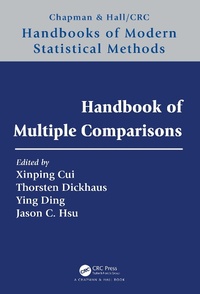
Handbook of Multiple Comparisons
1st Edition
Published on 17. November 2021
418 pages
978-0-429-63388-1 (ISBN)
Description

Written by experts that include originators of some key ideas, chapters in the Handbook of Multiple Testing cover multiple comparison problems big and small, with guidance toward error rate control and insights on how principles developed earlier can be applied to current and emerging problems. Some highlights of the coverages are as follows.
Error rate control is useful for controlling the incorrect decision rate. Chapter 1 introduces Tukey's original multiple comparison error rates and point to how they have been applied and adapted to modern multiple comparison problems as discussed in the later chapters.
Principles endure. While the closed testing principle is more familiar, Chapter 4 shows the partitioning principle can derive confidence sets for multiple tests, which may become important as the profession goes beyond making decisions based on p-values.
Multiple comparisons of treatment efficacy often involve multiple doses and endpoints. Chapter 12 on multiple endpoints explains how different choices of endpoint types lead to different multiplicity adjustment strategies, while Chapter 11 on the MCP-Mod approach is particularly useful for dose-finding. To assess efficacy in clinical trials with multiple doses and multiple endpoints, the reader can see the traditional approach in Chapter 2, the Graphical approach in Chapter 5, and the multivariate approach in Chapter 3.
Personalized/precision medicine based on targeted therapies, already a reality, naturally leads to analysis of efficacy in subgroups. Chapter 13 draws attention to subtle logical issues in inferences on subgroups and their mixtures, with a principled solution that resolves these issues. This chapter has implication toward meeting the ICHE9R1 Estimands requirement.
Besides the mere multiple testing methodology itself, the handbook also covers related topics like the statistical task of model selection in Chapter 7 or the estimation of the proportion of true null hypotheses (or, in other words, the signal prevalence) in Chapter 8. It also contains decision-theoretic considerations regarding the admissibility of multiple tests in Chapter 6. The issue of selected inference is addressed in Chapter 9.
Comparison of responses can involve millions of voxels in medical imaging or SNPs in genome-wide association studies (GWAS). Chapter 14 and Chapter 15 provide state of the art methods for large scale simultaneous inference in these settings.
Error rate control is useful for controlling the incorrect decision rate. Chapter 1 introduces Tukey's original multiple comparison error rates and point to how they have been applied and adapted to modern multiple comparison problems as discussed in the later chapters.
Principles endure. While the closed testing principle is more familiar, Chapter 4 shows the partitioning principle can derive confidence sets for multiple tests, which may become important as the profession goes beyond making decisions based on p-values.
Multiple comparisons of treatment efficacy often involve multiple doses and endpoints. Chapter 12 on multiple endpoints explains how different choices of endpoint types lead to different multiplicity adjustment strategies, while Chapter 11 on the MCP-Mod approach is particularly useful for dose-finding. To assess efficacy in clinical trials with multiple doses and multiple endpoints, the reader can see the traditional approach in Chapter 2, the Graphical approach in Chapter 5, and the multivariate approach in Chapter 3.
Personalized/precision medicine based on targeted therapies, already a reality, naturally leads to analysis of efficacy in subgroups. Chapter 13 draws attention to subtle logical issues in inferences on subgroups and their mixtures, with a principled solution that resolves these issues. This chapter has implication toward meeting the ICHE9R1 Estimands requirement.
Besides the mere multiple testing methodology itself, the handbook also covers related topics like the statistical task of model selection in Chapter 7 or the estimation of the proportion of true null hypotheses (or, in other words, the signal prevalence) in Chapter 8. It also contains decision-theoretic considerations regarding the admissibility of multiple tests in Chapter 6. The issue of selected inference is addressed in Chapter 9.
Comparison of responses can involve millions of voxels in medical imaging or SNPs in genome-wide association studies (GWAS). Chapter 14 and Chapter 15 provide state of the art methods for large scale simultaneous inference in these settings.
More details
Series
Edition
1. Auflage
Language
English
Place of publication
London
United Kingdom
Publishing group
Taylor & Francis Ltd
Target group
College/higher education
Illustrations
53 Tables, black and white; 77 Line drawings, black and white; 77 Illustrations, black and white
ISBN-13
978-0-429-63388-1 (9780429633881)
Copyright in bibliographic data and cover images is held by Nielsen Book Services Limited or by the publishers or by their respective licensors: all rights reserved.
Schweitzer Classification
Other editions
Additional editions
Xinping Cui | Thorsten Dickhaus | Ying Ding
Handbook of Multiple Comparisons
Book
01/2024
1st Edition
Chapman & Hall/CRC
€120.40
Shipment within 10-20 days
Xinping Cui | Thorsten Dickhaus | Ying Ding
Handbook of Multiple Comparisons
Book
11/2021
1st Edition
Chapman & Hall/CRC
€311.60
Shipment within 15-20 days
Persons
Xinping Cui is professor and chair of the Department of Statistics at the University of California, Riverside, USA. Her interdisciplinary research focuses on multiple testing, statistical genomics, precision medicine and system biology.
Thorsten Dickhaus is full professor of Mathematical Statistics at the University of Bremen, Germany. He is a (co-) author of approx. 50 journal articles and four books. For more than 15 years, his research focuses on simultaneous statistical inference and multiple testing.
Ying Ding is Associate Professor in the Department of Biostatistics at the University of Pittsburgh. Her research focuses on survival analysis, large-scale genomics and proteomics analysis, multiple testing, and precision medicine.
Jason C. Hsu is an Emeritus Professor in Statistics at the Ohio State University. His research interests are in multiple comparison, logic-respecting estimands, and targeted therapies for personalized/precision medicine.
Thorsten Dickhaus is full professor of Mathematical Statistics at the University of Bremen, Germany. He is a (co-) author of approx. 50 journal articles and four books. For more than 15 years, his research focuses on simultaneous statistical inference and multiple testing.
Ying Ding is Associate Professor in the Department of Biostatistics at the University of Pittsburgh. Her research focuses on survival analysis, large-scale genomics and proteomics analysis, multiple testing, and precision medicine.
Jason C. Hsu is an Emeritus Professor in Statistics at the Ohio State University. His research interests are in multiple comparison, logic-respecting estimands, and targeted therapies for personalized/precision medicine.
Content
1. An Overview of Multiple Comparisons. 2. Multiple Test Procedures Based on p-Values. 3. Multivariate multiple test procedures. 4. Partitioning for Confidence Sets, Confident Directions, and Decision Paths. 5. Graphical approaches for multiple comparison procedures. 6. Decision Theoretic Considerations of Multiple Comparisons. 7 Identifying important predictors in large data bases - multiple testing and model selection. 8. Prevalence Estimation. 9. On agnostic post hoc approaches to false positive control. 10. Group sequential and adaptive designs. 11. Multiple testing for dose finding. 12. Multiple Endpoints. 13. Subgroups Analysis for Personalized and Precision Medicine Development. 14. Exploratory inference: localizing relevant effects with confidence. 15. Testing SNPs in Targeted Drug Development.
