

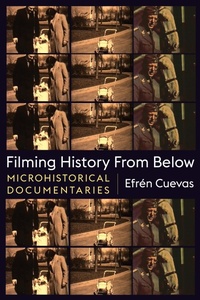
Filming History from Below
Microhistorical Documentaries
1st Edition
Published on 6. March 2023
304 pages
978-0-231-55157-1 (ISBN)
Description

Traditional historical documentaries strive to project a sense of objectivity, producing a top-down view of history that focuses on public events and personalities. In recent decades, in line with historiographical trends advocating "history from below," a different type of historical documentary has emerged, focusing on tightly circumscribed subjects, personal archives, and first-person perspectives. Efrén Cuevas categorizes these films as "microhistorical documentaries" and examines how they push cinema's capacity as a producer of historical knowledge in new directions.
Cuevas pinpoints the key features of these documentaries, identifying their parallels with written microhistory: a reduced scale of observation, a central role given to human agency, a conjectural approach to the use of archival sources, and a reliance on narrative structures. Microhistorical documentaries also use tools specific to film to underscore the affective dimension of historical narratives, often incorporating autobiographical and essayistic perspectives, and highlighting the role of the protagonists' personal memories in the reconstruction of the past. These films generally draw from family archives, with an emphasis on snapshots and home movies.
Filming History from Below examines works including Péter Forgács's films dealing with the Holocaust such as The Maelstrom and Free Fall; documentaries about the Israeli-Palestinian conflict; Rithy Panh's work on the Cambodian genocide; films about the internment of Japanese Americans during the Second World War such as A Family Gathering and History and Memory; and Jonas Mekas's chronicle of migration in his diary film Lost, Lost, Lost.
Cuevas pinpoints the key features of these documentaries, identifying their parallels with written microhistory: a reduced scale of observation, a central role given to human agency, a conjectural approach to the use of archival sources, and a reliance on narrative structures. Microhistorical documentaries also use tools specific to film to underscore the affective dimension of historical narratives, often incorporating autobiographical and essayistic perspectives, and highlighting the role of the protagonists' personal memories in the reconstruction of the past. These films generally draw from family archives, with an emphasis on snapshots and home movies.
Filming History from Below examines works including Péter Forgács's films dealing with the Holocaust such as The Maelstrom and Free Fall; documentaries about the Israeli-Palestinian conflict; Rithy Panh's work on the Cambodian genocide; films about the internment of Japanese Americans during the Second World War such as A Family Gathering and History and Memory; and Jonas Mekas's chronicle of migration in his diary film Lost, Lost, Lost.
More details
Other editions
Additional editions
Book
01/2022
Columbia University Press
€31.00
Shipment within 10-20 days
Book
01/2022
Columbia University Press
€124.00
Shipment within 10-20 days
Person
Efrén Cuevas is a professor in the Department of Culture and Audiovisual Communication at the University of Navarra. He is coeditor of The Man Without the Movie Camera: The Cinema of Alan Berliner (2002) and Landscapes of the Self: The Cinema of Ross McElwee (2008).
Content
Acknowledgments
Introduction: Film and History
1. Microhistory and Documentary Film
2. The Archive in the Microhistorical Documentary
3. Péter Forgács's Home Movie Chronicle of the Twentieth Century: The Maelstrom, Free Fall, and Class Lot
4. The Incarceration of Japanese Americans During World War II: Something Strong Within, A Family Gathering, From a Silk Cocoon, and History and Memory
5. Rithy Panh's Autobiographical Narrative of the Cambodian Genocide: The Missing Picture
6. Identities and Conflicts in Israel and Palestine: Israel: A Home Movie, For My Children, My Terrorist, My Land Zion, and A World Not Ours
7. The Immigrant Experience in Jonas Mekas's Lost, Lost, Lost
Epilogue: Looking to the Future
Filmography
Notes
Bibliography
Index
Introduction: Film and History
1. Microhistory and Documentary Film
2. The Archive in the Microhistorical Documentary
3. Péter Forgács's Home Movie Chronicle of the Twentieth Century: The Maelstrom, Free Fall, and Class Lot
4. The Incarceration of Japanese Americans During World War II: Something Strong Within, A Family Gathering, From a Silk Cocoon, and History and Memory
5. Rithy Panh's Autobiographical Narrative of the Cambodian Genocide: The Missing Picture
6. Identities and Conflicts in Israel and Palestine: Israel: A Home Movie, For My Children, My Terrorist, My Land Zion, and A World Not Ours
7. The Immigrant Experience in Jonas Mekas's Lost, Lost, Lost
Epilogue: Looking to the Future
Filmography
Notes
Bibliography
Index
