

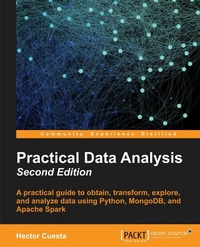
Practical Data Analysis
Pandas, MongoDB, Apache Spark, and more
2nd Edition
Published on 8. July 2025
338 pages
978-1-78528-666-7 (ISBN)
Description

A practical guide to obtaining, transforming, exploring, and analyzing data using Python, MongoDB, and Apache Spark
Key Features
[*] Learn to use various data analysis tools and algorithms to classify, cluster, visualize, simulate, and forecast your data
[*] Apply Machine Learning algorithms to different kinds of data such as social networks, time series, and images
[*] A hands-on guide to understanding the nature of data and how to turn it into insight
Book DescriptionBeyond buzzwords like Big Data or Data Science, there are a great opportunities to innovate in many businesses using data analysis to get data-driven products. Data analysis involves asking many questions about data in order to discover insights and generate value for a product or a service. This book explains the basic data algorithms without the theoretical jargon, and you'll get hands-on turning data into insights using machine learning techniques. We will perform data-driven innovation processing for several types of data such as text, Images, social network graphs, documents, and time series, showing you how to implement large data processing with MongoDB and Apache Spark. What you will learn
[*] Acquire, format, and visualize your data
[*] Build an image-similarity search engine
[*] Generate meaningful visualizations anyone can understand
[*] Get started with analyzing social network graphs
[*] Find out how to implement sentiment text analysis
[*] Install data analysis tools such as Pandas, MongoDB, and Apache Spark
[*] Get to grips with Apache Spark
[*] Implement machine learning algorithms such as classification or forecasting
Who this book is forThis book is for developers who want to implement data analysis and data-driven algorithms in a practical way. It is also suitable for those without a background in data analysis or data processing. Basic knowledge of Python programming, statistics, and linear algebra is assumed.
Key Features
[*] Learn to use various data analysis tools and algorithms to classify, cluster, visualize, simulate, and forecast your data
[*] Apply Machine Learning algorithms to different kinds of data such as social networks, time series, and images
[*] A hands-on guide to understanding the nature of data and how to turn it into insight
Book DescriptionBeyond buzzwords like Big Data or Data Science, there are a great opportunities to innovate in many businesses using data analysis to get data-driven products. Data analysis involves asking many questions about data in order to discover insights and generate value for a product or a service. This book explains the basic data algorithms without the theoretical jargon, and you'll get hands-on turning data into insights using machine learning techniques. We will perform data-driven innovation processing for several types of data such as text, Images, social network graphs, documents, and time series, showing you how to implement large data processing with MongoDB and Apache Spark. What you will learn
[*] Acquire, format, and visualize your data
[*] Build an image-similarity search engine
[*] Generate meaningful visualizations anyone can understand
[*] Get started with analyzing social network graphs
[*] Find out how to implement sentiment text analysis
[*] Install data analysis tools such as Pandas, MongoDB, and Apache Spark
[*] Get to grips with Apache Spark
[*] Implement machine learning algorithms such as classification or forecasting
Who this book is forThis book is for developers who want to implement data analysis and data-driven algorithms in a practical way. It is also suitable for those without a background in data analysis or data processing. Basic knowledge of Python programming, statistics, and linear algebra is assumed.
All prices
More details
Edition
2nd Revised edition
Language
English
Place of publication
Birmingham
United Kingdom
Target group
Professional and scholarly
US School Grade: College Graduate Student
Edition type
Revised edition
File size
28,90 MB
ISBN-13
978-1-78528-666-7 (9781785286667)
Copyright in bibliographic data and cover images is held by Nielsen Book Services Limited or by the publishers or by their respective licensors: all rights reserved.
Schweitzer Classification
Other editions
Additional editions
Hector Cuesta | Sampath Kumar
Practical Data Analysis
Book
09/2016
Packt Publishing
€63.40
Shipment within 3-4 weeks
Persons
Cuesta Hector :
Hector Cuesta is founder and Chief Data Scientist at Dataxios, a machine intelligence research company. Holds a BA in Informatics and a M.Sc. in Computer Science. He provides consulting services for data-driven product design with experience in a variety of industries including financial services, retail, fintech, e-learning and Human Resources. He is an enthusiast of Robotics in his spare time. You can follow him on Twitter at https://twitter.com/hmCuesta.Kumar Dr. Sampath :
Dr. Sampath Kumar works as an assistant professor and head of Department of Applied Statistics at Telangana University. He has completed M.Sc., M.Phl., and Ph. D. in statistics. He has five years of teaching experience for PG course. He has more than four years of experience in the corporate sector. His expertise is in statistical data analysis using SPSS, SAS, R, Minitab, MATLAB, and so on. He is an advanced programmer in SAS and matlab software. He has teaching experience in different, applied and pure statistics subjects such as forecasting models, applied regression analysis, multivariate data analysis, operations research, and so on for M.Sc. students. He is currently supervising Ph.D. scholars.
Hector Cuesta is founder and Chief Data Scientist at Dataxios, a machine intelligence research company. Holds a BA in Informatics and a M.Sc. in Computer Science. He provides consulting services for data-driven product design with experience in a variety of industries including financial services, retail, fintech, e-learning and Human Resources. He is an enthusiast of Robotics in his spare time. You can follow him on Twitter at https://twitter.com/hmCuesta.Kumar Dr. Sampath :
Dr. Sampath Kumar works as an assistant professor and head of Department of Applied Statistics at Telangana University. He has completed M.Sc., M.Phl., and Ph. D. in statistics. He has five years of teaching experience for PG course. He has more than four years of experience in the corporate sector. His expertise is in statistical data analysis using SPSS, SAS, R, Minitab, MATLAB, and so on. He is an advanced programmer in SAS and matlab software. He has teaching experience in different, applied and pure statistics subjects such as forecasting models, applied regression analysis, multivariate data analysis, operations research, and so on for M.Sc. students. He is currently supervising Ph.D. scholars.
Content
Table of Contents
Getting Started with Data Analysis
Preprocessing the Data
Getting to Grips with Visualization
Text Classification
Similarity-based Image Retrieval
Simulation of Stock Prices
Predicting Gold Prices
Working with Support Vector Machines
Modeling Infectious Disease with Cellular Automata
Visualizing Social Network Graphs
Sentiment Analysis of Twitter Data
Data Processing and Aggregation with MongoDB
Working with MapReduce
On-line Data Analysis with Jupyter and Wakari
Big Data Using Spark
Getting Started with Data Analysis
Preprocessing the Data
Getting to Grips with Visualization
Text Classification
Similarity-based Image Retrieval
Simulation of Stock Prices
Predicting Gold Prices
Working with Support Vector Machines
Modeling Infectious Disease with Cellular Automata
Visualizing Social Network Graphs
Sentiment Analysis of Twitter Data
Data Processing and Aggregation with MongoDB
Working with MapReduce
On-line Data Analysis with Jupyter and Wakari
Big Data Using Spark

