

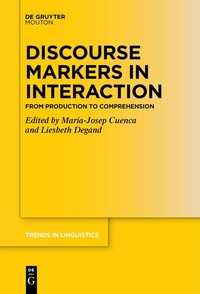
Discourse Markers in Interaction
Description

The aim of this volume is to bring together researchers interested in investigating the role that Discourse Markers play in language production and comprehension from an experimental or corpus-based perspective.
In any kind of human communication, Discourse Markers are part of the game. This omnipresence informs us of a crucial inherent aspect of human language. Yet, as a linguistic category, Discourse Markers remain underdetermined. To gain deeper insight into this complex linguistic category, more systematic work is needed on the production and on the interpretation of Discourse Markers in a variety of situational settings, resorting to different methodological approaches. The contributions in this volume aim at drawing more attention to the double face of Discourse Markers, namely as signals intentionally used by the speaker to facilitate the addressee's interpretation of the discourse, but also as potential traces of the speaker's production difficulties.
The combination of experimental and corpus-based approaches and the focus on processing of Discourse Markers in both production and comprehension makes this volume a unique contribution in answering the question why we use Discourse Markers in certain situations, but also when we do not.
Reviews / Votes
"To sum up, this enlightening and informative book, which makes methodological contributions and involves interdisciplinary studies, will promote more breakthroughs for future DM [Discourse Markers] researches." Yanhong Guo, Dandi Li in: Journal of Pragmatics 2023More details
Other editions
Additional editions
Persons
Content
- Intro
- Contents
- 1 Discourse markers in interaction: Introduction
- 2 Principles of Discourse Marking: An experimental approach of general and contrastive perspectives
- 3 New perspectives on car and parce que: Is it about subjectivity, reasoning or speakers?
- 4 Individual differences in the ability to master connectives: The importance of exposure to print
- 5 Do non-native readers rely on connectives? The processing of coherence relations in L2
- 6 How egocentric is discourse marker use? Investigating the impact of speaker orientation and cognitive load on discourse marker production
- 7 When do discourse markers affect computational sentence understanding?
- 8 Discourse markers and dialogue act annotation for computational dialogue systems
- 9 Translating discourse markers: Implicitation and explicitation strategies
- 10 Processing polyfunctional discourse markers: Making sense of Hebrew harey
- Index
