

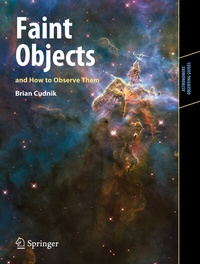
Faint Objects and How to Observe Them
Description

More details
Other editions
Additional editions
Person
Brian Cudnik has been an amateur astronomer for over 30 years and manages the Physics laboratories at Prairie View A& M University (a part of the A&M University of Texas). He has been the coordinator of the Lunar Meteoritic Impact Search section of the Association of Lunar and Planetary Observers (ALPO) since January 2000. Cudnik began at ALPO two months after it made the first confirmed visual observation of a meteoroid impact on the Moon during the Leonid storm of November 1999. Cudnik has an MSc and has published papers and posters on various astronomical subjects, both peer-reviewed and amateur. He has served as a board member of the Houston Astronomical Society, is presently an Associate member of the American Astrononmical Society, a member of the American Association of Variable Star and a regular contributor of observations to the International Occultation Timing Association. He teaches astronomy at the University of St. Thomas two evenings per week each semester.
Content
Preface.- Pushing the Envelope in Visual Astronomical Observations.- Part I: The Physical Nature of Faint Objects.- Chapter 1: The Astronomical Surveys.- Chapter 2: The Astronomers Behind the Historical Surveys.- Chapter 3: The Nature of Star Clusters and Nebulae.- Chapter 4: The Nature of Galaxies and Galaxy Clusters.- Chapter 5: The Nature of Quasars and Other Exotics.- Chapter 6: Ground-and Space-Based Observations of the Most Distant Parts of the Universe.- Part II: How to Observe Faint Objects.- Chapter 7: General Guidelines for Observing Faint Objects.- Chapter 8: Preparation and the Observing Session.- Chapter 9: Some Suggested Observing Projects.- Chapter 10: Suggested Projects by Survey and Source.- Chapter 11: Recording Your Observations and Other Tips to Help You Stick with the Program.- Chapter 12: Citizen Science Activities and Searching for Supernovae.- A Few Final Thoughts.- Appendix A: References and Footnotes.- Appendix B: Glossary.- Appendix C: Resources Useful for the Observation of Faint Objects.- Appendix D: Observing Software.- Appendix E: Astronomical League Observing Clubs.- Appendix F: How to Find More Observing Lists of Faint Objects.- Index.
