

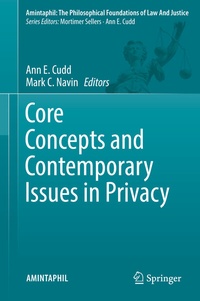
Core Concepts and Contemporary Issues in Privacy
Description

This book offers a comprehensive investigation of privacy in the modern world. It collects 16 papers that look at this essential topic from many facets, from the personal to the technological, from the philosophical to the legal. The contributors examine such issues as the value of privacy protection, the violation of spreading personal falsehoods, the digital rights of children, an individual's right to be forgotten from internet search engines, and more.
The organization of the volume helps provide a nuanced understanding of this often controversial topic. Coverage starts with key concepts before moving on to explore personal information privacy and the impact of new technologies. Next, the papers consider privacy in different contexts. These include work, sex, family, crime, and religion. This structure enables greater engagement with the difficult questions about privacy. Readers will gain deep insight into the core concepts of privacy as well as its application to everyday life.
This interdisciplinary volume brings together an international team of scholars. They provide a broad combination of expertise in law, philosophy, and political science. Overall, this thought-provoking examination will appeal to interested readers in both academia and practice.
More details
Other editions
Additional editions
Persons
Mark C. Navin is Associate Professor of Philosophy at Oakland University (Rochester, MI). His recent work concerns public health ethics, bioethics, and food justice. His book, Values and Vaccine Refusal: Hard Questions in Ethics, Epistemology and Health Care, was published by Routledge in 2016. He is the Executive Director of AMINTAPHIL.
Content
Ann E. Cudd and Mark C. Navin , Introduction: Conceptualizing Privacy Harms and Values.- Part I Privacy: Core Concepts.- 2. Judith Wagner DeCew , The Conceptual Coherence of Privacy as Developed in Law.- 3. Alistair MacLeod , Privacy: Concept, Value, Right?.- 4. Steven P. Lee , The Nature and Value of Privacy.- 5. Mane Hajdin , Privacy and Responsibility.- Part II Personal Information Privacy.- 6. Pierre LeMorvan , Information, Privacy, and False Light.- 7. Jonathan Schonsheck , The Unrelenting Darkness of False Light: A Sui Generis Tort.- 8. Richard T. DeGeorge , Privacy, Public Space, and Personal Information.- 9. Mark C. Navin , Privacy and Religious Exemptions.- Part III Privacy and Technology.- 10. Patrick Hubbard , The Need for Privacy Torts in an Era of Ubiquitous Disclosure and Surveillance.- 11. Patrick O'Callaghan , The Chance 'to Melt into the Shadows of Obscurity': Developing a 'Right to be Forgotten' in the United States.- 12. Renée N. Souris , Parents, Privacy, and Facebook: Legal and Social Responses to the Problem of 'Over-Sharing'.- 13. Wade L. Robison , Digitizing Privacy.- Part IV Privacy in Different Contexts: Work, Sex, Family, and Crime.- 14. John G. Francis and Leslie P. Francis , Privacy, Employment, and Dignity.- 15. Gordon A. Babst , Privacy and Outing.- 16. Emily R. Gill , Marriage: Public Institution or Private Contract?.- 17. Win-chiat Lee , Criminal Acts, Reasonable Expectation of Privacy and the Private/Public Split.
