

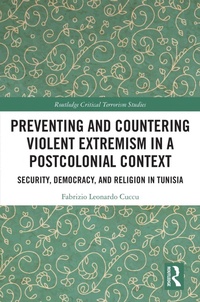
Preventing and Countering Violent Extremism in a Postcolonial Context
Security, Democracy, and Religion in Tunisia
Published on 1. August 2025
156 pages
978-1-040-40153-8 (ISBN)
Description

This book examines how global policies designed to prevent extremism have shaped religious and security governance in Tunisia in recent years, focusing on local programmes for training imams.
By tracing the evolution of security measures in Tunisia from the colonial era to today, this book highlights how transnational security policies-particularly those promoted after 2011-have reinforced state control over religion. While many studies explore religion's role in politics, this work shows how international security agendas influence religious institutions and discourse locally. Through interviews with religious leaders and civil society organizations, this book uncovers how Tunisian institutions have strategically used international counter-extremism frameworks to justify increased security measures. It also sheds light on the evolving role of imams as security actors. By linking past and present, this book challenges the idea that counter-extremism policies are "neutral", showing instead how they often echo colonial-era policing.
This book will be of interest to students of countering violent extremism, securitization, African studies, and International Relations in general.
By tracing the evolution of security measures in Tunisia from the colonial era to today, this book highlights how transnational security policies-particularly those promoted after 2011-have reinforced state control over religion. While many studies explore religion's role in politics, this work shows how international security agendas influence religious institutions and discourse locally. Through interviews with religious leaders and civil society organizations, this book uncovers how Tunisian institutions have strategically used international counter-extremism frameworks to justify increased security measures. It also sheds light on the evolving role of imams as security actors. By linking past and present, this book challenges the idea that counter-extremism policies are "neutral", showing instead how they often echo colonial-era policing.
This book will be of interest to students of countering violent extremism, securitization, African studies, and International Relations in general.
Reviews / Votes
"This important new book traces the development of P/CVE measures in Tunisia, highlighting the agency of local actors and situating counter-radicalisation initiatives in wider social and political contexts. With an enviable combination of historical nuance, original empirical findings, and cutting-edge conceptual insight, Preventing and Countering Violent Extremism in a Postcolonial Context will be essential reading to anyone interested in the complex contemporary intersections between security, religion, and politics. It deserves the widest possible audience."Lee Jarvis, Professor of Security and Society, Adelaide University, Australia
"In Preventing and Countering Extremism in a Postcolonial Context, Fabrizio Leonardo Cuccu delivers the first significant and book-length study of how counter-extremism moves from International Organisations to the postcolonial space. The text explores the unique refraction of P/CVE norms through the power structures of Tunisian politics and society, as well as the role played by Imams in highlighting and silencing parts of the P/CVE canon for the local environment. Cuccu's book teaches us that security is never simple; it is refracted through layers of history as well as geography, directed according to the interests of those who wield power, in any context."
Charlotte Heath-Kelly, Professor of Politics and International Studies, University of Warwick, United Kingdom
More details
Series
Language
English
Place of publication
London
United Kingdom
Publishing group
Taylor & Francis Ltd
Target group
College/higher education
Professional and scholarly
File size
2,17 MB
ISBN-13
978-1-040-40153-8 (9781040401538)
Copyright in bibliographic data and cover images is held by Nielsen Book Services Limited or by the publishers or by their respective licensors: all rights reserved.
Schweitzer Classification
Other editions
Additional editions
Fabrizio Leonardo Cuccu
Preventing and Countering Violent Extremism in a Postcolonial Context
Security, Democracy, and Religion in Tunisia
Book
08/2025
1st Edition
Routledge
€207.10
Shipment within 10-20 days
Person
Fabrizio Leonardo Cuccu is Alumni Research Fellow at the Merian Centre for Advanced Studies in the Maghreb (MECAM), University of Tunis, Tunisia, and Research Assistant in the School of Law and Government, Dublin City University, Ireland. His research focuses on security, development, and migration policies in postcolonial settings. His work has been published in the Cambridge Review of International Affairs, L'Annee du Maghreb and Surveillance & Society.
Content
Introduction Chapter 1: Security in Postcolonial Settings: The Transnational Management of "Dangerous" Populations Chapter 2: Reproducing Colonial Logics: International Actors and the Assessment of Transnational Threats Chapter 3: Between International and National Discourses: Managing Islam in Postcolonial Tunisia Chapter 4: International Development and Violent Extremism: Multiple Actors in Local Programmes Chapter 5: "Vernacular" Security, Religion and Local Imams Conclusions: International P/CVE Programmes and the Continuation of Colonial Policing
