

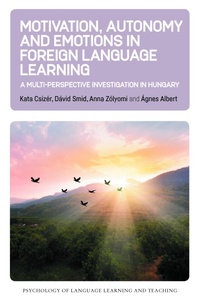
Motivation, Autonomy and Emotions in Foreign Language Learning
A Multi-Perspective Investigation in Hungary
Published on 12. November 2024
174 pages
978-1-80041-277-4 (ISBN)
Description

This book highlights the roles of several individual difference (ID) variables on the language learning process, exploring them from both the students' and the teachers' perspectives. It presents the results of a large-scale, mixed-methods investigation which was conducted with secondary school pupils and their teachers in Hungary. The quantitative questionnaire data is used to analyze the English language learners' motivation, autonomy and self-efficacy beliefs, and to examine the relationships between these and a wide range of positive and negative emotions. The qualitative data, consisting of interviews with teachers, gives voice not only to an understanding of student-related ID variables but also to teachers' reflections on their own cognitive, affective and behavioral processes. Taken together, the contrastive analysis of these two datasets yields interactional results that provide fresh insights into the language learning process and practical classroom applications.
Reviews / Votes
This book presents a large-scale rigorously designed and executed mixed-methods project, giving insights into hitherto unexplored areas of individual differences. Based on the intriguing results of the survey and the teacher interview data, the authors offer hands-on pedagogical suggestions that are relevant far beyond the Hungarian context. The volume is a must-have for research students, scholars and practitioners interested in individual differences and the methods that can be applied to study them. * Judit Kormos, Lancaster University, UK * Using data from foreign language learners and teachers in Hungarian secondary schools, the authors do a superb job of painting an intriguing picture of the interplay of motivation, autonomy and self-efficacy, as well as positive and negative emotions. Their findings offer crucial insights that extend far beyond one specific context. I wholeheartedly recommend this book to anyone interested in the role of individual variation in learning additional languages. * Miroslaw Pawlak, Adam Mickiewicz University, Poland * This exemplary large-scale study is a mixed-methods research gem. Readers interested in motivation and emotions will discover a series of interrelated findings presented with clarity, in detailed and nuanced ways. This book inspires thoughtful consideration of similarities and differences between teacher and learner psychology and how they change over time. * Peter D. MacIntyre, Cape Breton University, Canada * The volume stands out for its systematic examination of motivation, autonomy, emotions, and self-efficacy within a less commonly researched EFL context [and] arrives at a timely moment when educational systems worldwide are grappling with the effects of digital transformation and the need to understand learner profiles in increasingly diverse and challenging contexts. * Guangxiang Liu, Southeast University, Nanjing, China, Applied Linguistics, 2025 *More details
Series
Language
English
Place of publication
Bristol
United Kingdom
Target group
College/higher education
Product notice
Reflowable
ISBN-13
978-1-80041-277-4 (9781800412774)
Copyright in bibliographic data and cover images is held by Nielsen Book Services Limited or by the publishers or by their respective licensors: all rights reserved.
Schweitzer Classification
Other editions
Additional editions

Kata Csizer | David Smid | Anna Zolyomi
Motivation, Autonomy and Emotions in Foreign Language Learning
A Multi-Perspective Investigation in Hungary
Book
11/2024
Multilingual Matters
€41.80
Shipment within 10-20 days
Persons
Kata Csizer is Professor at Eoetvoes Lorand University, Hungary. Her research focuses on foreign language learning motivation, and she is Associate Editor of the Studies in Second Language Learning and Teaching journal and Co-Editor of the monograph series Applied Linguistics in the 21st Century, published by Akademiai Kiado.
David Smid is Postdoctoral Researcher at the University of Graz, Austria. His research interests include language learner psychology, teacher psychology and positive psychology, and he is Co-Editor-in-Chief of the Journal for the Psychology of Language Learning.
Anna Zolyomi is Assistant Professor at ELTE Eoetvoes Lorand University, Hungary. Her research explores individual differences, implicit and explicit learning and differentiated instruction, and she is Section Editor at GiLE Journal of Skills Development.
Agnes Albert is Assistant Professor at ELTE Eoetvoes Lorand University, Hungary. Her research focuses on task-based language learning, foreign language learning-related emotions and flow, and she is Associate Editor of the Studies in Second Language Learning and Teaching journal.
David Smid is Postdoctoral Researcher at the University of Graz, Austria. His research interests include language learner psychology, teacher psychology and positive psychology, and he is Co-Editor-in-Chief of the Journal for the Psychology of Language Learning.
Anna Zolyomi is Assistant Professor at ELTE Eoetvoes Lorand University, Hungary. Her research explores individual differences, implicit and explicit learning and differentiated instruction, and she is Section Editor at GiLE Journal of Skills Development.
Agnes Albert is Assistant Professor at ELTE Eoetvoes Lorand University, Hungary. Her research focuses on task-based language learning, foreign language learning-related emotions and flow, and she is Associate Editor of the Studies in Second Language Learning and Teaching journal.
Content
Tables
Acknowledgments
Chapter 1. Introduction
Chapter 2. The Context and the Research Study
Chapter 3. The Theoretical Background of the Study
Chapter 4. Methods
Chapter 5. Results and Discussion: Dispositions and Views of Participants
Chapter 6. Results and Discussion: Teachers' Views of the Individual
Chapter 7. Results and Discussion: Student Profiles
Chapter 8. Results and Discussion: The Comparative Analysis of Student and Teacher Perspectives
Chapter 9. Conclusion
Appendices
References
Index
Acknowledgments
Chapter 1. Introduction
Chapter 2. The Context and the Research Study
Chapter 3. The Theoretical Background of the Study
Chapter 4. Methods
Chapter 5. Results and Discussion: Dispositions and Views of Participants
Chapter 6. Results and Discussion: Teachers' Views of the Individual
Chapter 7. Results and Discussion: Student Profiles
Chapter 8. Results and Discussion: The Comparative Analysis of Student and Teacher Perspectives
Chapter 9. Conclusion
Appendices
References
Index
