

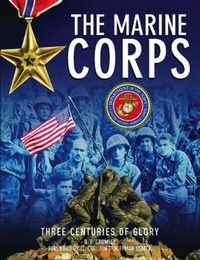
The Marine Corps
Description

More details
Other editions
Additional editions
Person
Content
Foreword by Lt. Col. Jon T. Hoffman USMCR
1. The Early Years
2. World War I
3. Interwar Years
4. World War II
5. Korea
6. Vietnam
7. Semper Fidelis
Appendices
Commandants of the Marine Corps
Marine Corps Medal of Honor Recipients
Index
CHAPTER 1
THE EARLY YEARS
"Resolved, That two battalions of marines be raised . that they be inlisted and commissioned to serve for and during the present war between Great Britain and the colonies, unless dismissed by order of Congress: that they be distinguished by the names of the first and second battalions of American marines."
Thus was the Marine Corps born, on November 10, 1775.
It had been a tumultuous year for the colonies. Seven months before, the American revolution had begun with the battles of Lexington and Concord. Throughout the fall, the Second Continental Congress, meeting in Philadelphia, had debated the subject of a Continental Navy. By February 17, 1776, the debate was over. A contingent of eight ships sailed down the icy Delaware River, bound for the Bahamas. It was the first deployment of the Continental Navy. Under the command of Commodore Esek Hopkins was the flagship Alfred with her 24 guns. Beside her sailed the Columbus, the Andrea Doria, and the Cabot. The sloops Hornet and Providence were nearby, as were the schooners Wasp and Fly. Sailing with the Continental Navy were 234 enlisted Marines under the command of Captain Samuel Nicholas. Hopkins planned to seize the capital city of Nassau, on the northern side of New Providence Island. The harbor was guarded by Forts Montague and Nassau. A secret report to Congress claimed a large cache of military stores were located there. Hopkins hoped to obtain casks of gunpowder, desperately needed by Washington's Army.
On March 3, 1776, Samuel Nicholas and his Marines executed the first amphibious landing in Marine history when they came ashore on New Providence Island. The landing was unopposed and Fort Montague was secured. At dawn, Captain Nicholas led his men to Fort Nassau, which was surrendered after a few cannon shots. The British colors were taken down and the Marines raised the Grand Union. When the Continental Navy sailed two weeks later, they took with them 3 captured British ships, 24 casks of gunpowder, cannons, and brass mortars. For his role in the New Providence raid, Captain Nicholas was promoted to the rank of major and ordered to raise four more companies of Marines. These men were to man the tops and the great guns of four new frigates.
By December 1776, a series of British attacks had Washington's Army on the run. Told "the Enemy having overrun the Jerseys, & our Army being greatly reduced," Nicholas was ordered to Trenton. He took with him a "battalion" of 131 Marines, and for the first time, Marines joined an American army in a land campaign. On New Year's Day, 1777, Washington dispatched a force to delay any advance of the British Army, under the command of Major-General Charles Cornwallis. Fighting with the Philadelphia brigade, under the command of Colonel John Cadwalader, the Marines took up position along Assunpink Creek. There the British attempted to cross, but were stopped.
The delaying action gave Washington the time he needed. That night, in the bitter cold, the Continental Army left their campfires burning. They slipped around the left flank of Cornwallis' army and marched toward Princeton. In the morning, Washington divided his forces into two columns. One column, to which the Marines were attached, was to cut the main road from Trenton to Princeton. That column, however, ran into three British regiments and was beginning to falter when Washington rode up and rallied the brigade for a charge against Cornwallis's men. As reinforcement arrived, the tide of the battle turned. It was now the British who were on the run, retreating north. For the "soldiers of the sea," their first land campaign was at an end. Washington's forces moved to their winter quarters in Morristown, New Jersey. Nicholas's "battalion" was down to 80 men.
As the Continental Navy grew, so did the Marines. By 1778, there were 11 detachments of Marines afloat. They fought from the rigging, firing muskets or dropping grenades onto British ships. Often, the Marines manned the great guns, serving as artillerymen. It was from the Marine detachments that boarding parties and raiding parties were formed, carrying the battles onto enemy ships or enemy-held shores.
On January 27, a 28-man detachment off the frigate Providence made a second amphibious assault on New Providence Island. The objective was the seizure of the British privateer Mary, which was being overhauled at Nassau. Led ashore in darkness by Captain John Trevett, the Marines slipped through a gap in Fort Nassau's palisade. Guarded only by two watchmen, the Marines quickly secured the fort. Trevett informed Nassau's town council his orders were to seize the Mary. The council decided not to intervene, and the Marines held Nassau for four days, then sailed with the Mary and four captured American ships they had discovered in the harbor.
Later that year, Continental Marines accompanied John Paul Jones on the raid of Whitehaven in the Solway Firth. Jones, a fiery Scot, commanded the Ranger. On the night of April 22, Jones and a landing party of 30 men rowed ashore. It was the first time since 1667 that a foreign enemy had landed on British soil. Scaling the wall of the fort that guarded the southern end of the harbor, they found the gunners asleep at their post. Jones took them prisoner and spiked the guns. After repeating the feat at the northern battery, Jones procured a torch from a public house and set alight the hold of a large ship. However, the townspeople, alerted that Yankee pirates were burning the shipping in the harbor, extinguished the fires, and Jones and his men made their escape back to the Ranger.
The Marines who landed at Penobscot Bay, Maine, the following year were not so fortunate. A large British force, including the Argyll Highlanders and three sloops-of-war, had moved down from Halifax to establish a fort at the mouth of the Penobscot River. The fort was to serve as an advanced base from which to strike American privateers and to protect a colony of Loyalists. The Massachusetts State Board of War assembled a large force to expel the British. Commanded by Captain Dudley Saltonstall, three ships of the Continental Navy set sail, along with the four brigs that comprised the Massachusetts navy. With them went a dozen privateers and some 20 merchantmen.
On July 25, the Americans found the bay protected by the three sloops. In addition, a battery had been established and construction of a log fort begun on Banks Island. An interlocking field of fire covered the entrance to the harbor. The following day, Marines led by Captain John Welsh seized Banks Island and captured four light artillery pieces. The British ships began taking fire from the captured battery and withdrew upriver. Brigadier-General Solomon Lovell, commanding the landing force, wanted to put ashore on the southern side of the peninsula. Saltonstall disagreed, not wishing to enter the harbor until the fort was destroyed. Lovell's force would, instead, land on the western shore of the peninsula. On July 28, the Marines came ashore under heavy musket fire and scrambled to the top of a steep cliff defended by British Marines and soldiers of the Hamilton regiment. The British were driven back to Fort George. The British commander stood ready to haul down his colors and surrender, but an attack never came. Brigadier-General Lovell refused to attack until the American ships were brought in close enough to add their firepower to the fray, and Saltonstall refused to bring the ships close to the British sloops-of-war. By August 13, a British fleet comprised of the 64-gun Raisonable, four frigates, and three sloops-of-war entered Penobscot Bay. Saltonstall signaled, "All ships fend for yourself." Nineteen of the American vessels were captured, sunk, or burned. The soldiers and Marines ashore were left to escape into the Maine wilderness.
By 1779, John Paul Jones had a new ship, the Bonhomme Richard. A force of 137 Marines, Irish soldiers of the French Army's Infanterie Irlandaise Regiment de Walsh-Serrant, manned the fighting tops. On September 23, Jones sighted a British convoy escorted by the Serapis and the Countess of Scarborough. Closing, Jones fired a starboard broadside into Serapis. Within an hour, the Marines had cleared Serapis's tops. Jones had the two ships lashed together, bow to stern. Marine musketry prevented the British from cutting the grappling hooks. Both ships continued to fire at point-blank range, and soon the two ships were ablaze and in danger of sinking. It was the presence of Marines in the tops that turned the epic sea battle, for they kept Serapis cleared of defenders. A seaman then dropped a grenade from the yardarm of the...
