

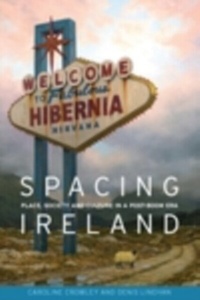
Spacing Ireland
Place, Society and Culture in a Post-Boom Era
1st Edition
Published on 16. May 2016
208 pages
978-1-5261-1191-3 (ISBN)
Available for download
Description

In light of the innumerable interventions that characterise the transformation of Ireland over the last two decades, Spacing Ireland: Place, society and culture in a post-boom era explores questions of 'space' and 'place' to understand the nature of major social, cultural and economic change in contemporary Ireland.
The authors explore the intersections between everyday life and global exchanges through the contexts of the 'stuff' of contemporary everyday encounters: food, housing, leisure, migration, music, shopping, travel and work. These are the multiple layers of space we now inhabit. Ireland is a turbulent place. It is fruitful to consider the contemporary geographies of the island through the various forms where change is expressed. The wide range of topics addressed in the collection and the plurality of spaces they represent make the book appealing not only to students and academics, but to anyone who follows social, cultural and economic developments in Ireland. -- .
The authors explore the intersections between everyday life and global exchanges through the contexts of the 'stuff' of contemporary everyday encounters: food, housing, leisure, migration, music, shopping, travel and work. These are the multiple layers of space we now inhabit. Ireland is a turbulent place. It is fruitful to consider the contemporary geographies of the island through the various forms where change is expressed. The wide range of topics addressed in the collection and the plurality of spaces they represent make the book appealing not only to students and academics, but to anyone who follows social, cultural and economic developments in Ireland. -- .
More details
Language
English
Place of publication
Manchester
United Kingdom
Target group
College/higher education
Professional and scholarly
Edition type
Digital original
Illustrations
Illustrations, black & white|Tables|Maps
Illustrations, black & white|Tables|Maps
ISBN-13
978-1-5261-1191-3 (9781526111913)
Copyright in bibliographic data and cover images is held by Nielsen Book Services Limited or by the publishers or by their respective licensors: all rights reserved.
Schweitzer Classification
Other editions
Additional editions
Book
06/2016
Manchester University Press
€30.40
Shipment within 3-4 weeks
Book
05/2013
Manchester University Press
€131.50
Shipment within 15-20 days
Persons
Caroline Crowley is Research Associate with the Institute for Social Sciences in the 21st Century (ISS21) at University College Cork
Denis Linehan is Lecturer in Human Geography at University College Cork -- .
Denis Linehan is Lecturer in Human Geography at University College Cork -- .
Content
Preface
Introduction: Geographies of the post-boom era
Part I: Spacing belonging
1. Ghost estates: Spaces and spectres of Ireland after NAMA
2. 'Of course I'm not Irish': Young people in migrant worker families in Ireland
3. Migrants in the fields: Making work pay
4. Raising the emerald curtain: Communities and collaboration along the Irish border
Part II: Mobility, space and consumption
5. Reading the Irish motorway: Landscape, mobility and politics after the 'Crash'
6. Lone parents, leisure mobilities and the everyday
7. Rethinking the liveable city in a post boom-time Ireland
8. Flocking north: Renegotiating the Irish border
9. Growth amidst decline: Ireland's grassroots food growing movement
Part III: Culture and place
10. Ancestors in the field: Irish farming knowledges
11. Health and wellness or conspicuous consumption? The spa in Celtic Tiger Ireland
12. 'Traditional Irish music here tonight': Exploring the session space
13. 'Through American eyes': A hundred years of Ireland in the National Geographic Magazine
Index -- .
Introduction: Geographies of the post-boom era
Part I: Spacing belonging
1. Ghost estates: Spaces and spectres of Ireland after NAMA
2. 'Of course I'm not Irish': Young people in migrant worker families in Ireland
3. Migrants in the fields: Making work pay
4. Raising the emerald curtain: Communities and collaboration along the Irish border
Part II: Mobility, space and consumption
5. Reading the Irish motorway: Landscape, mobility and politics after the 'Crash'
6. Lone parents, leisure mobilities and the everyday
7. Rethinking the liveable city in a post boom-time Ireland
8. Flocking north: Renegotiating the Irish border
9. Growth amidst decline: Ireland's grassroots food growing movement
Part III: Culture and place
10. Ancestors in the field: Irish farming knowledges
11. Health and wellness or conspicuous consumption? The spa in Celtic Tiger Ireland
12. 'Traditional Irish music here tonight': Exploring the session space
13. 'Through American eyes': A hundred years of Ireland in the National Geographic Magazine
Index -- .

