

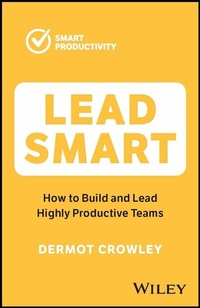
Lead Smart
Description

The simple truth is that leaders have never felt so distracted, so overwhelmed and so unable to find the time they need to make a real impact. In Lead Smart, productivity expert Dermot Crowley delivers proven strategies for cutting through the busyness and working and leading more effectively, maximising productivity for you and your team. You'll discover specific actions and solutions for shifting your focus from activity to impact -- so you can direct your energy to the opportunities and challenges that matter the most.
With Lead Smart, you'll learn how to make productivity your central priority, so you can maximise your own time as well as that of your people. To be an effective leader, you need to protect your time to think, to plan, to make good decisions and to provide clear direction. You need to be responsive and available, so you can empower your team to act in line with your organisation's goals. And you need time to coach and mentor your people, leveraging their skills, capacity and productivity.
Lead Smart shows you how to:
* Level up your time management and personal productivity, so you can minimise distractions and noise
* Streamline how you interact with your team and delegate more effectively
* Lead the team culture from the top down when it comes to aligning priorities, managing urgency and fostering accountability
* Boost your team's productivity by building conviction, effectively negotiating workloads and deadlines and protecting the team from outside distraction
* Inspire a wider cultural change around workload productivity in your organisation through your commitment to an elite productivity philosophy
This moment in time, when we are defining a new way of working, is an opportunity for managers, leaders and executives to reflect on old mindsets, habits and behaviours. Lead Smart is the book you need to upgrade how you use your time, energy and focus to better thrive and inspire as a leader.
This book is part of the Smart Productivity series, helping readers find practical solutions for better managing their time, energy and focus.
More details
Other editions
Additional editions
Person
Content
Introduction xiii
Part I: Yourself 1
1 Know your productivity style 9
2 Find your balance 35
3 Develop deep and wide focus 57
4 Have more impact 77
Part II: Team interface 95
5 Leverage your support 99
6 Delegate early and well 121
7 Be responsive, not reactive 137
Part III: Your team 163
8 Lead productive cultures 169
9 Create a contract of trust 185
Part IV: External interface 197
10 Practice respectful negotiation 199
11 Inspire your peers 209
Conclusion 215
Introduction
As a leader, working at or near the top levels of your organisation, your role is leading the troops, setting the strategy and executing the plans. You must have been somewhat organised and productive to get to this level. You have to be efficient and effective, using your time, energy and focus with laser precision to operate successfully as a leader. In fact, your ability to get stuff done would be seen as a critical skill as you rose to your position.
But what if I told you that you may not be as efficient or effective as you think, and you may have attained this position in spite of, rather than because of, your organisation skills?
What if I said that, as a leader, you may be a part of the reason your team struggles with their productivity? Or that your team culture could be working against productivity rather than supporting it?
What if you and your team are incredibly busy, but busy working on the wrong stuff?
What if you are the leader, but are simply too busy to lead effectively?
The path to leadership is a long and often challenging one. We work diligently at school, then possibly spend a few years at university. We get our first job, the first rung on the ladder to be climbed. Over the years, we work hard and develop our skills. We eventually find ourselves in a position where we are managing and leading people. For the select few, you might climb to the pinnacle of senior leadership, and possibly end up as MD or CEO.
Some of us deliberately choose this path, while some of us fall into it. Either way, now that we are here, we want to have an impact. We want to make a difference, lead our teams well and help our organisation to excel. But in the back of our minds, some fears lurk and fester. The fear that we are busy doing lots of activity, but not having the impact that we would like. Or the fear that we are having an impact, but at a cost to our balance, family and life outside of work. Or the fear that if we keep going at this pace, we are going to crash and burn.
For many leaders, the reality is that, now they have achieved what would traditionally be described as career success, they have never felt so busy, so distracted, so overwhelmed and so unable to find time for the things that truly matter in their role. They have never felt so much pressure to stay on top of everything whilst moving at a million miles an hour.
In my work with thousands of leaders over the last 25 years, I have seen a lot of these leaders fall victim to crushing meeting schedules, hopelessly overflowing inboxes, constant interruptions and a sense of busyness that does not equate to effectiveness in their role. Many of these leaders work in large corporates: financial institutions, large consulting firms, multinational manufacturing or retail conglomerates. But this problem is not solely the problem of leaders in large organisations (although, of course, this problem is most likely to exist in these larger companies due to their complexity). This problem can also be seen in medium and even small businesses.
The simple truth is that leaders are often too busy to have the impact that they need to have. But I strongly believe that when we attain a leadership role, we need to become less busy and shift our focus and mindsets from activity to impact. We need to concentrate our time, energy and focus on the few things that really matter and empower our teams to execute on the right priorities with our direction. We need to protect time to think, to plan, to make good decisions and to provide clear direction. We need to be responsive and available to our team, not constantly unavailable in meetings. And we need time to coach and mentor our people, leveraging their skills, capacity and productivity.
That's a bit of a strong start, isn't it? I haven't given you much time to settle in. Now I know that you are unlikely to be experiencing all of the issues listed above, but I am sure you identify with at least some of them. And the good news is, there are things you can do, as a leader with agency, that will make a difference and maybe even change the game for you.
Lead Smart is the third of a trilogy of books that I have written on productivity in the corporate workplace. My vision was always to start with the individual, and to present a framework to maximise personal productivity. Smart Work serves that purpose. The next step was Smart Teams, which explores how we can work together more productively, and minimise what I call 'productivity friction' by creating more productive cultures within our teams.
This is the final piece of the puzzle, where I address the specific productivity issues faced at the leadership level. But to round this trilogy off fully, this book needs to go beyond tactical productivity strategies for leaders. It needs to sound a clarion call to leaders to level up their own productivity, as well as leverage the productivity of everyone around them. To step up to this worthy task, leaders need to put personal and team productivity front and centre of their priorities, to pay attention to it, and work on it every single day.
While the value in this book is not dependent on having read the other books in the series, you will find I do refer to strategies in these other books where relevant. If you want to dig deeper, a read of Smart Work and Smart Teams would not be a bad idea.
Productivity: A core strand in the leadership rope
Productivity, at least personal productivity, is a topic for discussion for many leaders, but most leaders do not do anywhere near enough work to ensure they and their teams can operate at the highest levels of effectiveness. Productivity is often seen as a minor strand in the complex rope that is leadership.
A cable-laid rope is a large rope typically made of several multi-strand smaller ropes twisted together to form a tight, virtually waterproof cable that is incredibly strong and durable. It was, and in some cases still is, used on ships, where keeping the rope from getting wet is desirable to avoid it getting too heavy to pull out of the water.
A leadership role is like a multi-strand rope, with many different skillsets that combine to make an effective leader, from strategy to motivation to decision-making. I see productivity as one of these strands. A leader must be personally productive and must also work to maximise the capacity of their team to produce great work.
What could be more central to a leader's role than increasing the capability and capacity of everyone that they work with?
I worry, though, that productivity is only seen as a minor strand in the leadership rope, surrounded by and lost amongst the more prominent strands associated with a leader's role. I urge you to shift your thinking on this, and see productivity as a core strand. What could be more central to a leader's role than increasing the capability and capacity of everyone that they work with?
It is often assumed that people will be naturally productive or will learn on the job to work effectively. But in today's busy, fast-paced and noisy workplace, productivity cannot be assumed. The productivity strand in a leader's rope needs to be actively developed with purpose and care. If it is not, our rope begins to fray and split, making it weak and at risk of breaking.
I don't pretend to be able to advise you on every strand of your leadership rope. I am not a leadership expert, but I do know productivity, and have worked with many thousands of leaders over the last 25 years. I believe I understand the challenges they face in maintaining effectiveness. I have worked in many industries and businesses, and the productivity cultures that drive these organisations. I have seen firsthand the impact unhealthy productivity cultures have on their people, and the role that leaders play in allowing these cultures to exist.
I believe that there is so much a leader can do to gain more control over what sometimes feels like a chaotic and uncontrollable workplace culture. But unfortunately, a leader's approach to productivity, even if it is solid and organised, is often a reactive approach to productivity. By this, I do not mean that you are reactive rather than proactive, but rather your approach to productivity has been shaped in part as a reaction to your work, your culture and your environment. Next-level productivity requires the leader to shape their own approach to productivity, one that better serves themselves, their team and everyone around them. To be a highly productive leader, you need to demonstrate a sense of agency in a demanding and busy workplace. You need to make productivity a priority, and work at it tirelessly, knowing that the payback will be immensely worthwhile for you and those around you.
Your leadership rope can serve as a tool to lift others up to a higher level, or to tie them up, frustrating their efforts and keeping them down. Let us work together to achieve the former!
What specific problems are we solving?
When we lead productivity, we should experience a productivity gain for ourselves and our team. Ideally, we want this productivity gain to be sustained over a long period of time, not just for a few weeks or months. The challenge is that no matter how high the initial gain is, over time, productivity friction wears away at it until we revert back to a lower level of productivity (see figure A, overleaf).
As we will explore a little further on, productivity friction is often...
