

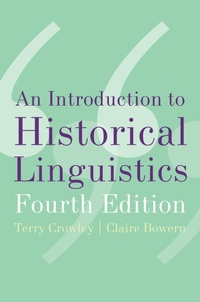
An Introduction to Historical Linguistics
4th Edition
Published on 18. February 2010
409 pages
978-0-19-971099-7 (ISBN)
Description

All languages change, just as other aspects of human society are constantly changing. This book is an introduction to the concepts and techniques of diachronic linguistics, the study of language change over time. It covers all themajor areas of historical linguistics, presenting concepts in a clear and concise way. Examples are given from a wide range of languages, with special emphasis on the languages of Australia and the Pacific. While the needs of undergraduate students of linguistics have been kept firmly in mind, the book will also be of interest to the general reader seeking to understand langauge and language change.
For this fourth edition, a number of new sections have been written, including many new problems and several datasets. Existing materials have been supplemented with new sections on grammaticalization, tonogenesis, morphological change, and using statistical methods in language classification.
More details
Other editions
Additional editions
Terry Crowley | Claire Bowern
An Introduction to Historical Linguistics
Book
03/2010
4th Edition
Oxford University Press Inc
€53.90
Shipment within 15-20 days
Persons
Terry Crowley was Senior Lecturer in Linguistics at the University of Waikato in New Zealand.
Claire Bowern is Assistant Professor of Linguistics, Yale University.
Content
- Intro
- Contents
- List of Tables
- List of Figures
- List of Maps
- How to Use This Book
- 1 Introduction
- 1.1 The Nature of Linguistic Relationships
- 1.2 How and Why Do Languages Change?
- 1.2.1 Anatomy and Ethnic Character
- 1.2.2 Climate and Geography
- 1.2.3 Substratum
- 1.2.4 Local Identification
- 1.2.5 Functional Need
- 1.2.6 Simplification
- 1.2.7 Structural Pressure
- 1.3 Attitudes to Language Change
- 2 Types of Sound Change
- 2.1 Lenition and Fortition
- 2.2 Sound Loss
- 2.2.1 Apheresis
- 2.2.2 Apocope
- 2.2.3 Syncope
- 2.2.4 Cluster Reduction
- 2.2.5 Haplology
- 2.3 Sound Addition
- 2.3.1 Excrescence
- 2.3.2 Epenthesis or Anaptyxis
- 2.3.3 Prothesis
- 2.4 Metathesis
- 2.5 Fusion, Fission, and Breaking
- 2.5.1 Fusion
- 2.5.2 Unpacking or Fission
- 2.5.3 Vowel Breaking
- 2.6 Assimilation
- 2.7 Dissimilation
- 2.8 Tone Changes
- 2.9 Unusual Sound Changes
- 3 Expressing Sound Changes
- 3.1 Writing Rules
- 3.2 Ordering of Changes
- 4 Phonetic and Phonemic Change
- 4.1 Phonetic Change without Phonemic Change
- 4.2 Phonetic Change with Phonemic Change
- 4.2.1 Phonemic Loss
- 4.2.2 Phonemic Addition
- 4.2.3 Rephonemicization
- 4.3 Phonemic Change without Phonetic Change
- 5 The Comparative Method (1): Procedures
- 5.1 Sound Correspondences and Reconstruction
- 5.2 An Example of Reconstruction: Proto-Polynesian
- 5.2.1 Setting Out the Data
- 5.2.2 Finding the Cognates
- 5.2.3 Sound Correspondences
- 5.2.4 Reconstruction Principles
- 5.2.5 Residual Issues
- 5.3 Reconstruction of Conditioned Sound Changes
- 5.4 The Reality of Protolanguages
- 6 Determining Relatedness
- 6.1 Finding Families
- 6.2 Subgrouping
- 6.3 Shared Innovation and Shared Retention
- 6.4 Long-Distance Relationships
- 7 Internal Reconstruction
- 7.1 Using Synchronic Alternations
- 7.2 Internal Reconstruction and Indo-European Laryngeals
- 7.3 Limitations of Internal Reconstruction
- 7.4 Summary: Procedures for Internal Reconstruction
- 8 Computational and Statistical Methods
- 8.1 Distance-Based versus Innovation-Based Methods
- 8.2 Lexicostatistics
- 8.2.1 Basic Vocabulary
- 8.2.2 Subgrouping Levels
- 8.2.3 Applying the Method
- 8.3 Criticisms of Lexicostatistics and Glottochronology
- 8.4 Subgrouping Computational Methods from Biology
- 8.4.1 Inferring Correspondence Sets
- 8.4.2 Inferring Subgrouping
- 8.4.3 Some Definitions
- 8.4.4 Selecting Data and Coding Characters
- 8.4.5 Methods for Inferring Phylogenies
- 9 The Comparative Method (2): History and Challenges
- 9.1 Background: The Neogrammarians
- 9.2 Convergent Lexical Development
- 9.3 Nonphonetic Conditioning
- 9.4 The Wave Model and Lexical Diffusion
- 9.5 Dialect Chains and Nondiscrete Subgroups
- 10 Morphological Change
- 10.1 Changes in Morphological Structure
- 10.1.1 Allomorphic Change
- 10.1.2 Changes in Conditioning
- 10.1.3 Boundary Shifts
- 10.1.4 Doubling and Reinforcement
- 10.1.5 Change in Order of Morphemes
- 10.2 Analogy
- 10.2.1 Analogical Change by Meaning
- 10.2.2 Analogical Change by Form
- 10.2.3 Analogical Extension and Leveling
- 10.3 Doing Morphological Reconstruction
- 11 Semantic and Lexical Change
- 11.1 Basic Meaning Changes
- 11.1.1 Amelioration and Pejoration
- 11.1.2 Broadening
- 11.1.3 Narrowing
- 11.1.4 Bifurcation
- 11.1.5 Shift
- 11.2 Influences in Direction of Change
- 11.2.1 Metaphor
- 11.2.2 Euphemism
- 11.2.3 Hyperbole
- 11.2.4 Interference
- 11.2.5 Folk Etymology
- 11.2.6 Hypercorrection
- 11.3 Lexical Change
- 11.3.1 Borrowing
- 11.3.2 Internal Lexical Innovation
- 11.3.3 Shortening Words
- 11.4 Consequences of Borrowing and Irregular Lexical Change
- 11.4.1 Semantic Change
- 11.4.2 Borrowing and Copying
- 12 Syntactic Change
- 12.1 Studying Syntactic Change
- 12.2 Typology and Grammatical Change
- 12.2.1 Morphological Type
- 12.2.2 Accusative and Ergative Languages
- 12.2.3 Basic Constituent Order
- 12.2.4 Verb Chains and Serialization
- 12.3 Grammaticalization
- 12.3.1 Direction of Grammaticalization
- 12.3.2 Grammaticalization and Reconstruction
- 12.4 Mechanisms of Grammatical Change
- 12.4.1 Reanalysis
- 12.4.2 Analogy and Extension
- 12.4.3 Diffusion or Borrowing
- 13 Observing Language Change
- 13.1 Early Views
- 13.2 Indeterminacy
- 13.3 Variability
- 13.3.1 Class-Based Variation
- 13.3.2 Variation in Small Communities
- 13.4 The Spread of Change and Lexical Diffusion
- 14 Language Contact
- 14.1 Convergence
- 14.2 Language Genesis: Pidgins and Creoles
- 14.2.1 Some Definitions
- 14.2.2 Case Study 1: Tok Pisin
- 14.2.3 Case Study 2: Motu
- 14.2.4 Research on Pidgins and Creoles
- 14.3 Mixed Languages
- 14.4 Esoterogeny and Exoterogeny
- 14.5 Language Death and Language Shift
- 14.5.1 Causes of Language Death
- 14.5.2 Young People's Varieties: Structure Change during Language Shift
- 14.5.3 Speed of Language Death
- 15 Cultural Reconstruction
- 15.1 Archaeology
- 15.2 Oral History
- 15.3 Comparative Culture
- 15.4 Historical Linguistics
- 15.4.1 Relative Sequence of Population Splits
- 15.4.2 The Nature of Cultural Contact
- 15.4.3 Sequences of Cultural Contact with Respect to Population Splits
- 15.4.4 The Content of a Culture
- 15.4.5 The Homeland of a People
- 15.5 Paleolinguistics and Language Origins
- 15.6 The Reliability of Cultural Reconstruction
- Datasets
- 1 Palauan (Micronesia)
- 2 Nganyaywana (New South Wales, Australia)
- 3 Mbabaram (North Queensland, Australia)
- 4 Yimas and Karawari (East Sepik, Papua New Guinea)
- 5 Lakalai (West New Britain, Papua New Guinea)
- 6 Suena and Zia (Morobe Province, Papua New Guinea)
- 7 Korafe, Notu, and Binandere (Oro Province, Papua New Guinea)
- 8 Paamese (Vanuatu)
- 9 Motu (Central Province, Papua New Guinea)
- 10 Sepa, Manam, Kairiru, and Sera (Coastal Sepik, Papua New Guinea)
- 11 Burduna (Western Australia)
- 12 Québec French (Canada)
- 13 Tiene (Democratic Republic of Congo)
- 14 Cypriot Arabic
- 15 Nyulnyulan (Western Australia)
- 16 Aroma, Hula, and Sinaugoro (Central Province, Papua New Guinea)
- 17 Proto-Gazelle Peninsula and Daughter Languages (New Britain, Papua New Guinea)
- Notes
- Language References
- References
- Index
- A
- B
- C
- D
- E
- F
- G
- H
- I
- J
- K
- L
- M
- N
- O
- P
- Q
- R
- S
- T
- U
- V
- W
- Y
